NCERT Solutions - Era of One Party Dominance

Q1: Choose the correct option to fill in the blanks.
(a) The First General Elections in 1952 involved simultaneous elections to the Lok Sabha and _______ (The President of India/State Assemblies/Rajya Sabha/The Prime Minister)
(b) The party that won the second largest number of Lok Sabha seats in the first elections was the _______ (Praja Socialist Party/Bharatiya Jana Sangh/Communist Party of India/Bharatiya Janata Party)
(c) One of the guiding principles of the ideology of the Swatantra Party was _______ (Working class interest/protection of Princely States/Economy free from State control/Autonomy of States within the Union)
Ans:
(a) State Assemblies
Explanation: In the first general elections of 1952, elections to the Lok Sabha and to the State Assemblies were held at the same time. These concurrent elections meant that voters chose both national and state representatives in a single electoral exercise, which helped to co-ordinate the democratic process across the country and reduced the administrative burden of separate polls.
(b) Communist Party of India
Explanation: The Indian National Congress won the largest share of seats in 1952. The Communist Party of India emerged as the second largest party in terms of Lok Sabha seats, with particular strength in states such as West Bengal and Kerala. Its regional support translated into the position of the main opposition by seat count in that election.
(c) Economy free from state control
Explanation: The Swatantra Party, formed in 1959 by leaders including C. Rajagopalachari, promoted a liberal economic outlook. It opposed heavy state control and centralised planning, arguing instead for greater freedom for private enterprise and reduced government intervention in economic affairs.
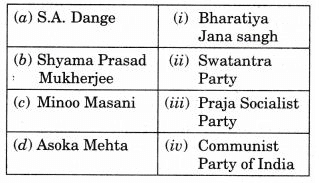 Ans: (a)-(iv), (b)-(i), (c)-(ii), (d)-(iii)
Q3: Four statements regarding one-party dominance are given below. Mark each of them as true or false:
(a) One-party dominance is rooted in the absence of strong alternative political parties
(b) One-party dominance occurs because of weak public opinion.
(c) One-party dominance is linked to the nation's colonial past.
(d) One-party dominance reflects the absence of democratic ideals in a country.
Ans:
(a) True
Explanation: One-party dominance often arises when there are no strong or well-organised opposition parties capable of challenging the ruling party. This weakness may be due to lack of organisation, resources, leadership or public support for alternatives, allowing a single party to maintain electoral superiority for extended periods.
(b) False
Explanation: One-party dominance is not necessarily caused by weak public opinion. A politically aware and active public may still return the same party to power repeatedly if it is perceived to perform well. Dominance can also result from the ruling party's control over institutions, resources, patronage networks or favourable electoral conditions.
(c) True
Explanation: In several post-colonial states the party that led the struggle for independence gained credibility and widespread support, which helped it become the dominant party in the initial decades after independence. Historical legitimacy from the independence movement often translated into electoral advantage.
(d) False
Explanation: One-party dominance does not automatically indicate the absence of democratic ideals. It can occur in democratic systems where voters repeatedly choose the same party. It becomes a threat to democracy only if dominance is sustained by undemocratic means such as suppression of dissent, manipulation of institutions or electoral fraud.
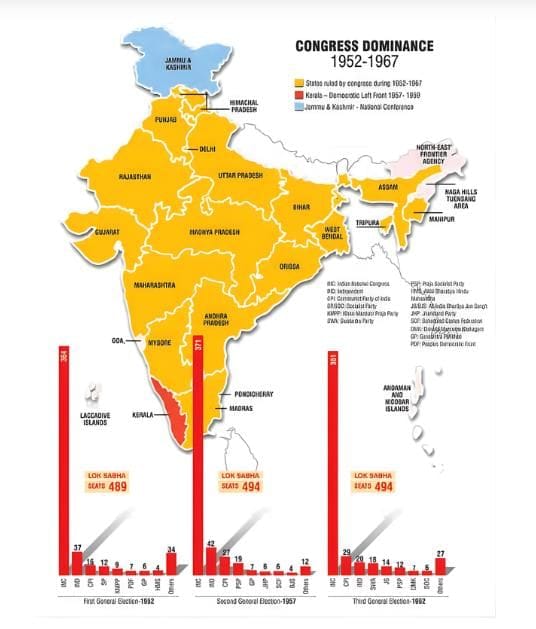
Q4: Take a political map of India (with State outlines) and mark
(a) Two states where Congress was not in power at some point during 1952-67.
(b) Two states where the Congress remained in power through this period.
Ans:
(a) Kerala and Madras (now Tamil Nadu)
(b) Punjab and Uttar Pradesh
Q5: Read the following passage and answer the questions below:
"Patel, the organisational man of the Congress, wanted to purge the Congress of other political groups and sought to make of it a cohesive and disciplined political party. He .... sought to take the Congress away from its all-embracing character and turn it into a close-knit party of disciplined cadres. Being a 'realist' he looked more for discipline than for comprehension. While Gandhi took too romantic a view of "carrying on the movement," Patel's idea of transforming the Congress into strictly political party with a single ideology and tight discipline showed an equal lack of understanding of the eclectic role that the Congress, as a government, was to be called upon to perform in the decades to follow." - Rajni Kothari
(a) Why does the author think that Congress should not have been a cohesive and disciplined party?
(b) Give some examples of the eclectic role of the Congress party in the early years.
(c) Why does the author say that Gandhi's view about Congress' future was romantic?
Ans:
(a) The author argues that Congress should not have become a narrowly cohesive and strongly disciplined party because it needed to keep its all-embracing character. As the principal organisation of the national movement and later the main governing party, Congress had to accommodate diverse social groups, regional interests and varied political viewpoints. A closed, cadre-based party would have constrained its ability to represent and integrate this wide variety of interests.
(b)Examples of the eclectic role of Congress in the early years include:
- Leading the national movement against colonial rule while also acting as an umbrella for social and reform movements;
- Forming governments at the provincial and central levels and handling complex tasks such as integrating princely states and setting economic and social policies;
- Balancing different ideological currents within the same organisation-ranging from socialists to conservatives-while addressing development, security and social cohesion simultaneously.
(c) Rajni Kothari describes Gandhi's view as romantic because Gandhi emphasised continuity of the movement and moral persuasion rather than accepting the practical demands of government. Gandhi's approach assumed that the Congress could continue as a broad moral movement, whereas the realities of administration and nation-building required clearer organisational structures and pragmatic compromises-something Gandhi's optimistic view did not fully acknowledge.
FAQs on NCERT Solutions - Era of One Party Dominance
| 1. What was the main party that dominated the political landscape during the Era of One Party Dominance in India? |  |
| 2. How did the Era of One Party Dominance impact the political system in India? | |
| 3. What factors contributed to the dominance of a single party during this era? | |
| 4. How did the Era of One Party Dominance come to an end in India? | |
| 5. What were some of the consequences of the Era of One Party Dominance on the Indian political system? | |





