NCERT Solutions - Challenges to and Restoration of Congress System

Q1: Which of these statements about the 1967 elections is/are correct?
(a) Congress won the Lok Sabha elections but lost the Assembly elections in many states.
(b) Congress lost both Lok Sabha and Assembly elections.
(c) Congress lost majority in the Lok Sabha but formed a coalition government with the s upport of some other parties.
(d) Congress retained power at the Centre with an increased majority.
Ans: (a)
In the 1967 general elections the Congress party retained a majority in the Lok Sabha and formed the Central government. However, it suffered heavy losses in many state legislative assembly elections. The result marked the end of Congress dominance in several states and the rise of regional parties and anti-Congress coalitions at the state level.
Q2: Match the following: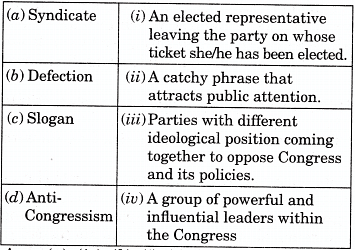 Ans:
Ans:
(a) Syndicate → (iv) A group of powerful and influential leaders within the Congress
(b) Defection → (i) An elected representative leaving the party on whose ticket she/he has been elected
(c) Slogan → (ii) A catchy phrase that attracts public attention
(d) Anti-Congressism → (iii) Parties with different ideological positions coming together to oppose Congress and its policies
Q3: Whom would you identify with the following slogans/phrases?
(a) Jai Jawan, Jai Kisan
(b) Indira Hatao!
(c) Garibi Hatao!
Ans:
(a) Lai Bahadur Shastri: Jai Jawan, Jai Kisan
(b) Syndicate: Indira Hatao!
(c) Indira Gandhi: Garibi Hatao!
Q4: Which of the following statement about the Grand Alliance of 1971 is correct? The Grand Alliance ...
(а) was formed by non-Communist, non-Congress parties.
(b) had a clear political and ideological programme.
(c) was formed by all non-Congress parties.
Ans: (a) was formed by non-Communist, non-Congress parties.
The "Grand Alliance" referred to a coalition of several non-Congress parties that joined together in opposition to Indira Gandhi's Congress faction. It did not include all non-Congress formations and was not ideologically homogeneous; it primarily grouped non-Communist parties opposed to the Congress leadership at that time.
Q5: How should a political party resolve its internal differences? Here are some suggestions. Think of each and list out their advantages and shortcomings?
(a) Follow the footsteps of the party president
(b) Listen to the majority group
(c) Secret ballot voting on every issue
(d) Consult the senior and experienced leaders of the party
Ans:
(a) Advantage: Following the party president can provide unity, quick decision-making and discipline.
Shortcoming: The party president can take its decision without taking into consideration the views of its party members. So, the inner democracy may get weakened.
(b) Advantage: If the party listens to the majority group, there will be more confidence among the party members and inner democracy will be strengthened.
Shortcoming: If the party listens to the majority group, factionalism may increase in the party. One faction may try to back another faction to gather support.
(c) Advantage: Secret ballot voting is an appropriate system. It is more democratic. Through it, any member can express his views.
Shortcoming: Sometimes, the party members may vote through secret ballot by ignoring the whip of the party issued by the party president. It may prove fatal to the party.
(d) Advantage: The novice and less experienced candidates will be benefited if they consult the senior and experienced leaders of the party and also follow their guidelines.
Shortcoming: If the party members only consult the senior and experienced leaders and follow their guidelines, their hold will get strengthened in the party.
Q6: State which of these were reasons for the defeat of the Congress in 1967. Give reasons for your answer?
(a) The absence of a charismatic leader in the Congress party.
(b) Split within the Congress party.
(c) Increased mobilisation of regional, ethnic and communal groups.
(d) Increasing unity among non¬Congress parties.
(e) Internal differences within the Congress party.
Ans:
(a) It may not be the reason of the defeat of Congress party. Because there were so many experienced and charismatic leaders in the party.
(b) It was one of the main reasons of the defeat of Congress party. Now party was split into two groups. Syndicate had strong hold over the Congress party while Indira supporters were more inclined to their leader. One group was in support of capitalism and liberalisation while others opposed it.
(c) Due to the emergence of the Akali Dal in Punjab, D.M.K. in Tamil Nadu got and other regional parties, Congress setback. The party could not get majority at the centre and had to be deprived of power in various states.
(d) There was no unity among non¬Congress parties. So the non¬Congress parties got benefit in other provinces.
(e) Internal differences within the party were one of the major causes of its defeat.
Q7: What were the factors which led to the popularity of Indira Gandhi's Government in the early 1970s?
Ans:
- Socialist credentials became main projects during this period.
- Indira Gandhi campaigned to implement land reform legislations and land ceiling legislations.
- She ended her dependence on other political parties by strengthening her party's position and recommended the dissolution of Lok Sabha in December' 1970.
- The crisis in East Pakistan and Indo- Pak war to establish Bangladesh as an independent one, also enhanced the popularity of Indira Gandhi.
- Indira Gandhi's government was not accepted only as a protector of the poor and underprivileged but as a strong government also.
- Congress became popular among different social sections and restored dominance again.
Q8: What does the term 'syndicate' mean in the context of the Congress party of the . sixties? What role did the Syndicate play in the Congress party?
Ans: Syndicate was a group of powerful and influential leaders from within the Congress:
- Syndicate was led by K. Kamraj, former chief minister of Tamilnadu and the then president of Congress party. It also includes some powerful leaders like S.K. Patil, S. Nijalingappa, N. Sanjeeva Reddy and Atulya Ghosh.
- In the sixties, Syndicate played a decisive role by installing both Lai Bahadur Shastri and Indira Gandhi as a Prime Minister.
- Syndicate played decisive say in Indira Gandhi's first council of Ministers and formation and implementation of policies.
- After a split, two groups in Congress were created i.e. Congress (O), led by Syndicate and Congress (R), led by Indira Gandhi.
- Congress (R), won popularity after 1971 and Syndicate lost power and prestige.
Q9: Discuss the major issue which led to the formal split of the Congress Party in 1969.
Ans: The formal split in Congress took place in 1969 on the issue of nomination of the candidate during presidential elections:
- Despite, Indira Gandhi's reservations, the Syndicate nominated Neelam Sanjeeva Reddy, as the official Congress candidate for ensuing Presidential elections.
- Indira Gandhi retaliated the situation by encouraging Mr. V.V. Giri, the then Vice-President, to be nominated as an independent candidate.
- During election, the then Congress President S. Nijalingappa issued a whip asking all Congress MPs. MLAs to vote for N. Sanjeeva Reddy.
- On the other hand, after silently supporting V.V. Giri, the Prime Minister Mrs Indira Gandhi openly called for a conscience vote to vote the way they want.
- Elections went in favour of V.V. Giri due to this diplomatic effort and N. Sanjeeva Reddy was defeated.
- The defeat of N. Sanjeeva Reddy, the formal Congress candidate, formalised the split of party into two:
(a) Congress (O), i.e. organisation led by syndicate, known as Old Congress.
(b) Congress (R) i.e. requisitionists led by Indira Gandhi, known as New Congress.
Q10: Read the passage and answer the questions below:
"... Indira Gandhi changed the Congress into highly centralised and undemocratic party organisation, from the earlier federal, democratic and ideological formation that Nehru had led. ... But this ... could not have happened had not Indira Gandhi changed the entire nature of politics. This new, populist politics turned political ideology ... into a mere electoral discourse, use of various slogans not meant to be translated into government policies.... During its great electoral victories in early 1970s, amidst the celebration, the Congress party as a political organisation died -Sudipta Kaviraj
(a) What according to the author is the difference between the strategies of Nehru and Indira Gandhi?
(b) Why does the author say that the Congress party 'died' in the seventies?
(c) In what way, did the change in the Congress party affect other political parties also?
Ans:
(a) According to author, main difference between the strategies of Nehru and Indira Gandhi is that Jawaharlal Nehru led the Congress into federal, democratic and ideological nature whereas Indira Gandhi converted it into highly centralised and undemocratic party.
(b) Congress party died in the seventies due to changed nature of Congress, the new populist politics turned political ideology into a mere electoral discourage and the use of various slogans never meant to be translated into government policies i. e. electoral victories of 1970s.
(c) The change in the Congress party affected other political parties also as they formed SVD (Samyukt Vidhayak Dal) in the form of coalitions and grand alliance.
FAQs on NCERT Solutions - Challenges to and Restoration of Congress System
| 1. What were the major challenges faced by the Congress system? |  |
| 2. How did the Congress system restore its power after facing challenges? | |
| 3. What role did opposition parties play in challenging the Congress system? | |
| 4. How did the Congress system deal with the rise of regionalism? | |
| 5. What were the key factors contributing to the restoration of the Congress system? | |





