NCERT Solutions - The Crisis of Democratic Order

Q1: State whether the following statements regarding the Emergency are correct or incorrect.
(a) It was declared in 1975 by Indira Gandhi.
(b) It led to the suspension of all fundamental rights.
(c) It was proclaimed due to the deteriorating economic conditions.
(d) Many Opposition leaders were arrested during the emergency.
(e) CPI supported the proclamation of the Emergency.
Ans:
(a) Ans: Correct.
Explanation: The Emergency was proclaimed on 25 June 1975 when President Fakhruddin Ali Ahmed, on the advice of Prime Minister Indira Gandhi, declared a state of internal emergency. This decision followed political turmoil after the Allahabad High Court verdict and widespread unrest.
(b) Ans: Correct.
Explanation: Many fundamental rights were curtailed during the Emergency. In particular, the right to move the courts for enforcement of fundamental rights (Article 32) was suspended by a Presidential order under Article 359, and other civil liberties were heavily restricted in practice.
(c) Ans: Wrong.
Explanation: The government cited threats of internal disturbance and law-and-order breakdown as the constitutional ground for proclamation under Article 352. Economic problems were not presented as the primary legal reason for declaring the Emergency.
(d) Ans: Correct.
Explanation: The authorities used preventive detention laws to arrest many Opposition leaders and activists. Large-scale arrests and detentions were a widely reported feature of the Emergency period.
(e) Ans: Correct.
Explanation: The Communist Party of India (CPI) publicly supported the proclamation and the government during the Emergency, aligning with the ruling party at that time.
Q2: Find the odd one out in the context of proclamation of Emergency.
(a) The call for 'Total Revolution'.
(b) The Railway Strike of 1974
(c) The Naxalite Movement
(d) The Allahabad High Court verdict
(e) The findings of the Shah Commission Report
Ans: (c) The Naxalite Movement
Explanation: The other items - the call for 'Total Revolution' (by Jayaprakash Narayan), the Railway Strike of 1974, the Allahabad High Court verdict against Indira Gandhi, and later the Shah Commission findings - were directly linked to the political crisis, mass mobilisation and legal controversies that led to or followed the Emergency. The Naxalite Movement, by contrast, was a long-standing guerrilla movement largely confined to particular regions and was not a direct, immediate trigger for the central political decisions surrounding the Emergency.
Q3: Match the following: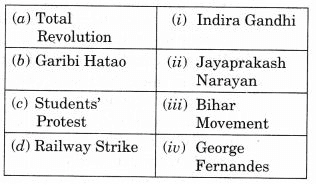 Ans: (a)-(iii), (b)-(i), (c)-(ii), (d)-(iv).
Q4: What were the reasons which led to the mid-term elections in 1980?
Ans:
- Janata Party lacked direction, leadership and a common programme. This internal incoherence weakened its ability to govern effectively.
- Janata party government could not bring a fundamental change in policies pursued by Congress, which disappointed many supporters who had expected major reforms after 1977.
- There was a split in Janata Party and the government led by Morarji Desai lost its majority in less than 18 months. Factionalism among leaders undermined parliamentary stability.
- Charan Singh government was formed with outside support of the Congress party but that support was withdrawn shortly afterwards, forcing Charan Singh to resign within four months.
- All the above mentioned reasons led to mid-term elections of 1980, in which the Janata Party was defeated and the Congress, led by Indira Gandhi, returned to power by winning 353 seats.
Q5: The Shah Commission was appointed in 1977 by the Janata Party Government. Why was it appointed and what were its findings?
Ans: The Shah Commission was appointed in May 1977 by the Janata Party government and was headed by Justice J. C. Shah, a retired Chief Justice of the Supreme Court of India, to investigate the abuses and excesses committed during the Emergency.
- Scope: It was tasked to inquire into allegations of misuse of authority, unlawful detentions, excesses and administrative malpractices carried out in the name of the Emergency declared on 25 June 1975.
- Procedure: The Commission examined evidence and recorded testimony from many officials and witnesses. It sought to summon and examine senior leaders, including Indira Gandhi, but she declined to answer the Commission's questions.
Findings of the Shah Commission:
- It documented a number of serious excesses and abuses of power committed during the Emergency period.
- Under preventive detention laws nearly 111,000 people were detained according to the Commission's records, indicating the scale of arrests.
- Press censorship had been imposed without proper legal safeguards; prior restraint and direct interference in publication were recorded as routine practices.
- The Commission reported incidents of administrative interference, for example orders to cut electricity to newspaper presses at odd hours to prevent publication, illustrating how state machinery was used to suppress dissent.
Q6: What reasons did the Government give for declaring a National Emergency in 1975?
Ans: Emergency was proclaimed following a petition filed by Raj Narain challenging Indira Gandhi's election. The government gave the following justifications:
(i) On 25 June 1975 the government invoked Article 352 on the ground of threat of internal disturbances.
(ii) Article 352 allows proclamation of an emergency on grounds of either internal or external disturbance; the government invoked the internal disturbance clause.
(iii) The government argued that the country faced a grave crisis requiring extraordinary measures to restore law and order, preserve administrative efficiency and implement welfare programmes for the poor.
(iv) President Fakhruddin Ali Ahmed issued the proclamation, marking one of the most controversial moments in India's political history.
Q7: The 1977 elections for the first time saw the Opposition coming into power at the Centre. What would you consider as the reasons for this development?
Ans: The 1977 elections produced a surprising result as the Congress party was defeated and the Janata coalition came to power. Key reasons include:
- The opposition adopted the slogan 'Save Democracy' and mobilised public sentiment against the imposition of Emergency and perceived authoritarian rule.
- The opposition campaigned on the non-democratic character of Emergency rule, highlighting excesses such as mass arrests and suppression of dissent.
- The opposition highlighted issues like preventive detention and press censorship to shape public opinion against the ruling party.
- Janata Party presented itself as a united platform to avoid splitting the non-Congress vote, which helped consolidate opposition strength.
- A section of the electorate in north India, especially the middle classes and regional groups, moved away from Congress and rallied behind the Janata coalition as an alternative.
- Thus, the 1977 outcome reflected a combination of resistance to Emergency excesses and effective political mobilisation by the Opposition rather than a single factor alone.
Q8: Discuss the effects of Emergency on the following aspects of our polity.
(a) Effects on civil liberties for citizens.
(b) Impact on relationship between the Executive and Judiciary.
(c) Functioning of Mass Media.
(d) Working of Police and Bureaucracy.
Ans:
(a) Effects on Civil Liberties for Citizens:
- The government carried out large-scale arrests using preventive detention laws, detaining political opponents and activists without trial.
- Those detained faced severe limitations on legal remedies; the suspension of the right to move the courts (Article 32) in many cases meant habeas corpus and other remedies were ineffective or delayed.
- Authorities often refused to provide detainees with clear grounds for arrest, and legal safeguards were weakened in practice.
- Overall, the Emergency period saw serious constraints on personal liberty, freedom of speech and assembly for many citizens.
(b) Impact on Relationship between the Executive and Judiciary:
- Parliament and the Executive enacted constitutional changes that curtailed judicial review and insulated certain actions from legal challenge.
- The Forty-Second Amendment introduced during this period made several changes - such as expanding the scope of executive power and altering provisions on elections and legislative terms - that had implications for the balance between branches of government.
- These developments strained the independence of the judiciary and led to long-term debates about checks and balances in the constitutional system.
(c) Functioning of Mass Media:
- Strict press censorship was imposed; newspapers had to obtain prior approval before publishing certain material, and many critical voices were suppressed.
- Public protests, strikes and political agitations were banned or severely restricted, reducing avenues for dissent.
- Several writers and public intellectuals protested; for example, Kannada writer Shivarama Karanth and Hindi writer Fanishwarnath Tanu returned national honours in protest against the suspension of democratic freedoms.
- Newspapers such as the Indian Express and The Statesman protested censorship by leaving blank spaces where stories had been cut, signalling public concern over press restrictions.
(d) Working of Police and Bureaucracy:
- Police forces were extensively used to enforce Emergency measures, including preventive detentions and suppression of demonstrations.
- The bureaucracy played an active role in implementing the government's directives; many officials complied with central orders, sometimes at the cost of civil liberties.
- These changes resulted in a perception of increased administrative authoritarianism and a weakening of institutional safeguards against misuse of power.
Q9: In what way did the imposition of Emergency affect the party system in India? Elaborate your answer with examples.
Ans:
- Concentration of power in the ruling party during Emergency showed how a dominant party could override democratic processes and institutions.
- The limits of institutional democracy became visible; the party in power used wide and open-ended powers conferred during Emergency to curb opposition and dissent.
- A tension emerged between institution-based democracy (formal rules and courts) and democracy based on popular participation, as many popular voices were excluded from decision making.
- The crisis exposed the inability of the existing party system to accommodate some popular aspirations, leading to realignments.
- For the first time, several opposition parties united to form the Janata Party, in order to avoid splitting the anti-Congress vote and to offer a consolidated alternative.
- The 1977 elections ended one-party dominance and produced a non-Congress coalition at the Centre, demonstrating the emergence of coalition politics in subsequent years.
Q10: Read the passage and answer the questions below:
"Indian democracy was never so close to a two-party system as it was during the 1977 elections. However, the next few years saw a complete change. Soon after its defeat, the Indian National
Congress split into two groups
The Janata Party also went
through major convulsions David
Butler, Ashok Lahiri and Prannoy Roy.
-Partha Chatterjee
(a) What made the party system in India look like a two-party system in 1977?
(b) Many more than two parties existed in 1977. Why then are the authors describing this period as close to a two-party system?
(c) What caused splits in Congress and the Janata Party?
Ans:
(a) The political contest in 1977 was dominated by two broad camps - the Congress on one side and the united non-Congress opposition, mainly represented by the Janata coalition, on the other. This consolidation made the party system resemble a two-party contest at the national level.
(b) Although many parties formally existed, most non-Congress parties had come together under the umbrella of the Janata Party to prevent division of anti-Congress votes. As a result, electoral competition occurred mainly between the Congress and a united non-Congress front, which is why observers described the period as close to a two-party system.
(c) Congress split earlier (notably in 1969) over leadership and the presidential election, creating rival Congress factions. The Janata Party later fractured because of internal tensions and leadership struggles among prominent figures such as Morarji Desai, Charan Singh and Jagjivan Ram, which undermined its cohesion after the initial victory.
FAQs on NCERT Solutions - The Crisis of Democratic Order
| 1. What is the crisis of democratic order? |  |
| 2. How does the crisis of democratic order impact society? | |
| 3. What are some factors contributing to the crisis of democratic order? | |
| 4. How can the crisis of democratic order be addressed? | |
| 5. What are the consequences of not addressing the crisis of democratic order? | |





