NCERT Solutions - Regional Aspirations

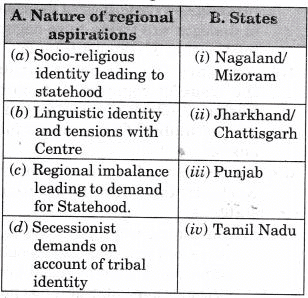 Ans: (a)-(iii), (b)-(iv), (c)-(ii), (d)-(i).
Q2: Regional aspirations of the people of North-East get expressed in different ways. These include movements against outsiders, movement for greater autonomy and movement for separate . national existence. On the map of the North-East, using different shades for these three, show the States where these expressions are prominently found.
Ans:
- Movement against outsiders: Tripura - Protests and movements have arisen in response to large-scale migration. Locals have feared cultural and political marginalisation, and they have demanded measures to protect their identity and political rights.
- Movement for greater autonomy: Arunachal Pradesh - There have been demands for greater local control to protect tribal identity, customary institutions and local decision-making. These demands are best represented by a distinct shade on the map.
- Movement for separate national existence: Mizoram - Historically, the Mizo National Front led a strong separatist movement seeking an independent polity. This movement was later resolved through political settlement, but it is the principal example of a demand for separate national existence in the region.
Note: On a map, use three distinct shades and label each State with the corresponding expression above.
Q3: What were the main provisions of the Punjab accord? In what way can they be the basis for further tensions between the Punjab and its neighbouring States?
Ans: Punjab Accord was an agreement signed between the then Prime Minister Rajiv Gandhi and Harchand Singh Longowal, the then President of Akali Dal in 1985 to be known as 'Rajiv Gandhi-Longowal Accord' to restore normalcy in Punjab:
- Chandigarh would be transferred to Punjab after an agreed arrangement for its status and administration.
- A separate commission would be appointed to resolve the boundary disputes between Punjab and Haryana.
- A tribunal would be set up to settle the sharing of Ravi-Beas river water among Punjab, Haryana and Rajasthan.
- Compensation and assistance would be provided to those affected by militancy in Punjab.
- Provisions were made for the withdrawal of certain special powers and for restoring normal civil authority in the State.
However, restoration of peace proved difficult and the agreement produced the following problems which could generate tensions between Punjab and neighbouring States:
- Security excesses and human rights violations during the period of unrest increased mistrust between communities and between States.
- The Akali Dal fragmented as internal disagreements over the Accord weakened a coherent political response.
- President's Rule was imposed, suspending normal politics and delaying settlement of contentious issues such as borders and river water.
- Low voter turnout in subsequent elections (for example, around 1992) showed weak public confidence in political solutions, which left unresolved issues that could become sources of interstate tension.
Q4: Why did the Anandpur Sahib Resolution become controversial?
Ans: Anandpur Sahib Resolution was passed at the conference of Akali Dal at Anandpur Sahib in 1973:
- It sought greater regional autonomy and a redefinition of Centre-State relations to protect Punjab's interests.
- The resolution emphasised Sikh political rights and identity; some phrases (for example, claims about Sikh "bolbala" or strength) were interpreted by critics as asserting Sikh dominance.
- Some critics interpreted parts of the resolution as implying a desire for a separate Sikh nation, although supporters presented it as a demand for stronger federal safeguards within India.
It became controversial for several reasons:
- Its proposals did not command universal support beyond Akali Dal and were presented in a way that opponents found alarming.
- Political instability in the State during the 1980s, including dismissals of state governments and periods of direct rule, reduced the space for peaceful political negotiation.
- Some issues raised in the resolution, such as water distribution, became focal points for agitation; as moderation weakened, extremist elements gained influence in parts of the movement.
- When agitation turned violent in parts, the resolution was blamed by some for creating an atmosphere that extremists exploited, which increased its controversy.
Q5: Explain the internal divisions of the State of Jammu and Kashmir and describe how these lead to multiple regional aspirations in that State.
Ans: Jammu and Kashmir comprised of three regions:
- Kashmir Valley: Predominantly Kashmiri-speaking and mostly Muslim, with a Hindu minority concentrated in certain towns.
- Jammu: A diverse region of foothills and plains with Hindus, Muslims and Sikhs and a variety of languages and cultures.
- Ladakh: Sparsely populated, with significant Buddhist and Muslim communities, and distinct cultural and geographic characteristics.
These internal divisions produced multiple regional aspirations because:
- One strand of opinion in the Valley sought full independence, arguing for a separate Kashmiri nation independent of both India and Pakistan.
- Another group favoured merger with Pakistan, reflecting religious and political affinities with that country.
- A third strand supported greater autonomy for the State within the Indian Union, seeking more decision-making powers at the regional level.
- Within the State there were also demands for intra-state autonomy so that regions such as Ladakh and Jammu could protect their own distinct identities and interests.
In recent years, many groups that earlier took separatist positions have engaged in dialogue to renegotiate the relationship with India, showing how internal divisions continue to shape varied political demands.
Q6: What are the various positions on the issue of regional autonomy for Kashmir? Which of these do you think are justifiable? Give reasons for your answer.
Ans: On the issue of regional autonomy for Kashmir, the following positions are stated:
- Some Kashmiris argued that accession to India had been agreed with a promise that a final decision would be taken by the people once normalcy returned; this gave rise to demands for a plebiscite to settle the question of accession.
- Others argued that the special federal status guaranteed by Article 370 had been eroded in practice, and therefore called for restoration of full autonomy or for greater state autonomy within the Indian Union.
- Another view pointed out that democratic institutions and practices had not been fully consolidated in Jammu and Kashmir to the same extent as in other Indian States, and therefore called for stronger democratic reforms and protections.
Justification of a preferred position:
- Among these, a plebiscite is seen by many as a democratic way to resolve the question because it allows the people most directly affected to express their choice.
- However, practical difficulties, legal constraints and geopolitical realities make a plebiscite complicated to implement.
- Restoring meaningful autonomy combined with strengthening democratic institutions and protections for all communities offers a justifiable and practical route to address regional aspirations while preserving constitutional order.
Q7: The Assam movement was a combination of cultural pride and economic backwardness. Explain.
Ans: The Assam movement (late 1970s-1980s) combined concerns about cultural identity with economic grievances:
- Cultural pride and identity: Many Assamese felt that their language, culture and identity were being threatened by large-scale migration from neighbouring regions. Fear of cultural dilution and loss of political influence motivated strong local mobilisation.
- Economic backwardness and resource concerns: Despite natural resources such as tea, oil and coal, Assam experienced high unemployment and poverty. Local people felt that benefits from these resources and from economic development were not reaching them, and that outsiders were taking a disproportionate share of opportunities.
- Together, cultural fears and real economic grievances strengthened mass mobilisation, making the movement both an assertion of Assamese identity and a demand for fair economic treatment and local development.
Q8: All regional movements need not lead to separatist demands. Explain by giving examples from this chapter.
Ans: Not all regional movements aim for separation. Many seek recognition, autonomy or better development and are resolved through political negotiation.
Examples and points:
- Regional aspirations are a normal part of democratic politics and provide groups a way to press for local interests and rights.
- Expressions of regional issues do not necessarily imply anti-national goals; they often ask for accommodation within the constitutional framework.
- International examples: Scotland, Wales and Northern Ireland have regional aspirations within the United Kingdom but operate mainly through democratic channels.
- In India, many movements were met through negotiation and political settlement rather than suppression.
- For example, the settlement with Mizoram transformed an insurgency into a political process and an autonomous arrangement, showing a peaceful resolution to a separatist demand.
- Other movements have sought language recognition, more resources or administrative reorganisation rather than full separation.
Q9: Regional demands from different parts of India exemplify the principle of unity with diversity. Do you agree? Give reasons.
Ans: Yes, we agree with the statement because India has generally responded to regional aspirations through democratic means rather than by treating them as uniformly anti-national:
- India's democratic politics allows groups to raise issues on the basis of regional identity, culture and specific problems, which brings those concerns into public debate and policy making.
- Regional demands have often been accommodated through administrative reorganisation, greater devolution of powers, language recognition and targeted development programmes.
- Examples from the 1980s include negotiated settlements in Mizoram and various measures to address problems in Assam, Punjab and the North-East.
- Such political engagement has helped to manage diversity by recognising distinct identities while preserving the unity of the nation.
Q10: Read the passage and answer the questions below:
One of Hazarika's songs dwells on the unity theme; the seven states of north-eastern India become seven sisters born of the same mother 'Meghalaya went own way ...., Arunachal too separated and Mizoram appeared in Assam's gateway as a groom to marry another daughter.' The song ends with
a determination to keep the unity of the Assamese with other smaller nationalities that are left in the present-day Assam- 'the Karbis and the Mising brothers and sisters are our dear ones.'
-Sanjib Baruah
(a) Which unity is the poet talking about?
(b) Why were some States of North-East created separately out of the erstwhile State of Assam?
(c) Do you think that the same theme of unity could apply to all the regions of India? Why?
Ans:
(a) According to the given passage, the poet speaks of the unity between the Assamese and the smaller nationalities of the North-East - an emotional bond that recognises them as "dear ones" and seeks to preserve neighbourly ties despite administrative separation.
(b) Some States were carved out of the erstwhile State of Assam to protect distinct ethnic, linguistic and cultural identities and to prevent domination by the Assamese majority. Administrative reorganisation responded to regional aspirations for recognition, local control and the safeguarding of language and culture.
(c) Yes. The theme of unity alongside recognition of diversity can apply across India because democratic accommodation, dialogue and administrative measures can allow different peoples to retain their identities while remaining part of the larger polity. Respecting local cultures, addressing grievances and negotiating solutions help maintain national unity in a diverse country.
FAQs on NCERT Solutions - Regional Aspirations
| 1. What are regional aspirations and why are they important? |  |
| 2. How do regional aspirations impact national politics? | |
| 3. What are some examples of regional aspirations in India? | |
| 4. How can the government address regional aspirations effectively? | |
| 5. What role do regional parties play in representing regional aspirations? | |





