NCERT Solutions - An Empire Across Three Continents

Q1: If you had lived in the Roman Empire, where would you rather have lived - in the towns or in the countryside? Explain why.
Ans: If I had a choice, I would prefer to live in a town of the Roman Empire. Town life offered a range of facilities and services that made daily life more comfortable and secure than life in the countryside.
Some important aspects or amenities provided by the towns have been discussed below:
- Opportunity for cultural upliftment: Roman towns were centres of learning, art and public life. People who moved from villages to towns could attend schools, watch performances and take part in public debates. Such exposure helped individuals learn new customs, improve manners and access a wider range of ideas.
- Economic opportunities: Towns offered many kinds of work. Educated people could find jobs in administration as clerks or local officials. Craftsmen and artisans produced goods such as pottery, metalwork and jewellery. Traders, entertainers and service providers could also earn a living in busy urban markets.
- Effective administration: Towns were organised for better governance. Cities were divided into manageable districts and local officials managed civic affairs. Law and order were maintained by official forces, which helped reduce crime and made urban life safer for residents.
- Food security: Towns had reliable supplies of food because they were linked to surrounding rural areas by well-established trade routes. Large storehouses and public granaries helped store surplus grains, reducing the risk of shortages during bad harvests or other emergencies.
- Leisure: Towns had many options for leisure and social life. Public baths provided places to relax, read and meet friends. Theatres, chariot races and gladiatorial spectacles offered entertainment, while markets and public squares were centres of social interaction.
Q2: Compile a list of some of the towns, cities, rivers, seas and provinces mentioned in this chapter, and then try and find them on the maps. Can you say something about any three of the items in the list you have compiled?
Ans: Some of the towns, cities, rivers, seas and provinces mentioned in this chapter have been tabulated below:
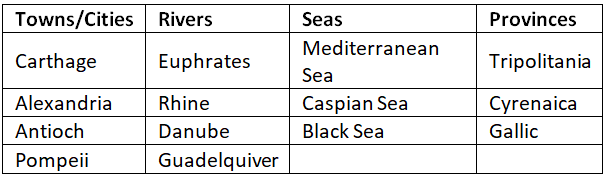
Let's now discuss three items from the table provided above:
- Alexandria: Alexandria was an important port city in Egypt and a major hub for trade and learning. Jewish merchants were active there and evidence such as letters preserved in the Geniza collection shows long-distance trading connections. Alexandria also served as a conduit for goods and ideas moving between the Mediterranean and the interior of Africa and Asia.
- Black Sea: The Black Sea lies between south-eastern Europe and western Asia. In antiquity it served as a busy waterway linking regions such as the steppes of Central Asia, the Black Sea coasts, Mesopotamia to the south and the Greek world to the south-west. Maritime contacts around the Black Sea supported trade in grain, timber, fish and other goods.
- Mediterranean Sea: The Mediterranean was the central maritime highway of the Roman world. Its coasts were lined with Greek cities and later with Roman ports. Coastal trade and communication along the Mediterranean helped cities flourish and allowed cultural and commercial exchanges across three continents. Much of the economic life of the empire depended on safe sea routes in this inland sea.
Q3: Imagine that you are a Roman housewife preparing a shopping list for household requirements. What would be on the list?
Ans: If I were a Roman housewife, my shopping list would include:
- Essential food items: grains such as wheat and barley (for bread), pulses, vegetables, fruits like dates, meat and fish.
- Common cooking ingredients: olive oil, wine and salt, which were widely used in Roman households.
- Fish products: garum (a popular fish sauce), which was an important ingredient in Roman cooking.
- Trade goods: items brought through long-distance Mediterranean trade, such as olive oil and wine from different regions of the empire.
Q4: Why do you think the Roman government stopped coining in silver? And which metal did it begin to use for the production of coinage?
Ans: The Roman government gradually stopped coining in silver because of the debasement of the silver coin (denarius). Over time, the silver content in the denarius was reduced, which led to a decline in its value and reliability. This reflected broader economic difficulties within the empire.
To overcome this problem, the Romans increasingly shifted to gold coinage, especially the solidus, which became a more stable and reliable currency for high-value transactions.
Answer in a Short Essay
Q5: Suppose the emperor Trajan had actually managed to conquer India and the Romans had held on to the country for several centuries. In what ways do you think India might be different today?
Ans: Trajan was a powerful ruler of the Roman Empire. If India had come under long-term Roman rule, several changes might have taken place based on the features of the Roman Empire described in the chapter. The main possibilities are:
- Urbanisation and development of cities: The Romans relied heavily on cities for administration and taxation. Under Roman rule, more cities might have developed in India as centres of governance, trade and public life.
- Expansion of trade networks: India could have become more closely connected to the vast Roman trade network centred around the Mediterranean. This would have increased long-distance trade and economic activity across regions.
- Administrative organisation: The Romans followed a well-organised system of provincial administration, taxation and record-keeping. These systems might have led to more centralised and structured governance in India.
- Cultural interaction: As the Roman Empire included diverse cultures, there could have been interaction between Indian and Roman traditions, including exchange of ideas, languages and customs.
Q6: Go through the chapter carefully and pick out some basic features of Roman society and economy which you think make it look quite modern.
Ans: Some basic features of the Roman society that seem modern are:
- Nuclear family: In Roman society, adult children often established separate households rather than living in large extended families. This pattern resembles the modern idea of the nuclear family.
- Rights of women: Roman women could hold property in their own name and had legal rights over property they inherited. Marriage did not always merge all property into a single household fund. Divorce was also comparatively straightforward, giving individuals greater personal freedom.
- Literacy and education: Evidence of schools and private tutors shows that basic education and literacy were valued. Urban populations had access to primary teaching and, for some, higher education in rhetoric and law.
Some basic features of the Roman economy that appear modern are:
- Economic infrastructure: Romans invested in harbours, roads, mines and brickyards. Such infrastructure supported production, transport and trade across the empire.
- Trade: A dense network of sea and land routes linked the empire's regions and connected Rome to partners in Spain, North Africa, Egypt and beyond. Trade in goods such as grain, olive oil, wine, marble and metals was central to the economy.
- Advanced technology: Romans used water-power for milling, developed engineering techniques for mining and built durable public works. These practical innovations helped increase productivity and support large urban populations.
- Money and banking: Coinage, money-changers and informal banking arrangements supported commerce. Argentarii (money-changers and bankers) operated near markets, forums and ports, providing services that resemble basic modern financial functions.
FAQs on NCERT Solutions - An Empire Across Three Continents
| 1. What was the Ottoman Empire and how did it expand across three continents? |  |
| 2. Why did the Ottoman Empire decline and what were the main reasons for its fall? | |
| 3. How did the Ottoman administration system work across such vast territories? | |
| 4. What made the Ottoman military so powerful and how did they conquer so many territories? | |
| 5. How did Ottoman culture influence the regions under its rule? | |