NCERT Solutions - Nomadic Empires

Exercise Page No 61 (Activity 1)
Q. Assume that Juwaini's account of the capture of Bukhara is accurate. Imagine yourself as a resident of Bukhara and Khurasan who heard the speeches. What impact would they have had on you?
Ans: If I were a resident of Bukhara and Khurasan and heard the speeches described by Juwaini, I would feel a mixture of fear, grief and uncertainty. The cruelty of the Mongol attackers would produce immediate terror about my safety and that of my family, and sadness at the likely loss of neighbours, homes and livelihoods. I would also worry about the disruption to trade, food supplies and local institutions, which could lead to hunger and displacement. At the same time, I might feel anger and helplessness, and perhaps a resolve to protect what remained of my community, to rebuild if possible, or to seek refuge elsewhere. Finally, hearing such speeches could increase distrust of local leaders if they seemed unable to defend the people, or encourage cooperation and mutual support among survivors to face the crisis.
Exercise Page No 71 (Activity 2)
Q. Note the areas traversed by the Silk Route and the goods that were available to traders along the way. This map does not reflect one of the eastern terminal points of the silk route during the height of Mongol power. Can you place the missing city? Could it have been on the Silk Route in the twelfth century? Why not?
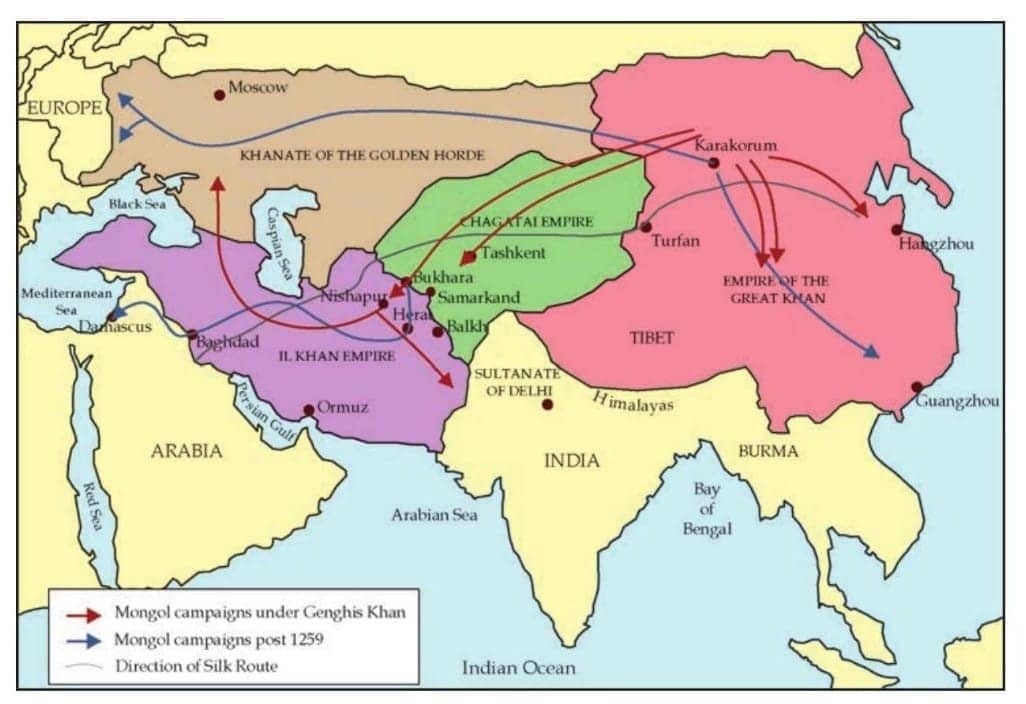
Ans: The missing eastern terminal point of the Silk Route during the height of Mongol power was Karakorum, the capital of the Mongol Empire. During the thirteenth century, under Mongol rule, the Silk Route extended beyond China into Mongolia, and Karakorum became an important centre of trade, linking different parts of Asia and Europe.
However, Karakorum could not have been on the Silk Route in the twelfth century because the Mongol Empire had not yet been established at that time. Before the rise of Genghis Khan, Mongolia was not a major centre of long-distance trade. It was only after the Mongols unified the region and created a vast empire that trade routes expanded to include Karakorum.
Exercise Page No 72 (Activity 3)
Q. Why was there a conflict of interests between pastoralists and peasants? Would Genghis Khan have expressed sentiments of this nature in a speech to his nomad commanders?Ans: There was a conflict of interests between pastoralists and peasants because pastoralists depended on open grazing lands for their animals, while peasants required fixed agricultural land for cultivation. This led to competition over land and resources, often resulting in raids and tensions between the two groups.
As reflected in Ghazan Khan's speech, Mongol rulers gradually realised that excessive plundering of peasants was harmful in the long run. If peasants were destroyed, it would reduce agricultural production and revenue. Therefore, a ruler like Genghis Khan might have advised his commanders to avoid unnecessary destruction and instead protect peasants to ensure a stable supply of food and resources. This shows a shift from mere plunder to a more organised system of governance.
Exercise Page No 72 (Activity 4)
Q. Did the meaning of yasa alter over the four centuries separating Genghis Khan from 'Abdullah Khan? Why did Hafiz-i Tanish make a reference to Genghis Khan's yasa in connection with 'Abdullah Khan's prayer at the Muslim festival ground?
Ans: Yes, the meaning of yasa did change over time. During Genghis Khan's reign, it referred to specific administrative regulations and laws concerning the organisation of the army, hunting, and the postal system.
Over time, however, yasa came to be seen as a broader symbol of law, authority and governance. It was no longer just a set of rules but also represented the legacy and legitimacy of Genghis Khan's rule.
Hafiz-i Tanish referred to Genghis Khan's yasa in connection with 'Abdullah Khan's prayer to show continuity with the traditions of Genghis Khan. By doing so, he aimed to legitimise 'Abdullah Khan's authority and present him as a ruler who followed the established and respected laws of the past.
Answer in Brief
Q1: Why was trade so significant to the Mongols?
Ans: The region occupied by the Mongols lacked many natural resources needed for settled agriculture. The steppes had a harsh climate and could not sustain large-scale cultivation, so pastoralism alone did not provide all necessities. Trade supplied food, luxury goods, metal, and manufactured items that the steppes could not produce. Trade also brought wealth, diplomatic contacts and artisans, and helped integrate different parts of the empire during Mongol rule. For these reasons trade was vital to the Mongols' survival and prosperity.
Q2: Why did Genghis Khan feel the need to fragment the Mongol tribes into new social and military groupings?
Ans: Genghis Khan reorganised the Mongol social and military order for these reasons: (i) The old tribal groups carried strong loyalties and rivalries that could threaten central authority. He reduced this risk by mixing people from different tribes into new units and by placing family members at distant posts so loyalty became personal to him rather than to a single tribe.
(ii) He built a more efficient and disciplined army by using a decimal system with units of 10, 100, 1,000 and 10,000 soldiers. This structure allowed merit-based promotion, clearer command, and rapid mobilisation of mixed groups loyal to the ruler rather than to tribal chiefs.
Q3: How do later Mongol reflections on the yasa bring out the uneasy relationship they had with the memory of Genghis Khan.
Ans: At the 1206 Assembly of Mongol Chieftains (quriltai), Genghis Khan promulgated the Yasa (the code of law). Later rulers treated his memory in mixed ways to suit their needs. Sometimes they invoked the name of Genghis Khan and the yasa to claim legitimacy and order; at other times they altered, ignored or reinterpreted parts of the yasa to fit new administrative needs or religious contexts. Thus the yasa became both a source of authority and a flexible symbol whose meaning was adapted, showing an uneasy relationship between reverence for the founder and changing political realities.
Q4: 'If history relies upon written records produced by city-based literati, nomadic societies will always receive a hostile representation.' Would you agree with this statement? Does it explain the reason why Persian chronicles produced such inflated figures of casualties resulting from Mongol campaigns?
Ans: Yes, I agree with the statement for the following reasons:
(i) City-based literati wrote from the perspective of settled, urban communities that suffered directly from nomadic invasions; their accounts therefore often emphasised destruction and loss to express fear and grief.
(ii) Chroniclers sometimes inflated casualty figures and dramatic details to condemn the violence and to persuade readers of the scale of suffering; exaggeration could serve moral or political purposes.
(iii) Sources varied widely in language, purpose and access to information; different authors used varying figures and rhetoric, so numbers are often unreliable. Together, these factors help explain why Persian chronicles and other urban accounts portray nomads in a hostile and sometimes exaggerated manner.
Answer in Short Essay
Q5: Keeping the nomadic element of the Mongol and Bedouin societies in mind, how, in your opinion, did their respective historical experiences differ? What explanations would you suggest account for these differences?Ans: Both Mongols and Bedouins were nomadic groups dependent on herds and mobility, but their historical experiences diverged for several reasons. The Mongols lived on the vast Eurasian steppes, an environment suitable for large horse herds and rapid cavalry movements; this allowed leaders like Genghis Khan to unite tribes and create a large, organised army that conquered vast territories and established a transcontinental empire. Bedouins lived in deserts where mobility, smaller group sizes and camel pastoralism shaped their social organisation; they focused more on raiding, caravan trade and local alliances and later integrated into the expanding Islamic polities rather than building a large imperial state. Differences in leadership and political organisation also mattered: Mongol leaders broke tribal loyalties to form centralised military institutions, while many Bedouin groups retained clan-based loyalties and often negotiated with settled rulers. Finally, geography, the scale of available resources, and opportunities for long-distance conquest explain why Mongols formed an expansive empire whereas Bedouin groups generally remained influential within regional networks rather than creating comparable empires.
Q6: How does the following account enlarge upon the character of the Pax Mongolica created by the Mongols in the middle of the thirteenth century?
The Franciscan monk, William of Rubruck, was sent by Louis IX of France on an embassy to the great Khan Mongke's court. He reached Karakorum, the capital of Mongke, in 1254 and came upon a woman from Lorraine (in France) called Paquette, who had been brought from Hungary and was in the service of one of the prince's wives who was a Nestorian Christian. At the court, he came across a Parisian goldsmith named Guillaume Boucher, 'whose brother dwelt on the Grand Pont in Paris'. This man was first employed by Queen Sorghaqtani and then by Mongke's younger brother. Rubruck found that at the great court festivals, the Nestorian priests were admitted first, with their regalia, to bless the Grand Khan's cup, and were followed by the Muslim clergy and Buddhist and Taoist monks...
Ans: The account highlights important features of the Pax Mongolica during the thirteenth century. It shows that the Mongol Empire established close connections between distant regions such as Europe and Asia, as seen in the embassy of William of Rubruck and the presence of Europeans at Karakorum.
The presence of people like Guillaume Boucher and others from different parts of the world indicates the movement of skilled artisans across the empire. This reflects increased mobility and cultural exchange under Mongol rule. The participation of different religious groups-Nestorian Christians, Muslims, Buddhists and Taoists-at court ceremonies shows that the Mongols followed a policy of religious tolerance.
Furthermore, the account suggests that long-distance travel became safer and easier, which encouraged trade along the Silk Route. Thus, the Pax Mongolica created conditions of peace, security and interaction across a vast empire.
FAQs on NCERT Solutions - Nomadic Empires
| 1. What were the main characteristics of nomadic empires? |  |
| 2. How did nomadic empires influence trade in ancient times? | |
| 3. What were the major nomadic empires in history? | |
| 4. How did the lifestyle of nomadic tribes differ from settled societies? | |
| 5. What role did religion play in nomadic empires? | |