NCERT Solutions - Changing Cultural Traditions

Exercise Page No. 109 (Activity 1)
Q. Locate Venice on the map of Italy, and look carefully at the painting on p. 108. How would you describe the city, and in what ways was it different from a cathedral town?Ans: Venice lies in the north-eastern part of Italy, set on a group of small islands in a shallow lagoon of the Adriatic Sea. The painting shows a city built along narrow waterways, crossed by many bridges, with façades that display Gothic and Byzantine influences. Public life is organised around the canals and the harbour rather than around a single church. Unlike a cathedral town, which grew up around a central cathedral and was closely linked to rural hinterlands and feudal authorities, Venice's economy and social life centred on maritime trade, shipbuilding and banking. Its government was that of a maritime republic, led by a Doge and ruling councils chosen from the merchant and patrician classes, so civic institutions and commercial spaces - not a cathedral - gave shape to the city.
Exercise Page No. 113 (Activity 2)
Q. Describe the different scientific elements in the work of sixteenth-century Italian artists.
Ans: Sixteenth-century Italian artists incorporated several scientific ideas and methods into their work:
- They used linear perspective and geometric proportions to create the illusion of depth and ordered space in paintings.
- Many artists, notably Leonardo da Vinci and Michelangelo, studied human anatomy through dissections to represent bodies with realistic proportions and movement.
- Artists developed careful observation of light and shadow (chiaroscuro) to model forms and create a three-dimensional effect.
- The combined use of anatomy, geometry and physics helped artists achieve realism and accuracy in their work.
.
Exercise Page No. 116 (Activity 3)
Q. Compare the aspirations for women expressed by a woman (Fedele) and by a man (Castiglione). Did they have only women of a particular class in mind?
Ans: Laura Cereta (often called Fedele) and Baldassare Castiglione expressed different ideas about women:
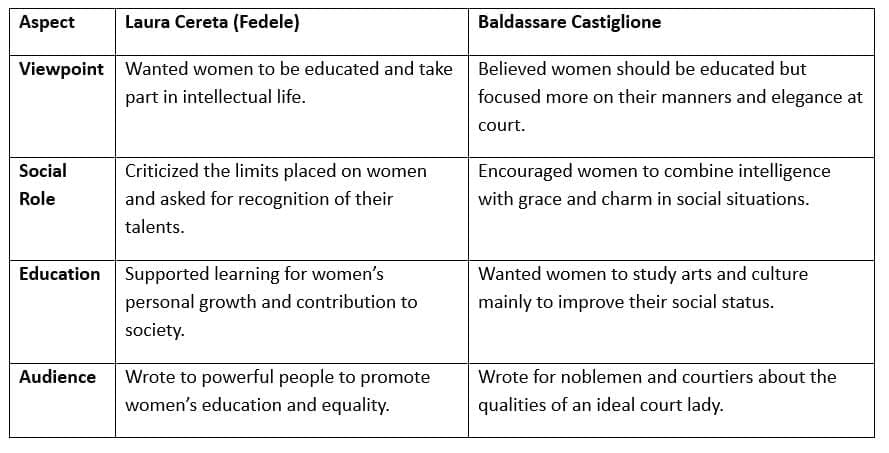
Exercise Page No. 118 (Activity 4)
Q. What were the issues on which the Protestants criticised the Catholic Church?
Ans: Protestants criticised the Catholic Church on several important grounds:
- Authority: They rejected the exclusive authority of the Pope and argued that the Bible should be the primary source of religious truth and guidance.
- Corruption: They condemned corrupt practices among clergy, most famously the sale of indulgences, which were seen as abuses that exploited believers.
- Priesthood: They questioned the special status of priests and objected to strict rules such as mandatory clerical celibacy, arguing for a different understanding of ministry.
- Rituals: They wanted simpler forms of worship and criticised elaborate ceremonies that, they felt, distracted from personal faith and understanding.
- Idolatry: They attacked the excessive veneration of saints, the use of relics and images, seeing some practices as bordering on idolatry rather than true devotion.
Answer in Brief
Q1: Which elements of Greek and Roman culture were revived in the fourteenth and fifteenth centuries?
Ans: During the 14th and 15th centuries, Italian towns revived many elements of Greek and Roman culture, including classical texts and learning, realistic styles in sculpture and painting, architectural forms such as arches and columns, and a renewed interest in rhetoric and civic ideas. Artists and writers studied ancient models and adapted their techniques and themes to new civic and intellectual life.
Q2: Compare details of Italian architecture of this period with Islamic architecture.
Ans: (i) Both traditions placed great value on decoration and craftsmanship: Italian architecture revived Roman arches, columns and a clear sense of proportion, while Islamic architecture emphasised intricate surface decoration, geometric patterns and the use of domes.
(ii) Both built monumental religious buildings: Italians constructed cathedrals and monastic complexes; Islamic societies built large mosques with courtyards and minarets.
(iii) The arch and pillar were important in both, but their visual languages differed because Italian builders drew on Roman ruins and classical orders, whereas Islamic builders developed distinctive decorative motifs and structural forms shaped by regional influences.
(iv) Contacts through trade and the Byzantine world led to exchanges of ideas; patronage in both traditions produced impressive urban architecture that reflected religious and civic priorities.
Q3: Why were Italian towns the first to experience the ideas of humanism?
Ans: Italian towns were the first to adopt humanist ideas because:
(i) They had growing urban centres with courts, universities and schools where learning spread.
(ii) Classical books and manuscripts were available in libraries and through contacts with Byzantine and Islamic scholars.
(iii) Wealthy patrons, merchants and civic institutions supported education, scholarship and the arts.
(iv) The social and political life of Italian towns encouraged discussion of civic virtue, literature and the study of classical authors, making humanism attractive and influential.
Q4: Compare the Venetian idea of good government with those in contemporary France.
Ans: Venice was governed by a stable republican system in which the Doge and a number of councils, dominated by merchant and patrician families, shared power; its institutions emphasised order, the rule of law and the interests of commerce. In contemporary France authority was increasingly centralised under the king, with monarchy and a stronger role for royal officials. While Venice was led by an oligarchic merchant elite, France developed a more absolute monarchical state with less citizen participation in government.
Answer in Short Essay
Q5: What were the features of humanist thought?
Ans: Humanist thought stressed the importance of human capacities and the study of classical learning. Key features include:
- Focus on Human Dignity: An emphasis on the worth and potential of the individual, and on cultivating human talents.
- Emphasis on Intellectual and Moral Growth: A balanced concern for learning, ethical conduct and physical well-being.
- Recovery of Classical Philosophy: A revival of Greek and Roman literature, history and philosophy that encouraged critical inquiry and secular study.
- Spread of Humanist Ideas: Originating with figures such as Petrarch, humanist education and ideas spread through schools and courts across Europe, influencing art, politics and learning.
- Cultural Expression: Humanist values appeared in art and literature - for example, in works by Leonardo da Vinci, Michelangelo and Raphael, which emphasised realistic human forms and classical themes.
Overall, humanism shifted attention from purely religious concerns to a broader aim of achieving fulfilment and effectiveness in earthly life, shaping the culture of the Renaissance.
Q6: Write a careful account of how the world appeared different to seventeenth century Europeans.
Ans: The seventeenth century brought major changes that transformed how Europeans understood the world:
Scientific Revolution:
- New ideas such as the heliocentric theory of Copernicus, the work of Galileo and Kepler, and Newton's laws challenged earlier beliefs.
- Knowledge came to be based on observation, experiment and reason rather than tradition.
- Nature began to be seen as the source of creation, replacing earlier beliefs that placed God at the centre of all explanations.
Spread of Knowledge:
- The printing press made books widely available, allowing ideas to spread quickly.
- Scientific societies and scholars promoted discussion, experiments and new discoveries.
Intellectual Change:
- People increasingly questioned traditional authority and relied on rational thinking.
- There was a shift from a worldview dominated by religion to one shaped by science and human reasoning.
These changes created a new outlook in which Europeans viewed the world as governed by natural laws that could be studied and understood.
FAQs on NCERT Solutions - Changing Cultural Traditions
| 1. What are the main factors contributing to changing cultural traditions in society? |  |
| 2. How do changing cultural traditions impact the identity of a community? | |
| 3. In what ways do education and youth influence cultural traditions? | |
| 4. What role does technology play in the evolution of cultural traditions? | |
| 5. Can changing cultural traditions lead to conflicts within a society? | |