NCERT Solutions - Geography as a Discipline

Q1: Multiple Choice Questions:
(i) Which one of the following scholars coined the term 'Geography'?
(a) Herodotus
(b) Erathosthenese
(c) Galileo
(d) Aristotle
Ans: (b) Erathosthenese
(ii) Which one of the following features can be termed as a 'physical feature'?
(a) Port
(b) Road
(c) Plain
(d) Water park
Ans: (c) Plain
(iii) Make correct pairs from the following two columns and mark the correct option. (a) 1B,2C,3A,4D
(b) 1A,2D,3B,4C
(c) 1D,2B,3C,4A
(d) 1C,2A,3D,4B
Ans: (d)
- Meteorology is the study of weather and climate, so it pairs with Climatology.
- Demography is the study of populations, so it pairs with Population Geography.
- Sociology is the study of society and social behaviour, so it pairs with Social Geography.
- Pedology is the study of soils, so it pairs with Soil Geography.
(iv) Which one of the following questions is related to the cause-and-effect relationship?
(a) Why
(b) Where
(c) What
(d) When
Ans: (a) Why
(v) Which one of the following disciplines attempts temporal synthesis?
(a) Sociology
(b) Geography
(c) Anthropology
(d) History
Ans: (d) History
Q2: Answer the following questions in about 30 words.
(i) What important cultural features do you observe while going to school? Are they similar or dissimilar? Should they be included in the study of geography or not? If yes, why?
Ans: While going to school, we see some cultural features like shops, schools, clubs, offices, temples, mosques, and houses. These features are dissimilar.
Yes, they should be included in the study of geography as they are an essential part of human geography.
(ii) You have seen a tennis ball, a cricket ball, an orange and a pumpkin. Which one amongst these resembles the shape of the Earth? Why have you chosen this particular item to describe the shape of the Earth?
Ans: An orange resembles the shape of the Earth because all others are almost spherical, while the pumpkin is elongated. The Earth is not a perfect sphere; it rotates on its axis and has a geoid shape, slightly flattened at the poles, like an orange
(iii) Do you celebrate Van Mahotsava in your school? Why do we plant so many trees? How do the trees maintain ecological balance?
Ans: Yes, we do celebrate Van Mahotsava in our school.
We plant so many trees because trees provide us with food, oxygen, clean air, economic products such as rubber and paper and help in making medicine, etc.
By taking in carbon dioxide and giving off oxygen, trees maintain ecological balance.
(iv) You have seen elephants, deer, Earthworms, trees and grasses. Where do they live or grow? What is the name given to this sphere? Can you describe some of the important features of this sphere?
Ans: The sphere where elephants, deer, Earthworms, trees and grasses live and grow is known as the biosphere.
Important features of this sphere are:
- The biosphere is the layer of the planet Earth where life exists.
- Since life exists on the ground, in the air, and in the water, the biosphere overlaps all three other spheres.
- Plants and animals are biotic elements of the biosphere, while soil, water, and air are abiotic elements.
(v) How much time do you take to reach your school from your house? Had the school been located across the road from your house, how much time would you have taken to reach school? What is the effect of the distance between your residence and the school on the time taken to commute? Can you convert time into space and vice versa?
Ans: It takes me around half an hour to reach my school. Had my school been located across the road from my house, I could have been there within four minutes. Due to the long distance between my residence and school, a lot of time gets wasted in commuting, which affects my study hours as well as my playing hours negatively.
Time can be converted into space, and vice versa, i.e., space can also be expressed in terms of time.
Q3: Answer the following questions in about 150 words.
(i) You observe every day in your surroundings that there is variation in natural as well as cultural phenomena. Not all the trees are of the same variety. All the birds and animals you see are different. All these different elements are found on the Earth. Can you now argue that geography is the study of "areal differentiation"?
Ans: Geography encompasses a vast range of natural and cultural variations. It is fundamentally linked to the concept of areal differentiation, which refers to the differences observed across different locations. Here are key points to consider:
- Geography studies the distribution and location of various phenomena across the Earth's surface.
- It examines the patterns of these phenomena and interprets their significance.
- Geographers explore the relationships between different elements, considering how human activities interact with the physical environment.
- This discipline is not limited to identifying differences; it also seeks to understand the causes behind these variations.
- For instance, variations in cropping patterns across regions are influenced by factors such as soil type, climate, and market demands.
- Geography provides a holistic view, integrating both physical and human aspects to understand the world in its entirety.
In summary, geography is indeed the study of areal differentiation, but it also encompasses a broader understanding of how various elements interact and influence one another across different spaces.
(ii) You have already studied geography, history, civics and economics as parts of social studies. Attempt an integration of these disciplines, highlighting their interface.
Ans: Geography is an integrating discipline that combines the study of natural and social sciences to understand the relationship between humans and the environment. It explains how physical factors such as landforms, climate, soil, and resources influence human life and how human activities, in turn, modify the natural environment.
Integration with other disciplines:
- History: Geography provides the setting for historical events. River valleys supported ancient civilisations, and mountains offered protection from invasions.
- Political Science: Political geography studies the spatial aspects of territories, boundaries, and political behaviour.
- Economics: Economic geography analyses the spatial aspects of production, distribution, and consumption of goods and services.
Thus, geography provides a holistic understanding of the Earth by integrating physical and human phenomena in a spatial and temporal framework.
Project Work
Select a forest as a natural resource.
(i) Prepare a map of India showing the distribution of different types of forests.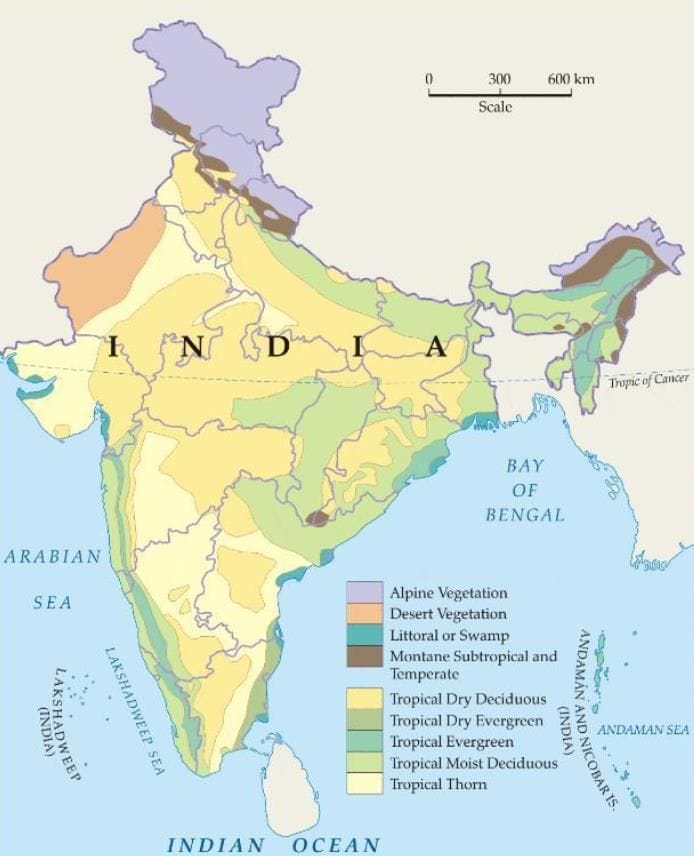
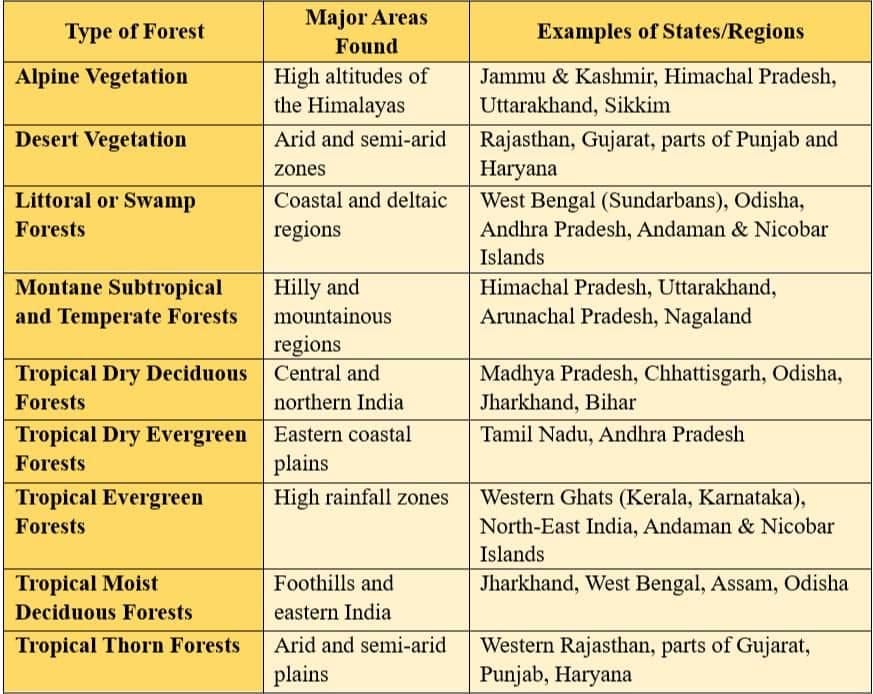
(ii) Write about the economic importance of forests for the country.
Ans: Forests are vital for a country's economy.
- Forests provide shelter to wild animals.
- We get wood from forests.
- We get paper, grass, bamboo, medicinal herbs, rubber, tea, coffee, food items, fodder from animals, etc from trees.
- Trees play an important role in preventing soil erosion.
(iii) Prepare a historical account of the conservation of forests in India with a focus on Chipko movements in Rajasthan and Uttaranchal.
Ans: Historical Account:
1. Early Period
- In ancient India, forests were considered sacred and protected as part of religious and cultural traditions.
- Texts like the Arthashastra mention forest officers (Vanikadhyaksha) who managed forests and wildlife.
2. British Period
- During British rule, forests were exploited for timber needed for railways and shipbuilding.
- The Indian Forest Acts (1865, 1878, 1927) took away local and tribal rights, leading to people's discontent.
- Forests were used mainly for commercial purposes, not for conservation.
3. Post-Independence Efforts
- The National Forest Policy (1952) recommended that 33% of India's land should be under forest cover.
- The Forest Conservation Act (1980) controlled the use of forest land for non-forest activities.
- Later, more focus was given to afforestation, social forestry, and community participation.
Focus: The Chipko Movement
- Started in the 1970s in the Himalayan region of Uttaranchal (now Uttarakhand).
- Villagers, especially women, hugged trees to stop them from being cut.
- Leaders: Sunderlal Bahuguna, Chandi Prasad Bhatt, and Gaura Devi.
- Aim: To protect forests from commercial logging and promote sustainable use.
- Impact: It became a symbol of people's participation in environmental protection.
Chipko Movement in Rajasthan
- The roots of Chipko go back to the Bishnoi Movement (1730) in Khejarli village, Rajasthan.
- Led by Amrita Devi Bishnoi, villagers sacrificed their lives to save Khejri trees.
- Their slogan was: "A chopped head is cheaper than a felled tree."
- This act of bravery inspired later forest conservation movements like Chipko in the Himalayas.
FAQs on NCERT Solutions - Geography as a Discipline
| 1. What are the main branches of geography and how do they differ from each other? |  |
| 2. Why is geography considered both a natural science and a social science? | |
| 3. How does the concept of scale-local, regional, national, and global-matter in geographical analysis? | |
| 4. What's the difference between geographical determinism and possibilism in understanding human societies? | |
| 5. How do geographers use the scientific method and qualitative research to study human and environmental phenomena? | |





