NCERT Solutions - The Origin and Evolution of the Earth

Q1: Multiple Choice Questions:
(i) Which one of the following figures represents the age of the Earth?
(a) 4.6 million years
(b) 13.7 billion years
(c) 4.6 billion years
(d) 13.7 trillion years
Ans: (c)
(ii) Which one of the following is not related to the formation or modification of the present atmosphere?
(a) Solar winds
(b) Differentiation
(c) Degassing
(d) Photosynthesis
Ans: (b)
(iii) Life on Earth appeared around how many years before the present?
(a) 13.7 billion
(b) 3.8 million
(c) 4.6 billion
(d) 3.8 billion
Ans: (b)
Q2: Answer the following questions in about 30 words.
(i) What is meant by the process of differentiation?
Ans: The process by which Earth-forming material got separated into different layers is called differentiation. Starting from the surface to the central parts, we have layers like the crust, mantle, outer core and inner core. From the crust to the core, the density of the material increases.
(ii) What was the nature of the Earth's surface initially?
Ans: The planet Earth initially was a barren, rocky and hot object with a thin atmosphere of hydrogen and helium. This is far from the present-day picture of the Earth.
(iii) What were the gases which initially formed the Earth's atmosphere?
Ans: Hydrogen and helium were the gases which initially formed the Earth's atmosphere. The early atmosphere, with hydrogen and helium, is supposed to have been stripped off as a result of the solar winds. During the cooling of the Earth, gases and water vapour were released from the interior solid Earth. This started the evolution of the present atmosphere.
Q3: Answer the following questions in about 150 words.
(i) Write an explanatory note on the 'Big Bang Theory'.
Ans: The Big Bang Theory, also known as the Expanding Universe Hypothesis, is the most accepted explanation for the origin of the universe.
- In 1920, Edwin Hubble provided evidence that galaxies are moving away from each other, proving that the universe is expanding.
- According to the theory, all matter once existed in a tiny, dense, and extremely hot mass called a singular atom.
- Around 13.7 billion years ago, this mass exploded violently, an event known as the Big Bang, causing a rapid expansion of the universe.
- Within the first three minutes, the first atoms began to form.
- About 300,000 years later, the temperature dropped to around 4,500 K, allowing the formation of atomic matter and making the universe transparent.
- The expansion continues even today, showing that the universe is still evolving and galaxies are moving farther apart.
(ii) List the stages in the evolution of the Earth and explain each stage in brief.
Ans: The evolution of the Earth took place through three main stages, each marking a major transformation.
Stage I - Formation of Layers (Lithosphere):
- The early Earth was in a molten and volatile state.
- Increasing density and temperature caused heavier elements like iron and nickel to sink to the core and lighter ones to rise to the surface.
- Through differentiation, the crust, mantle, outer core, and inner core were formed.
Stage II - Evolution of Atmosphere and Oceans:
- The primordial atmosphere of hydrogen and helium was lost due to solar winds.
- Through volcanic eruptions (degassing), gases and water vapour escaped from the interior.
- As the Earth cooled, condensation and rainfall formed oceans and a new atmosphere.
Stage III - Origin of Life:
- About 3,800 billion years ago, life began through chemical reactions, forming complex organic molecules.
- Photosynthetic organisms later released oxygen, enriching the atmosphere and enabling further evolution.
Project work
Collect information about the project "Stardust" (website: www.sci.edu/public.html and www.nasm.edu) along the following lines.
(i) Which is the agency that has launched this project?
Ans: The Stardust Project was launched by the National Aeronautics and Space Administration (NASA) under its Discovery Program of low-cost planetary missions. The spacecraft was managed by NASA's Jet Propulsion Laboratory (JPL), and the spacecraft was built by Lockheed Martin Astronautics.
(ii) Why are scientists interested in collecting Stardust?
Ans: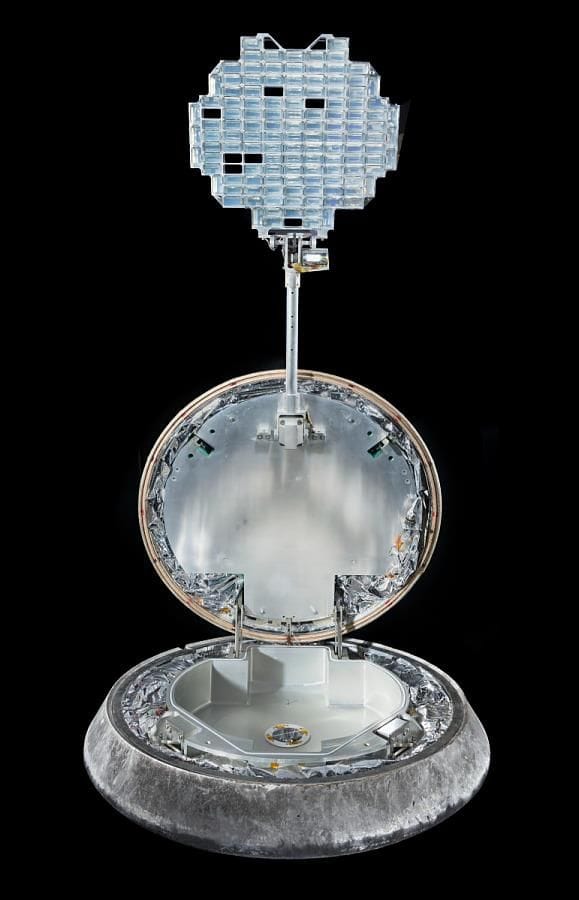
Scientists are interested in collecting "stardust" because:
- Stardust particles (cometary and interstellar dust) are among the oldest materials in the solar system.
- These particles preserve information about the early formation of the Sun, planets, and other celestial bodies.
- Studying their composition helps scientists understand the origin of organic molecules and the conditions that led to life on Earth.
- The Stardust mission was the first to bring samples from beyond the Moon's orbit back to Earth, allowing direct laboratory analysis.
(iii) Where from the Stardust being collected?
Ans:
- The Stardust spacecraft collected samples from the coma (dust cloud) of the comet 81P/Wild 2 during its flyby in January 2004.
- It also gathered interstellar dust particles that passed through the solar system on their way to the comet.
- These samples were captured using a unique material called aerogel, which gently trapped dust particles without damaging them.
- The collected samples were returned to Earth in January 2006, landing in Utah, USA.
References
- NASA Science - Stardust Mission Overview: https://science.nasa.gov/mission/stardust
- NASA Jet Propulsion Laboratory - Mission Details: https://www.jpl.nasa.gov/missions/stardust
- Smithsonian National Air and Space Museum - Stardust Capsule Exhibit (replacement for www.nasm.edu): https://airandspace.si.edu/collection-objects/capsule-stardust/nasm_A20080417000
- (Note) The older websites www.sci.edu/public.html and www.nasm.edu mentioned in older textbooks are no longer active; their materials are now hosted on the updated NASA and Smithsonian domains listed above.
FAQs on NCERT Solutions - The Origin and Evolution of the Earth
| 1. How did the Earth originate according to scientific theories? |  |
| 2. What is the process of Earth's evolution over time? | |
| 3. How do scientists study the origin and evolution of the Earth? | |
| 4. What role did the early atmosphere play in shaping the Earth's evolution? | |
| 5. How has the study of the Earth's origin and evolution helped us understand planetary systems beyond our own? | |