NCERT Solutions - Interior of the Earth

Q1: Multiple choice questions.
(i) Which one of the following Earthquake waves is more destructive?
(a) P-waves
(b) S-waves
(c) Surface waves
(d) None of the above
Ans: (c)
Explanation: Surface waves travel along the Earth's crust and usually have the largest amplitudes and longest durations. They produce both vertical and horizontal ground movement, causing the greatest damage to buildings and landforms compared with body waves.
(ii) Which one of the following is a direct source of information about the interior of the Earth?
(a) Earthquake waves
(b) Volcanoes
(c) Gravitational force
(d) Earth magnetism
Ans: (a)
Explanation: Earthquake (seismic) waves are a direct source because their speeds and paths change as they pass through different layers, allowing scientists to infer internal structure. Volcanoes also provide material from depth, but seismic waves permit remote probing of the whole interior.
(iii) Which type of volcanic eruptions have caused the Deccan Trap formations?
(a) Shield
(b) Flood
(c) Composite
(d) Caldera
Ans: (b)
Explanation: The Deccan Traps were formed by extensive flood basalt eruptions. Large volumes of low-viscosity basaltic lava issued through fissures and spread over wide areas, producing thick, layered basalt flows that now form the trap landscape.
(iv) Which one of the following describes the lithosphere:
(a) upper and lower mantle
(b) crust and upper mantle
(c) crust and core
(d) mantle and core
Ans: (b)
Explanation: The lithosphere is the rigid outer shell of the Earth made up of the crust and the uppermost part of the mantle. It forms the tectonic plates that move over the more ductile asthenosphere.
Q2: Answer the following questions in about 30 words.
(i) What are body waves?
Ans: Body waves are earthquake waves generated at the focus that travel through the body of the earth in all directions.
They are of two types-Primary (P) waves and Secondary (S) waves.
(ii) Name the direct sources of information about the interior of the Earth.
Ans: The direct sources include materials obtained from mining, deep drilling projects like the Kola Borehole, and volcanic eruptions that bring magma to the surface for analysis.
(iii) Why do Earthquake waves develop a shadow zone?
Ans: Earthquake waves produce shadow zones because they behave differently while passing through the Earth's internal layers. P-waves are refracted sharply at the core-mantle boundary, creating a shadow zone between 105° and 145° from the epicentre. S-waves completely disappear beyond 105° since they cannot travel through the Earth's liquid outer core.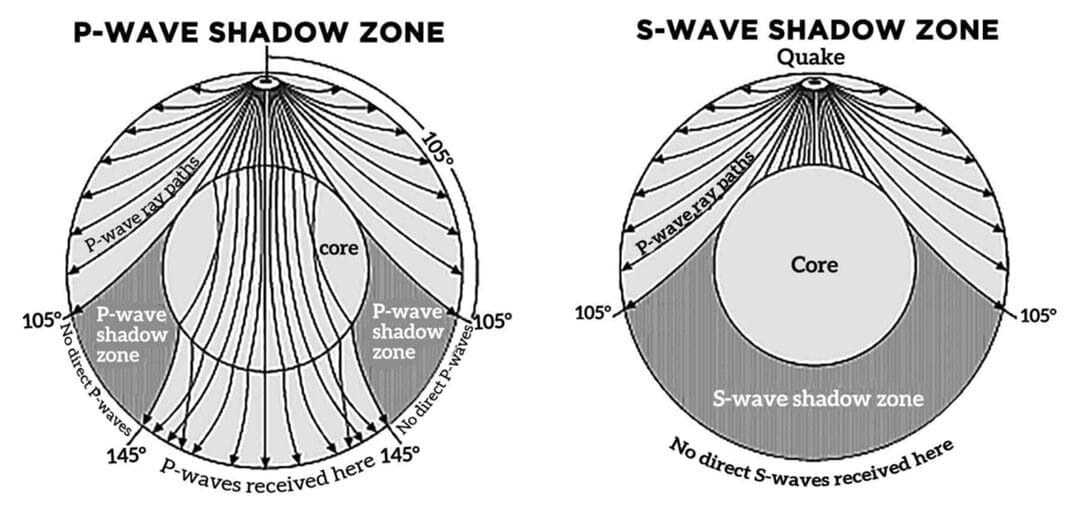
(iv) Briefly explain the indirect sources of information of the interior of the Earth other than those of seismic activity.
Ans: Indirect sources include variations in temperature, pressure, and density with depth; gravitational and magnetic field studies; and analysis of meteors that have a composition similar to that of the Earth.
Q3: Answer the following questions in about 150 words.
(i) What are the effects of the propagation of Earthquake waves on the rock mass through which they travel?
Ans: The earthquake waves cause vibrations in the body of the rocks through which they pass. These vibrations disturb the equilibrium of the rocks and result in stretching, compression, and displacement of the materials.
- P-waves (Primary waves) are the fastest and move through solid, liquid, and gaseous materials. They vibrate parallel to the direction of the wave, exerting pressure and creating density differences. This produces alternate stretching and squeezing of the rock mass, leading to temporary compression.
- S-waves (Secondary waves) are slower and can travel only through solids. They vibrate perpendicular to the direction of propagation, creating crests and troughs in the rock layers. Their movement distorts the rock mass and contributes to the overall shaking effect of an earthquake.
- Surface waves, generated when body waves reach the surface, travel along the Earth's crust. They cause the most damage because they produce horizontal and vertical displacements, shaking buildings and altering landforms severely.
(ii) What do you understand by intrusive forms? Briefly describe various intrusive forms.
Ans: When magma from the Earth's interior cools and solidifies below the surface, it forms intrusive igneous rocks. These structures are known as intrusive forms because they develop beneath the Earth's crust rather than on the surface. Their shapes and sizes depend on the nature of the molten material and the structure of the surrounding rocks.
- Batholiths: Massive dome-shaped bodies formed deep within the crust; they represent cooled magma chambers and are the largest intrusive forms.
- Laccoliths: Dome-shaped with a flat base, connected to the magma source through a pipe-like conduit.
- Lapoliths: Saucer-shaped bodies concave upward, formed when magma moves horizontally and settles in a curved manner.
- Phacoliths: Wavy bodies of magma that occupy the crests of anticlines or the troughs of synclines.
- Sills: Nearly horizontal sheets of magma intruded parallel to existing rock layers.
- Dykes: Vertical walls formed when magma fills cracks or fissures and solidifies.
FAQs on NCERT Solutions - Interior of the Earth
| 1. What are the different layers of the Earth's interior? |  |
| 2. How do scientists study the interior of the Earth? | |
| 3. What is the temperature and pressure like in the Earth's interior? | |
| 4. How do the different layers of the Earth's interior affect plate tectonics? | |
| 5. What role does the Earth's inner core play in the planet's magnetic field? | |





