NCERT Solutions - Composition and Structure of Atmosphere

Q1: Multiple choice questions.
(i) Which one of the following gases constitutes the major portion of the atmosphere?
(a) Oxygen
(b) Nitrogen
(c) Argon
(d) Carbon dioxide
Ans: (b)
Explanation: Nitrogen is the most abundant gas in Earth's atmosphere, making up about 78% of the dry air. It is relatively inert and forms the bulk of the atmospheric mass, far exceeding oxygen, argon and other trace gases.
(ii) Atmospheric layer important for human beings is:
(a) Stratosphere
(b) Mesosphere
(c) Troposphere
(d) Ionosphere
Ans: (c)
Explanation: The troposphere is the lowest layer of the atmosphere where almost all weather phenomena occur, where water vapour and dust are found, and where people, animals and plants live.
(iii) Sea salt, pollen, ash, smoke soot, fine soil - these are associated with:
(a) Gases
(b) Dust particles
(c) Water vapour
(d) Meteors
Ans: (b)
Explanation: Sea salt, pollen, ash, smoke soot and fine soil are examples of particulate matter or dust particles suspended in the air; they are solid or liquid particles, not gases or water vapour.
(iv) Oxygen gas is in negligible quantity at the height of atmosphere:
(a) 90 km
(b) 120 km
(c) 100 km
(d) 150 km
Ans: (b)
Explanation: The concentration of oxygen falls rapidly with altitude. Above roughly 100-120 km the oxygen available in molecular form becomes negligible because the atmosphere is extremely thin and atomic and ionised forms predominate.
(v) Which one of the following gases is transparent to incoming solar radiation and opaque to outgoing terrestrial radiation?
(a) Oxygen
(b) Nitrogen
(c) Helium
(d) Carbon dioxide
Ans: (d)
Explanation: Carbon dioxide is a greenhouse gas: it allows most short-wave solar radiation to pass through but absorbs and re-emits long-wave (terrestrial) radiation, thereby trapping heat in the lower atmosphere.
Q2: Answer the following questions in about 30 words.
(i) What do you understand by atmosphere?
Ans: The atmosphere is the layer of gases that surrounds the Earth. It is a mixture of nitrogen, oxygen, argon and other gases, together with water vapour and dust, and it supports life.
(ii) What are the elements of weather and climate?
Ans: The main elements of weather and climate are temperature, atmospheric pressure, winds, humidity, cloudiness and precipitation. These elements together determine short-term weather and long-term climate patterns.
(iii) Describe the composition of atmosphere.
Ans: The atmosphere consists of gases, water vapour and dust particles. Major components by volume are nitrogen (about 78.08%), oxygen (about 20.95%) and argon (about 0.93%). Other trace gases include carbon dioxide, neon, helium, krypton and xenon.
(iv) Why is troposphere the most important of all the layers of the atmosphere?
Ans: Troposphere is the most important layer of the atmosphere:
- All changes in weather and climate occur in this layer.
- It contains most of the atmospheric water vapour and dust particles that affect weather.
- All biological activities of humans, animals and plants take place within or close to this layer.
Q3: Answer the following questions in about 150 words.
(i) Describe the composition of the atmosphere.
Ans: The atmosphere is a mixture of gases, water vapour and dust particles. Its main components are:
- Nitrogen: approximately 78.08%
- Oxygen: approximately 20.95%
- Argon: approximately 0.93%
Other gases present in trace amounts include carbon dioxide, neon, helium, methane, hydrogen, krypton, xenon and ozone. Nitrogen and oxygen together account for the vast majority of dry air. Water vapour varies in amount with location and weather and is mostly confined to the lower atmosphere. Carbon dioxide, although a small fraction, plays an important role in the greenhouse effect by absorbing outgoing long-wave radiation; its concentration has risen due to human activities such as the burning of fossil fuels.
(ii) Draw a suitable diagram for the structure of the atmosphere and label it and describe it.
Ans: The atmosphere is divided into layers based on temperature changes with height. A suitable labelled diagram would show the following layers from the surface upward.
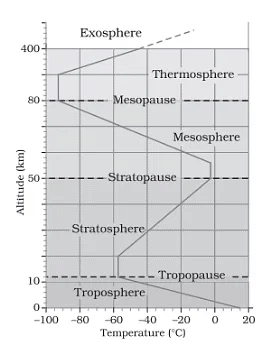
- Troposphere: The lowest layer, averaging about 13 km in height, reaching roughly 8 km near the poles and about 18 km at the equator. It has the greatest thickness at the equator due to strong convection. This layer contains dust and water vapour, and all ordinary weather phenomena occur here. Temperature generally falls with height at about 1°C for every 165 m.
- Stratosphere: Extending from the tropopause up to about 50 km. It contains the ozone layer, which absorbs harmful ultraviolet radiation from the Sun and thus protects life on Earth. Temperature in this layer increases with height in the upper stratosphere because of ozone absorption of radiation.
- Mesosphere: Above the stratosphere and extending up to about 80 km. Temperature again decreases with height in this layer and can fall to around -100°C near its upper boundary.
- Ionosphere (part of the upper atmosphere/thermosphere region): Located roughly between 80 km and 400 km, this region contains ions and free electrons produced by solar radiation. It reflects some radio waves, aiding long-distance radio communication, and temperature increases with height here.
- Exosphere: The outermost layer above the thermosphere, where the atmosphere thins out into space. Gas molecules are very sparse and can travel long distances without colliding; little is known about detailed processes in this faint outer region.
FAQs on NCERT Solutions - Composition and Structure of Atmosphere
| 1. What are the main gases that make up Earth's atmosphere and their percentages? |  |
| 2. How does atmospheric pressure change with altitude and why does it decrease? | |
| 3. What's the difference between the troposphere and stratosphere in terms of temperature? | |
| 4. Why does the stratosphere get warmer at higher altitudes even though it's farther from the sun? | |
| 5. How do aerosols and suspended particles affect atmospheric composition and visibility? | |





