NCERT Solutions - Solar Radiation, Heat Balance and Temperature

Q1: Multiple choice questions
(i) The sun is directly overhead at noon on 21st June at:
(a) The equator
(b) 23.5° S
(c) 23.5° N
(d) 66.5° N
Ans: (c)
Explanation: 21 June is the summer solstice in the Northern Hemisphere when the Sun reaches its northernmost declination of 23.5° N, the Tropic of Cancer. Therefore, at local noon on this date the Sun is overhead at 23.5° N.
(ii) In which one of the following cities, are the days the longest?
(a) Tiruvanantpuram
(b) Chandigarh
(c) Hyderabad
(d) Nagpur
Ans: (b)
Explanation: Day length varies with latitude; higher latitudes in the Northern Hemisphere have longer summer days. Among the listed cities, Chandigarh is at the highest latitude and therefore experiences the longest daylight hours, especially around the summer months.
(iii) The atmosphere is mainly heated by the:
(a) Short wave solar radiation
(b) Reflected solar radiation
(c) Long wave terrestrial radiation
(d) Scattered solar radiation
Ans: (c)
Explanation: The Sun supplies shortwave radiation to the Earth-atmosphere system, but much of the atmosphere is warmed by longwave (infra-red) radiation emitted from the heated surface. The surface absorbs solar energy and re-radiates it as longwave radiation, which is then absorbed by atmospheric gases and clouds, warming the atmosphere.
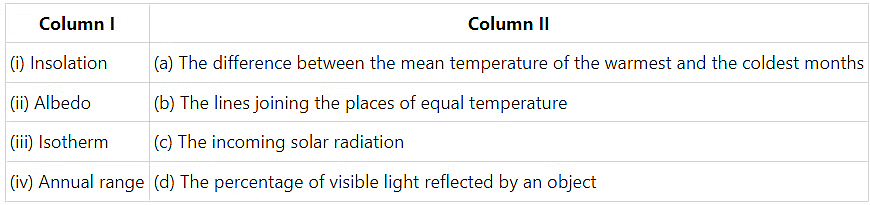
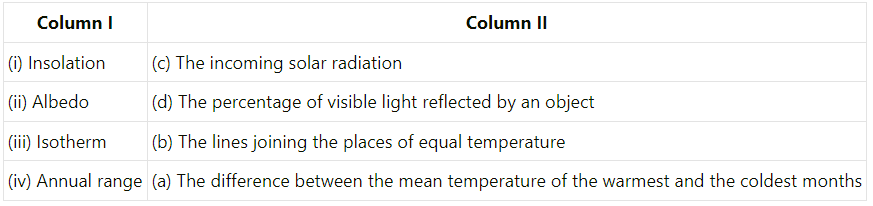
(iv) Make correct pairs from the following two columns.
Ans:
(v) The main reason that the earth experiences highest temperatures in the subtropics in the northern hemisphere rather than at the equator is:
(a) Subtropical areas tend to have less cloud cover than equatorial areas.
(b) Subtropical areas have longer day hours in the summer than the equatorial.
(c) Subtropical areas have an enhanced "green house effect" compared to equatorial areas.
(d) Subtropical areas are nearer to the oceanic areas than the equatorial locations.
Ans: (a)
Explanation: Many subtropical regions (around 25°-35° latitude) are dominated by descending dry air and clear skies, which reduce cloud cover and allow more solar radiation to reach the surface. This greater incoming shortwave radiation and reduced evaporative cooling often produce higher surface temperatures than at the equator, where persistent cloudiness and convection limit surface heating.
Q2: Answer the following questions in about 30 words.
(i) How does the unequal distribution of heat over the planet earth in space and time cause variations in weather and climate?
Ans: Unequal solar heating produces pressure differences between regions. These pressure gradients drive winds and atmospheric circulation, which redistribute heat and moisture and produce variations in weather and long-term climate patterns.
(ii) What are the factors that control temperature distribution on the surface of the earth?
Ans: The factors that control temperature distribution on the surface of the earth are:
- The latitude of the place
- The altitude of the place
- Distance from the sea, the airmass circulation
- The presence of warm and cold ocean currents
- Local aspects
(iii) In India, why is the day temperature maximum in May and why not after the summer solstice?
Ans: In India the highest daytime temperatures usually occur in May because the land has been heating through the pre-monsoon period under clear skies. After the summer solstice, the southwest monsoon advances, bringing clouds, rain and increased humidity that reduce daytime insolation and cause temperatures to fall.
(iv) Why is the annual range of temperature high in the Siberian plains?
Ans: The Siberian plains are far from oceanic influence and have a continental climate; very cold winters (often well below -20°C) and comparatively warm summers (above 10°C) produce a very large annual temperature range.
Q3: Answer the following questions in about 150 words.
(i) How do the latitude and the tilt in the axis of rotation of the earth affect the amount of radiation received at the earth's surface?
Ans: Latitude and the axial tilt together control the angle at which solar rays strike the surface and the seasonality of incoming radiation. At low latitudes the Sun is generally higher in the sky for much of the year, so solar rays are more direct and energy per unit area is larger. As latitude increases, the Sun's rays arrive at a more oblique angle and are spread over a larger surface, reducing the energy received. The Earth's axis is tilted by about 23.5°, which causes seasonal changes: during one hemisphere's summer the axial tilt brings that hemisphere closer in orientation to the Sun, increasing day length and the Sun's elevation and so raising radiation received; during winter the tilt reduces solar elevation and day length, lowering received radiation. On equinoxes the Sun is overhead at the equator, while on the solstices it is overhead at the Tropic of Cancer or the Tropic of Capricorn. Thus, both latitude and axial tilt determine the spatial and temporal distribution of solar radiation and drive the climatic zones.
(ii) Discuss the processes through which the earth-atmosphere system maintains heat balance.
Ans:
- Radiation: The primary source of energy is incoming shortwave solar radiation. The earth-atmosphere system emits outgoing longwave terrestrial radiation. Global heat balance is achieved when incoming shortwave equals outgoing longwave, after accounting for reflected solar radiation (albedo) and energy stored or transported within the system.
- Conduction: The warmed ground transfers heat by conduction to the air in immediate contact with the surface. This process is important very close to the surface and helps heat the lowest layers of the atmosphere.
- Convection: When surface air warms, it becomes buoyant and rises, carrying heat vertically into the atmosphere. Convection creates vertical mixing and is a key process in transferring surface heat through the troposphere, often forming clouds and storms in the process.
- Advection: Horizontal movement of air masses (advection) redistributes heat and moisture across regions. Winds move warm air toward cooler regions and cold air toward warmer regions, moderating temperature differences over large distances.
- Latent and Sensible Heat Transport: Evaporation of water consumes energy (latent heat) which is carried aloft and released on condensation, redistributing heat vertically and horizontally. Sensible heat fluxes (direct heat transfer between surface and air) also contribute to the surface energy budget.
Together these processes - radiation, conduction, convection, advection and latent/sensible heat transfers and interactions with land, ocean and clouds maintain the dynamic heat balance of the earth-atmosphere system.
(iii) Compare the global distribution of temperature in January over the northern and the southern hemisphere of the earth.
Ans: In January the Northern Hemisphere is in winter and the Southern Hemisphere in summer, producing contrasting temperature patterns. The Northern Hemisphere has a larger land area, and land cools and warms more rapidly than ocean; hence isotherms show greater distortion and larger temperature contrasts over continents. Cold continental masses in Eurasia and North America push isotherms toward lower latitudes. Over the North Atlantic, warm ocean currents (Gulf Stream and North Atlantic Drift) raise sea temperatures and bend isotherms poleward. In the Southern Hemisphere, oceans dominate and temperatures vary more gradually; isotherms are more nearly parallel to the latitudes because maritime influence moderates extremes. Thus, January isotherms reflect strong continentality and sharper gradients in the north, and milder, smoother patterns in the south, illustrated by the southward progression of similar temperature lines at higher latitudes (for example, 20°C, 10°C and 0°C isotherms occur farther poleward in the southern oceanic regions).
FAQs on NCERT Solutions - Solar Radiation, Heat Balance and Temperature
| 1. What is solar radiation and how does it impact the Earth's temperature? |  |
| 2. How does the Earth maintain heat balance despite receiving solar radiation? | |
| 3. What factors affect the temperature of a particular region on Earth? | |
| 4. How does the greenhouse effect contribute to the Earth's temperature regulation? | |
| 5. How do scientists measure solar radiation and its impact on the Earth's temperature? | |





