
JIPMER: Subject wise Tests & Practice JIPMER Aptitude Mock Test 3 Free
Full Mock Test & Solutions: JIPMER Aptitude Mock Test 3 (10 Questions)
You can boost your NEET 2026 exam preparation with this JIPMER Aptitude Mock Test 3 (available with detailed solutions).. This mock test has been designed with the analysis of important topics, recent trends of the exam, and previous year questions of the last 3-years. All the questions have been designed to mirror the official pattern of NEET 2026 exam, helping you build speed, accuracy as per the actual exam.
Mock Test Highlights:
- - Format: Multiple Choice Questions (MCQ)
- - Duration: 8 minutes
- - Total Questions: 10
- - Analysis: Detailed Solutions & Performance Insights
Sign up on EduRev for free and get access to these mock tests, get your All India Rank, and identify your weak areas to improve your marks & rank in the actual exam.

The town of Paranda is located on Green lake. The town of Akram is West of Paranda. Tokhada is East of Akhram but West of Paranda. Kakran is East of Bopri but West of Tokhada and Akram. If they are all in the same district, which town is the farthest in West?
Detailed Solution: Question 1
Study the following diagram:
There are hard - working workers who are members of the union but not working in factories. Which number indicate this section of workers in the above diagram?
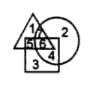
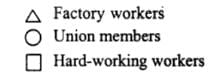
There are hard - working workers who are members of the union but not working in factories. Which number indicate this section of workers in the above diagram?

Arrange the words given below in a meaningful sequence.
1. Index 2. Contents 3. Title 4. Chapters 5. Introduction
1. Index 2. Contents 3. Title 4. Chapters 5. Introduction
If x stands for 'addition', ÷ stands for 'subtraction', + stands for 'multiplication' and - stands for 'division', then
20 x 8 ÷ 8 - 4 + 2 = ?
20 x 8 ÷ 8 - 4 + 2 = ?
Detailed Solution: Question 4
Detailed Solution: Question 5
Which is the Number that comes next in the series:
22, 21, 23, 22, 24, 23, .?
22, 21, 23, 22, 24, 23, .?
Detailed Solution: Question 6
Count each 1 in the following sequence of numbers that is immediately followed by 2, if 2 is not immediately followed by 3. How many such 1's are there ?
1 2 1 3 4 5 1 2 3 5 2 1 2 6 1 4 5 1 1 2 4 1 2 3 2 1 7 5 2 1 2 5
1 2 1 3 4 5 1 2 3 5 2 1 2 6 1 4 5 1 1 2 4 1 2 3 2 1 7 5 2 1 2 5
Detailed Solution: Question 7
In a class of 35 students, Mohit is placed seventh from the bottom whereas Sunil is placed ninth from the top. Manoj is placed exactly in between the two. What is Mohit’s position from Manoj?
In the following questions, the symbols @, #, $, % and © are used with the following meaning as illustrated below:
'P @ Q' means 'P is smaller than Q'.
'P # Q' means 'P is either smaller than or equal to Q'.
'P $ Q' means 'P is greater than Q'.
'P % Q' means 'P is either greater than or equal to Q'.
'P © Q' means 'P is neither greater than nor smaller than Q'.
Now in each of the following questions assuming the given statements to be true, find out which of the two conclusions I and II given below them is/are definitely true?
Give answer (1) if only Conclusion I is true.
Give answer (2) if only Conclusion II is true.
Give answer (3) if either Conclusion I or II is true.
Give answer (4) if neither Conclusion I nor II is true.
Give answer (5) if both conclusions I and II are true.
Q. Statements : M @ R, R © F, F # L
Conclusions : I. M @ L
II. R @ L
Options
'P @ Q' means 'P is smaller than Q'.
'P # Q' means 'P is either smaller than or equal to Q'.
'P $ Q' means 'P is greater than Q'.
'P % Q' means 'P is either greater than or equal to Q'.
'P © Q' means 'P is neither greater than nor smaller than Q'.
Now in each of the following questions assuming the given statements to be true, find out which of the two conclusions I and II given below them is/are definitely true?
Give answer (1) if only Conclusion I is true.
Give answer (2) if only Conclusion II is true.
Give answer (3) if either Conclusion I or II is true.
Give answer (4) if neither Conclusion I nor II is true.
Give answer (5) if both conclusions I and II are true.
Conclusions : I. M @ L
II. R @ L
Below are the statements followed by two conclusions numbered I and II. You have to consider the statements and the following conclusions and decide which of the conclusion(s) follows the statement(s).
Statements:
a.All jugs are plates.
b. All plates are cups.
c.All cups are bottles.
Conclusions :
I. Some bottles are jugs.
II. All plates are bottles.
a.All jugs are plates.
b. All plates are cups.
c.All cups are bottles.
Conclusions :
I. Some bottles are jugs.
II. All plates are bottles.
3 videos|8 docs|51 tests |
3 videos|8 docs|51 tests |
