NEET Exam  >  NEET Test  >  Topic-wise MCQ Tests  >  31 Years NEET Previous Year Questions: Heredity And Variation - 2 - NEET MCQ

31 Years NEET Previous Year Questions: Heredity And Variation - 2 Free


MCQ Practice Test & Solutions: 31 Years NEET Previous Year Questions: Heredity And Variation - 2 (20 Questions)

You can prepare effectively for NEET Topic-wise MCQ Tests for NEET with this dedicated MCQ Practice Test (available with solutions) on the important topic of "31 Years NEET Previous Year Questions: Heredity And Variation - 2". These 20 questions have been designed by the experts with the latest curriculum of NEET 2026, to help you master the concept.

Test Highlights:

  • - Format: Multiple Choice Questions (MCQ)
  • - Duration: 25 minutes
  • - Number of Questions: 20

Sign up on EduRev for free to attempt this test and track your preparation progress.

31 Years NEET Previous Year Questions: Heredity And Variation - 2 - Question 1

The incorrect statement with regard to Haemophilia is :

[NEET 2013]

Detailed Solution: Question 1

Haemophilia is sex linked recesive disease in which a simple protein that is a part of protein cascade involved in clotting of blood is affected. Due to this, in an affected individual a simple cut will result in non stop bleeding.

31 Years NEET Previous Year Questions: Heredity And Variation - 2 - Question 2

Which of the following statements is not true of two genes that show 50% recombination frequency?

[NEET 2013]

Detailed Solution: Question 2

Tightly linked genes exhibit a strong association, leading to a higher frequency of parental gene combinations compared to non-parental types. This is due to the physical proximity of the genes on the same chromosome, which reduces the likelihood of crossovers during meiosis.

  • Independent assortment occurs when genes are not linked, allowing for a mix of traits in offspring.
  • If genes are located on the same chromosome, they may experience multiple crossovers, resulting in varied combinations.
  • Genes with a recombination frequency of 50% can be on different chromosomes or far apart on the same chromosome.

In summary, genes that show 50% recombination frequency are not tightly linked, as they can assort independently or be located on different chromosomes.

31 Years NEET Previous Year Questions: Heredity And Variation - 2 - Question 3

Which Mendelian idea is depicted by a cross in which the F1 generation resembles both the parents?

[NEET 2013]

Detailed Solution: Question 3

In Co-dominance F1 generation resemble both the parents. Ex : Blood group inheritance.

31 Years NEET Previous Year Questions: Heredity And Variation - 2 - Question 4

If two persons with ‘AB’ blood group marry and have sufficiently large number of children these children could be classified as ‘A’ blood group: ‘AB’ blood group: ‘B’ blood group in 1 : 2 : 1 ratio. Modern technique of protein electrophoresis reveals presence of both ‘A’ and ‘B’ type proteins in ‘AB’ blood group individuals. This is an example of :              

[NEET 2013]

Detailed Solution: Question 4

ABO blood group system in human beings is an example of codominant, dominant recessive and multiple alletes. Blood groups are controlled by the gene I located on 9th chromosome that has 3 multiple alleles, out of which any two are found in a person. In codominance both gene express it self completely.

31 Years NEET Previous Year Questions: Heredity And Variation - 2 - Question 5

A test cross is carried out to

[2012M]

Detailed Solution: Question 5

A test cross, first introduced by Gregor Mendel, is used to determine if an individual exhibiting a dominant trait is homozygous or heterozygous for that trait. It takes place between F1 - Generation and recessive parent.

31 Years NEET Previous Year Questions: Heredity And Variation - 2 - Question 6

Which one of the following is a wrong statement regarding mutations?

[2012M]

Detailed Solution: Question 6

Change in single base pair of DNA is also a type of mutations called point mutations. It is a type of mutation that causes the replacement of a single base nucleotide with another nucleotide of the genetic material, DNA or RNA. For example, a point mutation is the cause of sickle cell disease.

31 Years NEET Previous Year Questions: Heredity And Variation - 2 - Question 7

A normal-visioned man whose father was colour¬blind, marries a woman whose father was also colour-blind. They have their first child as a daughter. What are the chances that this child would be colour-blind? [2012]

Detailed Solution: Question 7
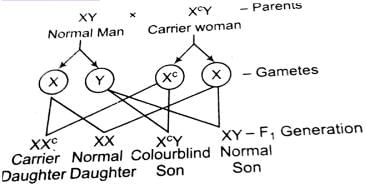
Colour blindness is a X-linked disease. So, woman whose father was colourblind will be carrier for the disease. So, possibility of a colourblind daughter (i.e., XcXc in F1 generation is 0%.)

31 Years NEET Previous Year Questions: Heredity And Variation - 2 - Question 8

A certain road accident patient with unknown blood group needs immediate blood transfusion. His one doctor friend at once offers his blood.What was the blood group of the donor?

[2012]

Detailed Solution: Question 8

Blood group O is known as the universal donor. This means that individuals with this blood group can donate blood to anyone, regardless of the recipient's blood type.

  • Blood group O contains no A or B antigens.
  • This absence prevents any adverse reactions during transfusions.
  • Therefore, the donor's blood group must be O.

31 Years NEET Previous Year Questions: Heredity And Variation - 2 - Question 9

Which one of the following conditions of the zygotic cell would lead to the birth of a normal human female child ?

[2011M]

Detailed Solution: Question 9

Two X chromosomes would lead to the birth of a normal human female child.

The sex of a child is determined by the combination of chromosomes inherited from the parents:

  • Females have two X chromosomes (XX).
  • Males have one X and one Y chromosome (XY).

During fertilisation:

  • The ovum from the female always carries an X chromosome.
  • The sperm from the male can carry either an X or a Y chromosome.

If the sperm carrying an X chromosome fertilises the ovum, the zygote will develop into a female (XX). Thus, the presence of two X chromosomes is essential for a normal female child.

31 Years NEET Previous Year Questions: Heredity And Variation - 2 - Question 10

Test cross in plants or in Drosophila involves crossing

[2011M]

Detailed Solution: Question 10

In test cross, genotype of an organism showing dominant phenotype is determined by crossing it with homozygous recessive genotype.

31 Years NEET Previous Year Questions: Heredity And Variation - 2 - Question 11

A person with unknown blood group under ABO system, has suffered much blood loss in an accident and needs immediate blood transfusion. His one friend who has a valid certificate of his own blood type offers blood donation without delay. What would have been the type of blood group of the donor friend?

[2011]

Detailed Solution: Question 11

Type Oblood group is considered the universal donor blood group. It can potentially be transfused to any patient regardless of their blood type. In emergency situation, this type of blood can be given to the patient.

31 Years NEET Previous Year Questions: Heredity And Variation - 2 - Question 12

Mutations can be induced with :

[2011]

Detailed Solution: Question 12

Mutation can be induced by gamma radiation.

Gamma radiation is a type of high-energy radiation that can cause changes in the DNA of organisms. Here are some key points:

  • Gamma radiation can lead to mutations, which are alterations in the genetic material.
  • These mutations can affect an organism's traits and may be passed on to future generations.
  • Other forms of radiation, such as UV radiation, can also induce mutations.

Understanding the effects of gamma radiation is important in fields such as genetics and cancer research.

31 Years NEET Previous Year Questions: Heredity And Variation - 2 - Question 13

Which one of the following conditions correctly describes the manner of determining the sex in the given example?

[2011]

Detailed Solution: Question 13

In grasshopper the males lack a Y-sex chromosome and have only an X-chromosome. They produce sperm cells that contain either an X chromosome or no sex chromosome, which is designated as O.

31 Years NEET Previous Year Questions: Heredity And Variation - 2 - Question 14

Select the correct statement from the ones given below with respect to dihybrid cross.

[2010]

Detailed Solution: Question 14

Linkage is the inheritance of genes of same chromosome together and capacity of these genes to retain their parental combination in subsequent generation. The strength of linkage between two genes is inversely proportional to the distance between the two. This means, two linked genes show higher frequency of recombination if the distance between them is higher and lower frequency if the distance is smaller.

31 Years NEET Previous Year Questions: Heredity And Variation - 2 - Question 15

The genotype of a plant showing the dominant phenotype can be determined by :

[2010]

Detailed Solution: Question 15

Test cross is the cross of an individual with an individual having recessive phenotype. It is used to determine the genotype of a plant showing the dominant phenotype, that means to determine whether the individual exhibiting dominating characters are homozygous or heterozygous.

31 Years NEET Previous Year Questions: Heredity And Variation - 2 - Question 16

Which one of the following can not be explained on the basis of Mendel’s Law of Dominance?

[2010]

Detailed Solution: Question 16

According to Mendel’s law of Dominance, out of two contrasting allelomorphic factors only one expresses itself in an individual. The factor that expresses itself is called dominant while the other which has not shown its effect in the heterozygous individual is termed as recessive. The option (c) in the given question cannot be explain-ed on the basis of law of dominance. It can only be explained on the basis of Mendel’s Law of independent assortment, according to which in a dihybrid cross, the two alleles of each character assort independently of the alleles of other character and separate at the time of gamete formation.

31 Years NEET Previous Year Questions: Heredity And Variation - 2 - Question 17

Point mutation involves:

[2009]

Detailed Solution: Question 17

A point mutation is a simple change in one base of the gene sequence. This is equivalent to changing one letter in a sentence, such as this example, where we change the ‘e’ in cat to an ‘h’: Original: The fat cat ate the wee rat. Point Mutation: The fat hat ate the wee rat.

31 Years NEET Previous Year Questions: Heredity And Variation - 2 - Question 18

Sickle cell anaemia is:

[2009]

Detailed Solution: Question 18

Option B is correct.

Sickle cell anaemia results from a single base substitution (point mutation) in the β-globin gene, which changes the codon GAG to GUG.

This base change causes the substitution of glutamic acid (Glu) by valine (Val) at the 6th amino acid position of each β-globin chain, converting normal haemoglobin (HbA) into sickle haemoglobin (HbS).

Because of the hydrophobic nature of valine at that position, haemoglobin molecules polymerize under low-oxygen conditions and distort red blood cells into a sickle (elongated) shape, which impairs their flexibility and causes clinical problems.

Statement evaluations:

Statement 1 is not presented as the correct option here because it now specifies the α-globin gene, which is not the gene mutated in sickle cell anaemia; the mutation occurs in the β-globin gene.

Statement 2 correctly describes the amino acid substitution (Glu → Val at position 6 of β-globin) and is therefore true.

Statement 3 is incorrect because mature human red blood cells are anucleate; although sickled RBCs are elongated, they do not contain a nucleus.

Statement 4 is incorrect because sickle cell anaemia shows an autosomal recessive pattern of inheritance, not dominant.

Final answer: Option B.

31 Years NEET Previous Year Questions: Heredity And Variation - 2 - Question 19

Study the pedigree chart given below: What does it show?
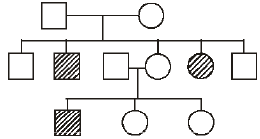
[2009]

Detailed Solution: Question 19

The chart shows the inheritance of a condition like phenylketonuria as an autosomal recessive trait. Parents’ needs to be heterozygous as two of their children are known to be sufferer of the disease. It cannot be recessive sex linked inheritance because then the male parent would also be sufferer.

31 Years NEET Previous Year Questions: Heredity And Variation - 2 - Question 20

Which one of the following conditions in humans. is correctly matched with its chromosomal abnormality/linkage?

[2008]

Detailed Solution: Question 20

Klinefelter's syndrome is a genetic disorder affecting men in which an individual gains an extra X chromosome, so that the usual Karyotype of XY is replaced by one of XXY. Symptoms of  Klinefelter's syndrome  named after us physician H.P. Klinefelter, include female characteristics (such as breast enlargement). 

8 docs|805 tests
Information about 31 Years NEET Previous Year Questions: Heredity And Variation - 2 Page
In this test you can find the Exam questions for 31 Years NEET Previous Year Questions: Heredity And Variation - 2 solved & explained in the simplest way possible. Besides giving Questions and answers for 31 Years NEET Previous Year Questions: Heredity And Variation - 2, EduRev gives you an ample number of Online tests for practice
Download as PDF