
Comprehension Based Questions: Matrices and Determinants - Free MCQ Practice
MCQ Practice Test & Solutions: Test: Comprehension Based Questions: Matrices and Determinants (13 Questions)
You can prepare effectively for JEE Crack JEE with 35 Years of Previous Year Solved Papers with this dedicated MCQ Practice Test (available with solutions) on the important topic of "Test: Comprehension Based Questions: Matrices and Determinants". These 13 questions have been designed by the experts with the latest curriculum of JEE 2026, to help you master the concept.
Test Highlights:
- - Format: Multiple Choice Questions (MCQ)
- - Duration: 20 minutes
- - Number of Questions: 13
Sign up on EduRev for free to attempt this test and track your preparation progress.

A square matrix in which all the elements except at least the one element in the diagonal are zeros is said to be a
Detailed Solution: Question 1
PASSAGE - 1
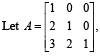 and U1, U2 and U3 are columns of a 3 × 3 matrix U. If column matrices U1, U2 and U3 satisfying
 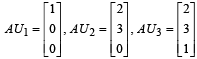 evaluate as directed in the following questions
Q. The sum of the elements of the matrix U–1 is
and U1, U2 and U3 are columns of a 3 × 3 matrix U. If column matrices U1, U2 and U3 satisfying evaluate as directed in the following questionsDetailed Solution: Question 2
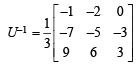


PASSAGE - 1
and U1, U2 and U3 are columns of a 3 × 3 matrix U. If column matrices U1, U2 and U3 satisfying evaluate as directed in the following questions
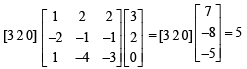
Q. The value of 
and U1, U2 and U3 are columns of a 3 × 3 matrix U. If column matrices U1, U2 and U3 satisfying evaluate as directed in the following questionsDetailed Solution: Question 3
PASSAGE - 2
Let  be the set of all 3× 3 symmetric matrices all of whose entries are either 0 or 1. Five of these entries are 1 and four of them are 0.
Q. The number of matrices in is
be the set of all 3× 3 symmetric matrices all of whose entries are either 0 or 1. Five of these entries are 1 and four of them are 0.isDetailed Solution: Question 4


PASSAGE - 2
Let be the set of all 3× 3 symmetric matrices all of whose entries are either 0 or 1. Five of these entries are 1 and four of them are 0.
Q. The number of matrices A in for which the system of linear equations

be the set of all 3× 3 symmetric matrices all of whose entries are either 0 or 1. Five of these entries are 1 and four of them are 0.for which the system of linear equations Detailed Solution: Question 5
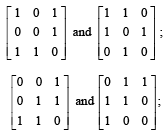
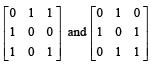
PASSAGE - 2
Let be the set of all 3× 3 symmetric matrices all of whose entries are either 0 or 1. Five of these entries are 1 and four of them are 0.
Q. The number of matrices A in for which the system of linear equations

be the set of all 3× 3 symmetric matrices all of whose entries are either 0 or 1. Five of these entries are 1 and four of them are 0. for which the system of linear equations Detailed Solution: Question 6
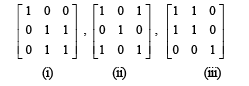
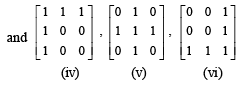
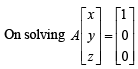
PASSAGE - 3
Let p be an odd prime number and Tp be the following set of 2 × 2 matrices :

Q. The number of A in Tp such that A is either symmetric or skew-symmetric or both, and det(A) divisible by p is
Detailed Solution: Question 7
PASSAGE - 3
Let p be an odd prime number and Tp be the following set of 2 × 2 matrices :
Q. The number of A in Tp such that the trace of A is not divisible by p but det (A) is divisible by p is
[Note: The trace of a matrix is the sum of its diagonal entries.]
Detailed Solution: Question 8
 then on dividing bc by p we should get
  for some
PASSAGE - 3
Let p be an odd prime number and Tp be the following set of 2 × 2 matrices :
Q. The number of A in Tp such that det (A) is not divisible by p is
Detailed Solution: Question 9
PASSAGE - 4
Let a, b and c be three real numbers satisfying
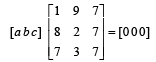 ...(E)
Q. If the point P(a, b, c), with reference to (E), lies on the plan e 2x + y + z = 1, then the value of 7a + b + c is
...(E)Detailed Solution: Question 10
PASSAGE - 4
Let a, b and c be three real numbers satisfying
...(E)
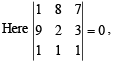
Q. Let ω be a solution of x3 – 1 = 0 with Im (ω) > 0 , if a = 2 with b and c satisfying (E), then the value of  equal to
...(E) equal toDetailed Solution: Question 11
PASSAGE - 4
Let a, b and c be three real numbers satisfying
...(E)
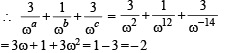
Q. Let b = 6, with a and c satisfying (E). If a and b are the roots of the quadratic equation ax2 + bx + c = 0, then 
...(E)Detailed Solution: Question 12
Consider the system of equations
x – 2y + 3z = –1
–x + y – 2z = k
x – 3y + 4z = 1
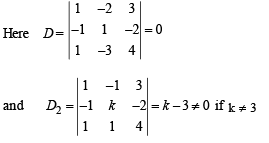
STATEMENT - 1 : The system of equations has no solution for k ¹ 3 and
STATEMENT-2 : The determinant 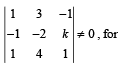 k ≠ 3 .
–x + y – 2z = k
x – 3y + 4z = 1
k ≠ 3 .Detailed Solution: Question 13
347 docs|185 tests |
