
Comprehension Based Questions: Applications of Derivatives - Free MCQ Practice
MCQ Practice Test & Solutions: Test: Comprehension Based Questions: Applications of Derivatives (7 Questions)
You can prepare effectively for JEE Crack JEE with 35 Years of Previous Year Solved Papers with this dedicated MCQ Practice Test (available with solutions) on the important topic of "Test: Comprehension Based Questions: Applications of Derivatives". These 7 questions have been designed by the experts with the latest curriculum of JEE 2026, to help you master the concept.
Test Highlights:
- - Format: Multiple Choice Questions (MCQ)
- - Duration: 10 minutes
- - Number of Questions: 7
Sign up on EduRev for free to attempt this test and track your preparation progress.

PASSAGE - 1
If a continuous function f defined on the real line R, assumes positive and negative values in R then the equation f(x) = 0 has a root in R. For example, if it is known that a continuous function f on R is positive at some point and its minimum value is negative then the equation f(x) = 0 has a root in R.
Consider f(x) = kex – x for all real x where k is a real constant.
Q. The line y = x meets y = kex for k < 0 at
Detailed Solution: Question 1

PASSAGE - 1
If a continuous function f defined on the real line R, assumes positive and negative values in R then the equation f(x) = 0 has a root in R. For example, if it is known that a continuous function f on R is positive at some point and its minimum value is negative then the equation f(x) = 0 has a root in R.
Consider f(x) = kex – x for all real x where k is a real constant.
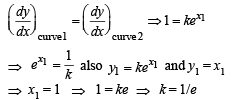
Q. The positive value of k for which kex – x = 0 has only one root is
Detailed Solution: Question 2

PASSAGE - 1
If a continuous function f defined on the real line R, assumes positive and negative values in R then the equation f(x) = 0 has a root in R. For example, if it is known that a continuous function f on R is positive at some point and its minimum value is negative then the equation f(x) = 0 has a root in R.
Consider f(x) = kex – x for all real x where k is a real constant.
Q. For k > 0, the set of all values of k for which kex – x = 0 has two distinct roots is
Detailed Solution: Question 3

PASSAGE - 2
Let f (x) = (1 – x)2 sin2x + x2 for all x ∈ I R and let 
Q.
Consider the statements:
P : Th er e exists some x ∈ R such th at f (x) + 2 x = 2(1 + x2)
Q : There exists some x ∈ R such that 2 f (x) + 1 = 2x (1 + x) Then
Detailed Solution: Question 4
PASSAGE - 2
Let f (x) = (1 – x)2 sin2x + x2 for all x ∈ I R and let
Q. Which of the following is true?
Detailed Solution: Question 5
PASSAGE - 3
 (the set of all real numbers) be a function. Suppose the function f is twice differentiable, f(0) = f(1) = 0 and satisfies
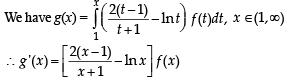
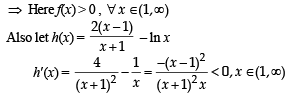
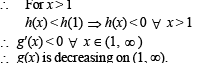
Q. Which of the following is true for 0 < x < 1?
(the set of all real numbers) be a function. Suppose the function f is twice differentiable, f(0) = f(1) = 0 and satisfies Detailed Solution: Question 6
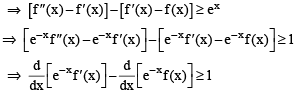
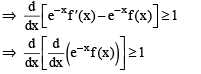

PASSAGE - 3
(the set of all real numbers) be a function. Suppose the function f is twice differentiable, f(0) = f(1) = 0 and satisfies
Q. If the function e–x f(x) assumes its minimum in the interval  which of the following is true?
(the set of all real numbers) be a function. Suppose the function f is twice differentiable, f(0) = f(1) = 0 and satisfies which of the following is true? Detailed Solution: Question 7
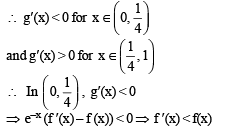
347 docs|185 tests |
