JEE Exam  >  JEE Test  >  Crack with 35 Years of Previous Year Solved Papers  >  Test: 35 Year JEE Previous Year Questions: Applications of Derivatives - JEE MCQ

35 Year JEE Previous Questions: Applications of Derivatives with solutions


MCQ Practice Test & Solutions: Test: 35 Year JEE Previous Year Questions: Applications of Derivatives (33 Questions)

You can prepare effectively for JEE Crack JEE with 35 Years of Previous Year Solved Papers with this dedicated MCQ Practice Test (available with solutions) on the important topic of "Test: 35 Year JEE Previous Year Questions: Applications of Derivatives". These 33 questions have been designed by the experts with the latest curriculum of JEE 2026, to help you master the concept.

Test Highlights:

  • - Format: Multiple Choice Questions (MCQ)
  • - Duration: 60 minutes
  • - Number of Questions: 33

Sign up on EduRev for free to attempt this test and track your preparation progress.

Test: 35 Year JEE Previous Year Questions: Applications of Derivatives - Question 1

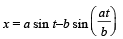
The maximum distance from origin of a point on the curve 
Detailed Solution: Question 1
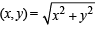
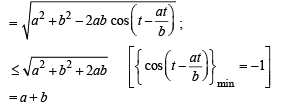
Distance of origin from  

∴ Maximum distance from origin = a + b

Test: 35 Year JEE Previous Year Questions: Applications of Derivatives - Question 2

If 2a + 3b + 6c = 0, (a, b, c ∈ R) then the quadratic equation ax2 + bx + c = 0 has

Detailed Solution: Question 2
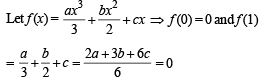
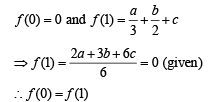
Also f (x) is continuous and differentiable in [0, 1] and [0, 1]. So by Rolle’s theorem, f ' (x) = 0.
i.e ax2 + bx + c = 0 has at least one root in [0, 1].

Test: 35 Year JEE Previous Year Questions: Applications of Derivatives - Question 3

If th e function f ( x) = 2x3 - 9ax2 + 12a2x+1 , whe re a > 0 , attains its maximum and minimum at  p and  q respectively such that p 2 = q , then a equals

Detailed Solution: Question 3

f (x) = 2x3 - 9ax2 + 12a2x +1
f '(x) = 6x2 - 18ax + 12a2; f"(x) = 12x- 18a
For max. or min.
6x2 - 18ax + 12a2 = 0 ⇒ x2 - 3ax + 2a2 = 0
⇒ x = aorx = 2a.At x = a max. and at x = 2a min

∴ p = a and q = 2a

As per question p2 = q 
∴ a = 2a ⇒ a = 2ora = 0
but a > 0, therefore, a = 2.

Test: 35 Year JEE Previous Year Questions: Applications of Derivatives - Question 4

A point on th e parabola y2 = 18x at which the ordinate increases at twice the rate of the abscissa is

Detailed Solution: Question 4
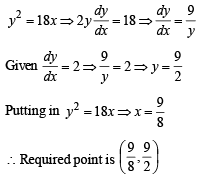
Test: 35 Year JEE Previous Year Questions: Applications of Derivatives - Question 5

A function y = f (x) h as a second or der der iva tive f "( x) = 6(x- 1). If its graph passes through the point (2,1) and at that point the tangent to the graph is y = 3x – 5, then the function is

Detailed Solution: Question 5

f ''(x) = 6(x - 1). Inegrating, we get
f '( x) = 3x2 -6 x+c
Slope at (2, 1)  = f '(2) = c = 3
[∴ slope of tangent  at (2,1) is 3]
∴ f '( x) = 3x2 - 6 x + 3 = 3(x- 1)2
Inegrating again, we get  f (x) = (x -1)3+D
The curve passes through (2, 1)
⇒1= (2-1)3 +D ⇒ D = 0
∴ f (x) = (x – 1)3

Test: 35 Year JEE Previous Year Questions: Applications of Derivatives - Question 6

The normal to the curve x = a(1 + cosθ), y = a sinθ at ‘θ’ always passes through the fixed point

Detailed Solution: Question 6
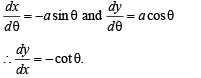
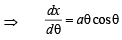
∴ The slope of the normal  at θ = tan θ
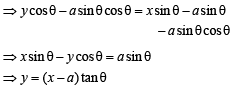
∴ The equation of the normal at θ is
y -a sin θ = tan θ( x -a -a cosθ)

which always passes through (a, 0)

Test: 35 Year JEE Previous Year Questions: Applications of Derivatives - Question 7

If 2a + 3b + 6c = 0, then at least one root of the equation ax2 + bx +c= 0 lies in the interval

Detailed Solution: Question 7
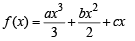
Let us defin e a function

Being  polynomial, it is continuous and differentiable, also,

∴ f (x) satisfies all condition s of Rolle’s theor em therefore f ’(x) = 0 has a root in (0, 1)

i.e. ax2 + bx +c= 0 has at lease one root in (0, 1)

Test: 35 Year JEE Previous Year Questions: Applications of Derivatives - Question 8

Area of the greatest rectangle that can be inscribed in the ellipse 

Detailed Solution: Question 8
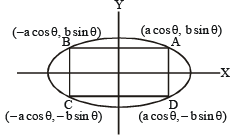
Area of rectangle ABCD = 2a cosθ (2b sin θ) = 2ab sin2θ

⇒ Area of greatest rectangle is equal to 2ab When sin 2θ = 1 .

Test: 35 Year JEE Previous Year Questions: Applications of Derivatives - Question 9

The normal to the curve x = a (cos θ + θ sin θ), y = a (sin θ – θ cos θ) at any point θ ' is such that

Detailed Solution: Question 9

x =a (cos θ + θ sinθ

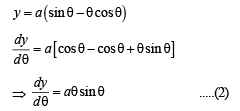
   .....(1)

From equations (1) and (2), we get

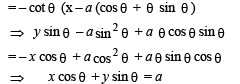
Equation of normal at ' θ ' is y – a (sin θ – θ cos θ)

Clearly this is an equation of straight line which is at a constant distance ‘a’ from origin.

Test: 35 Year JEE Previous Year Questions: Applications of Derivatives - Question 10

A spherical iron ball 10 cm in radius is coated with a layer of ice of uniform thickness that melts at a rate of 50 cm 3/min.
When the thickness of ice is 5 cm,then the rate at which the thickness of ice decreases is

Detailed Solution: Question 10
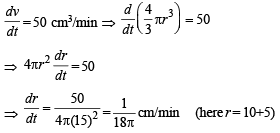
Given that

Test: 35 Year JEE Previous Year Questions: Applications of Derivatives - Question 11

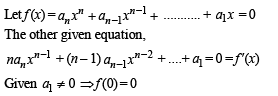
If the equation   has a positive root x = a , then the equation   has a positive root, which is

Detailed Solution: Question 11

Again f (x) has root a,  ⇒ f (a)=0
∴ f (0) = f (a)
∴ By Roll’s theorem f'(x) = 0 has root between (0, α)

Hence f '(x) has a positive root smaller than a.

Test: 35 Year JEE Previous Year Questions: Applications of Derivatives - Question 12

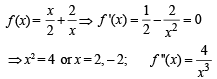
The function  has a local minimum at

Detailed Solution: Question 12


 has local min at x = 2.

Test: 35 Year JEE Previous Year Questions: Applications of Derivatives - Question 13

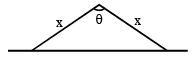
A triangular park is enclosed on two sides by a fence and on the third side by a straight river bank. The two sides having fence are of same length x. The maximum area enclosed by the park is

Detailed Solution: Question 13
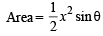


Maximum value of sinq is 1 at 

Test: 35 Year JEE Previous Year Questions: Applications of Derivatives - Question 14

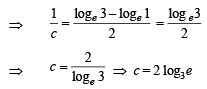
A value of c for which conclusion of Mean Value Theorem holds for the function f (x) = loge x on the interval [1, 3] is

Detailed Solution: Question 14
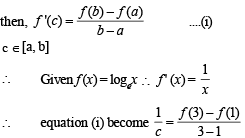
Using Lagrange's Mean Value Theorem
Let f (x) be a function defined on [a, b]


Test: 35 Year JEE Previous Year Questions: Applications of Derivatives - Question 15

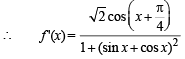
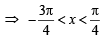
The function f (x) = tan–1(sin x  + cos x) is an increasing function in

Detailed Solution: Question 15
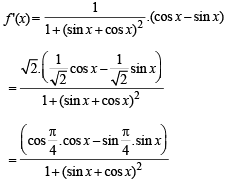
Given f (x) = tan–1 (sin x + cos x)


if f ’ (x) > O then f (x) is increasing function.
Hence f (x) is increasing, if 

Hence, f (x) is increasing when  

Test: 35 Year JEE Previous Year Questions: Applications of Derivatives - Question 16

If p and q are positive real numbers such that p2 + q2 = 1, then the maximum value of (p + q) is

Detailed Solution: Question 16
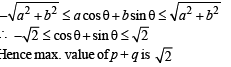
Given that p2 + q2 = 1
∴ p = cosθ and q = sinθ
Then p +q = cos θ + sinθ
We know that

Test: 35 Year JEE Previous Year Questions: Applications of Derivatives - Question 17

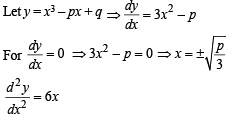
Suppose the cubic x3 – px + q has three distinct real roots where p > 0 and q > 0. Then which one of the following holds?

Detailed Solution: Question 17


Test: 35 Year JEE Previous Year Questions: Applications of Derivatives - Question 18

How many real solutions does the equation

x7 + 14x5 + 16x3 + 30x – 560 = 0 have?

Detailed Solution: Question 18
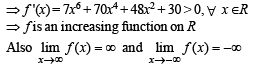
Let f (x) = x7 + 14x5 + 16x3 + 30x –560


⇒The curve y = f (x) crosses x-axis only once.
∴ f (x) = 0 has exactly  one real root.

Test: 35 Year JEE Previous Year Questions: Applications of Derivatives - Question 19

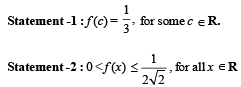
Let f (x) = x | x | and g (x) = sin x.

Statement-1 : gof is differentiable at x = 0 and its derivative is continuous at that point.
Statement-2 : gof is twice differentiable at x = 0.

Detailed Solution: Question 19
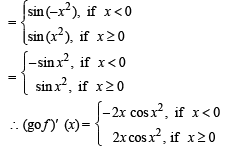
Given that f (x) = x | x | and g (x) = sin x
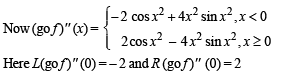
So that go f (x) = g (f (x)) = g (x | x |) = sin x | x |

Here we observe L (go f )' (0) =  0  =  R (go f)' (0)
⇒ go f is differentiable at x = 0 and (go f)' is continuous at x = 0

∴ L(go f)''  (0) ≠ R (go f )''  (0)
⇒ go f (x) is not twice differentiable at x = 0.
∴ Statement - 1 is true but statement -2 is false.

Test: 35 Year JEE Previous Year Questions: Applications of Derivatives - Question 20

Given P(x) = x4 + ax3 + bx2 + cx + d such that x = 0 is the only real root of P' (x) = 0. If P(–1) < P(1), then in the interval [ –1, 1] :

Detailed Solution: Question 20

We have P (x) = x4 + ax3 + bx2 + cx + d
⇒ P' (x) = 4x3 + 3ax2 + 2bx + c
But  P' (0) = 0 ⇒ c = 0
∴ P(x) = x4 + ax3 + bx2 + d
As given that P (– 1) < P (a)
⇒ 1 – a + b + d    <   1 + a + b + d ⇒ a > 0
Now P ' (x) = 4x3 + 3ax2 +2bx = x (4x2 + 3ax + 2b)
As P' (x) = 0, there is only one solution x = 0, therefore 4x2 + 3ax + 2b = 0 should not have any real roots i.e. D < 0


∴ P (x) is an increasing function on (0,1) ∴ P (0)  <  P (a)
Similarly we can prove P (x) is decreasing on (– 1, 0)
∴ P (– 1) >  P (0)
So we can conclude that
Max P (x) = P (1) and Min P (x) = P (0) ⇒ P(–1) is not minimum but P (1) is the maximum of  P.

Test: 35 Year JEE Previous Year Questions: Applications of Derivatives - Question 21

The equation of the tangent to the curve  that is parallel to the x-axis, is

Detailed Solution: Question 21

Since tangent is parallel to x-axis,

Equation of tangent is y – 3 = 0 (x – 2) ⇒ y = 3

Test: 35 Year JEE Previous Year Questions: Applications of Derivatives - Question 22

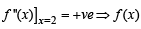
If f has a local minimum at x = – 1 , then a possible value of k is

Detailed Solution: Question 22
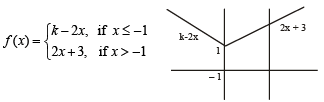
This is true where k = – 1

Test: 35 Year JEE Previous Year Questions: Applications of Derivatives - Question 23

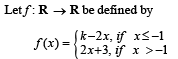
Let f : R → R be a continuous function defined by
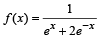
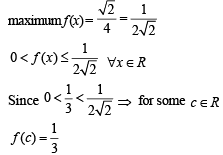
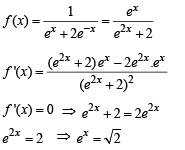
Detailed Solution: Question 23

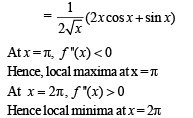
Test: 35 Year JEE Previous Year Questions: Applications of Derivatives - Question 24

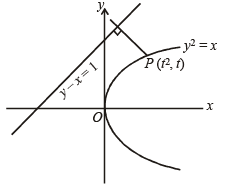
The shortest distance between line y – x = 1 and curve x = y2 is

Detailed Solution: Question 24
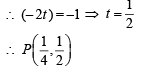
Shortest distance between two curve occurred along the common normal Slope of normal to y2 = x at point P(t2, t) is – 2t and slope of line y – x = 1 is 1.
As they are perpendicular to each other

and shortest distance 

So shortest distance between them is

Test: 35 Year JEE Previous Year Questions: Applications of Derivatives - Question 25

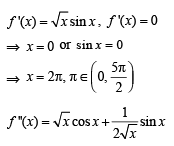
Detailed Solution: Question 25


Test: 35 Year JEE Previous Year Questions: Applications of Derivatives - Question 26

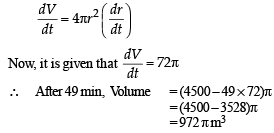
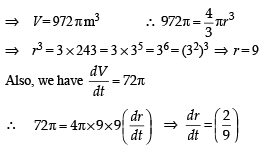
A spherical balloon is filled with 4500π cubic meters of helium gas. If a leak in the balloon causes the gas to escape at the rate of 72π cubic meters per minute, then the rate (in meters per minute) at which the radius of the balloon decreases 49 minutes after the leakage began is :

Detailed Solution: Question 26

Volume of spherical balloon 

Differentiating both the sides, w.r.t 't' we get,


Test: 35 Year JEE Previous Year Questions: Applications of Derivatives - Question 27

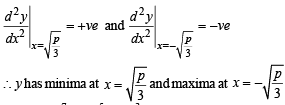
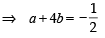
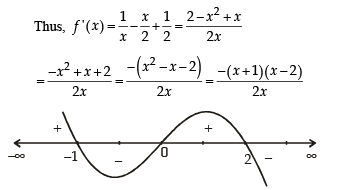
Let a, b ∈ R be such that the function f given by f (x) = ln |x|+ bx2 + ax, x ≠ 0 has extreme values at  x = –1 and x = 2

Statement-1 : f has local maximum at x = –1 and at x = 2.
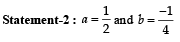
Detailed Solution: Question 27
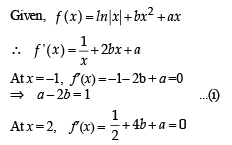

          ...(ii)
On solving (i) and (ii) we get  

So maxima at x = –1,2
Hence both the statements are true and statement 2 is a correct explanation for 1.

Test: 35 Year JEE Previous Year Questions: Applications of Derivatives - Question 28

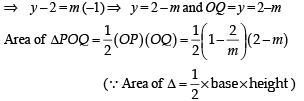
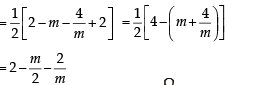
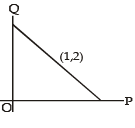
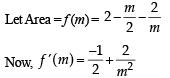
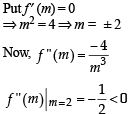
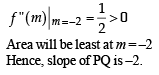
A line is drawn through the point (1,2) to meet the coordinate axes at P and Q such that it forms a triangle OPQ, where O is the origin. If the area of the triangle OPQ is least, then the slope of the line PQ is :

Detailed Solution: Question 28

Equation of a line passing through (x1,y1) having slope m is given by y – y1 = m (x–x1)
Since the line PQ is passing through (1,2) therefore its equation is
(y – 2) = m (x – 1)
where m is the slope of the line PQ.
Now, point P (x,0) will also satisfy the equation of PQ
∴ y –2 = m (x –1)
⇒ 0 – 2 = m (x – 1)


Similarly, point Q (0,y) will satisfy equation of PQ


Test: 35 Year JEE Previous Year Questions: Applications of Derivatives - Question 29

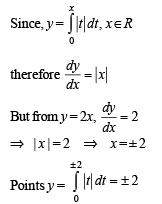
The intercepts on x-axis made by tangents to the curve,  which are parallel to the line y = 2x, are equal to :

Detailed Solution: Question 29

∴ equation of tangent is

y – 2 = 2(x – 2) or y + 2 = 2(x + 2)

⇒ x-intercept = ± 1.

Test: 35 Year JEE Previous Year Questions: Applications of Derivatives - Question 30

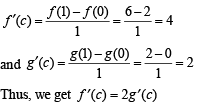
If f and g are differentiable functions in [0, 1] satisfying f (0) = 2 = g(1), g(0) = 0 and f (1) = 6, then for some c ∈[0,1]

Detailed Solution: Question 30

Since, f and g both are continuous functions on [0, 1] and differentiable on (0, 1) then 

View more questions
347 docs|185 tests
Information about Test: 35 Year JEE Previous Year Questions: Applications of Derivatives Page
In this test you can find the Exam questions for Test: 35 Year JEE Previous Year Questions: Applications of Derivatives solved & explained in the simplest way possible. Besides giving Questions and answers for Test: 35 Year JEE Previous Year Questions: Applications of Derivatives, EduRev gives you an ample number of Online tests for practice
Download as PDF