
JEE Main 35 Year PYQs- Haloalkanes & Haloarenes- 1 - Free MCQ Test
MCQ Practice Test & Solutions: Test: JEE Main 35 Year PYQs- Haloalkanes & Haloarenes- 1 (18 Questions)
You can prepare effectively for JEE Chapter-wise Tests for JEE Main & Advanced with this dedicated MCQ Practice Test (available with solutions) on the important topic of "Test: JEE Main 35 Year PYQs- Haloalkanes & Haloarenes- 1". These 18 questions have been designed by the experts with the latest curriculum of JEE 2026, to help you master the concept.
Test Highlights:
- - Format: Multiple Choice Questions (MCQ)
- - Duration: 36 minutes
- - Number of Questions: 18
Sign up on EduRev for free to attempt this test and track your preparation progress.

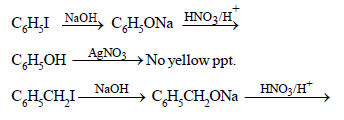
Bottles containing C6H5I and C6H5CH2I lost their originallabels. They were labelled A and B for testing. A and B wereseparately taken in test tubes and boiled with NaOH solution.The end solution in each tube was made acidic with dilute HNO3 and then some AgNO3 solution was added. Substance B gave a yellow precipitate. Which one of the followingstatements is true for this experiment ? [2003]
Detailed Solution: Question 1

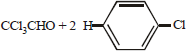
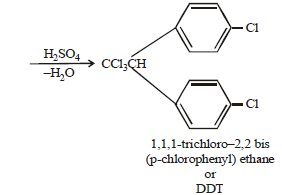
The compound formed on heating chlorobenzene withchloral in the presence of concentrated sulphuric acid, is [2004]
Detailed Solution: Question 2

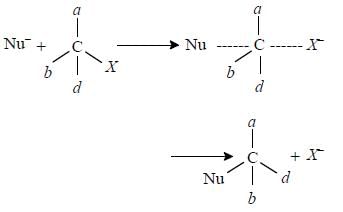
Tertiary alkyl halides are practically inert to substitution bySN2 mechanism because of [2005]
Detailed Solution: Question 3
Alkyl halides react with dialkyl copper reagents to give [2005]
Detailed Solution: Question 4
Elimination of bromine from 2-bromobutane results in theformation of – [2005]
Detailed Solution: Question 5

Phenyl magnesium bromide reacts with methanol to give [2006]
Detailed Solution: Question 6
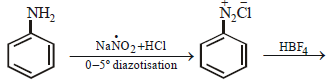
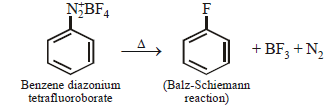
Fluorobenzene (C6H5F) can be synthesized in the laboratory [2006]
Detailed Solution: Question 7
Reaction of trans 2-phenyl-1-bromocyclopentane onreaction with alcoholic KOH produces [2006]
Detailed Solution: Question 8
 It follows E2 mechanism. Hughes and Ingold proposed that bimolecular elimination reactions take place when the two groups to be eliminated are trans and lie in one plane with the two carbon atoms to which they are attached i.e. E2 reactions are stereoselectively trans.
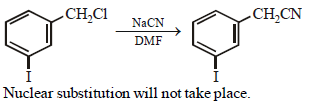
The structure of the major product formed in the following reaction
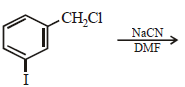 is
is
isDetailed Solution: Question 9
Which of the following is the correct order of decreasingSN2 reactivity? [2007]
(X is a halogen)
Detailed Solution: Question 10
The organic chloro compound, which shows completesterochemical inversion during a SN2 reaction, is [2008]
Detailed Solution: Question 11
Consider the following bromides :
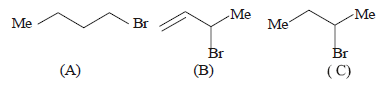
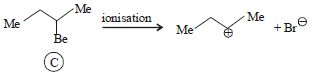
The correct order of SN1 reactivity is [2010]
Detailed Solution: Question 12


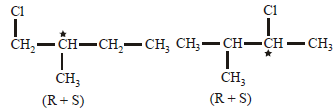
How many chiral compounds are possible onmonochlorination of 2- methyl butane ? [2012]
Detailed Solution: Question 13
What is DDT among the following ? [2012]
Detailed Solution: Question 14
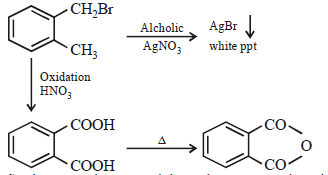
CompoundCompound (A), C8H9Br, gives a white precipitate when warmed with alcoholic AgNO3. Oxidation of (A) gives an
acid (B), C8H6O4. (B) easily forms anhydride on heating. Identify the compound (A). [JEE M 2013]
acid (B), C8H6O4. (B) easily forms anhydride on heating. Identify the compound (A). [JEE M 2013]
Detailed Solution: Question 15
In SN2 reactions, the correct order of reactivity for thefollowing compounds: [JEE M 2014]
CH3Cl,CH3CH2Cl, (CH3)2CHCl and ( CH3)3 CCl is:
CH3Cl,CH3CH2Cl, (CH3)2CHCl and ( CH3)3 CCl is:
Detailed Solution: Question 16
The major organic compound formed by the reaction of 1, 1, 1-trichloroethane with silver powder is: [JEE M 2014]
Detailed Solution: Question 17

The synthesis of alkyl fluorides is best accomplished by : [JEE M 2015]
Detailed Solution: Question 18
446 docs|929 tests |
