JEE Exam  >  JEE Test  >  Crack with 35 Years of Previous Year Solved Papers  >  Test: MCQs (One or More Correct Option): Carbohydrates, Amino Acids, Polymers & Miscellaneous | JEE Advanced - JEE MCQ

MCQs (One or More Correct Option): Carbohydrates, Amino Acids, Polymers


MCQ Practice Test & Solutions: Test: MCQs (One or More Correct Option): Carbohydrates, Amino Acids, Polymers & Miscellaneous | JEE Advanced (11 Questions)

You can prepare effectively for JEE Crack JEE with 35 Years of Previous Year Solved Papers with this dedicated MCQ Practice Test (available with solutions) on the important topic of "Test: MCQs (One or More Correct Option): Carbohydrates, Amino Acids, Polymers & Miscellaneous | JEE Advanced". These 11 questions have been designed by the experts with the latest curriculum of JEE 2026, to help you master the concept.

Test Highlights:

  • - Format: Multiple Choice Questions (MCQ)
  • - Duration: 20 minutes
  • - Number of Questions: 11

Sign up on EduRev for free to attempt this test and track your preparation progress.

Test: MCQs (One or More Correct Option): Carbohydrates, Amino Acids, Polymers & Miscellaneous | JEE Advanced - Question 1

The pair of compounds in which both the compounds  give positive test with Tollen’s reagent is

Detailed Solution: Question 1

Glucose being an aldose responds to Tollen’s test while fructose, although a ketose, undergoes rearrangement in presence of basic medium (provided by Tollen’s reagent) to form glucose, which then responds to Tollen’s test.

Test: MCQs (One or More Correct Option): Carbohydrates, Amino Acids, Polymers & Miscellaneous | JEE Advanced - Question 2

The two forms of D-glucopyranose obtained from the solution of D-glucose are called

Detailed Solution: Question 2

The two is omeric forms (a – and b –) of D-glucopyronose differ in configuration only at C– 1; hence these are called anomers.

Test: MCQs (One or More Correct Option): Carbohydrates, Amino Acids, Polymers & Miscellaneous | JEE Advanced - Question 3

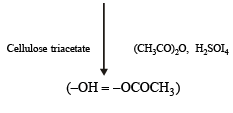
Cellulose upon acetylation with excess acetic anhydride/ H2SO4 (catalytic) gives cellulose triacetate whose structure is

Detailed Solution: Question 3
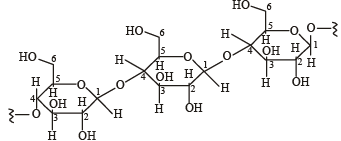
Cellulose is a polysaccharide composed of only Dglucose units. Every adjacent glucose units are joined by β-glycosidic linkage between C1 of one glucose and C4 of the next.
NOTE : Thus in every glucose units only three –OH groups are free to form triacetate.


Test: MCQs (One or More Correct Option): Carbohydrates, Amino Acids, Polymers & Miscellaneous | JEE Advanced - Question 4

Among cellulose, poly (vinyl chloride), nylon and natural rubber, the polymer in which the intermolecular force of attraction is weakest is

Detailed Solution: Question 4

Nylon and cellulose, both have in termolecular hydrogen bonding, polyvinyl chloride has dipoledipole interaction, while natural rubber has van der Waal forces which are weakest.

Test: MCQs (One or More Correct Option): Carbohydrates, Amino Acids, Polymers & Miscellaneous | JEE Advanced - Question 5

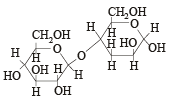
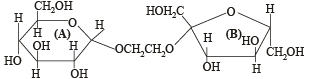
The correct statement about the following disaccharide is
Test: MCQs (One or More Correct Option): Carbohydrates, Amino Acids, Polymers & Miscellaneous | JEE Advanced - Question 6

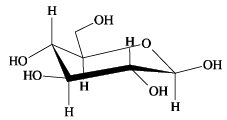
The following carbohydrate is

Detailed Solution: Question 6
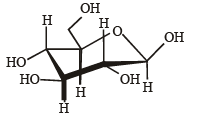
It is a β-pyranose hence it is an aldohexose.

Test: MCQs (One or More Correct Option): Carbohydrates, Amino Acids, Polymers & Miscellaneous | JEE Advanced - Question 7

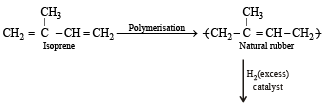
On complete hydrogenation, natural rubber produces

Detailed Solution: Question 7

*Multiple options can be correct
Test: MCQs (One or More Correct Option): Carbohydrates, Amino Acids, Polymers & Miscellaneous | JEE Advanced - Question 8

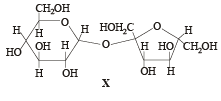
The correct statement(s) about the following sugars X and Y is(are)
Detailed Solution: Question 8

We know that carbohydrates having acetal linkage are non-reducing while that with hemiacetal linkage are reducing. In the give structure,

X has acetal linkage, hence non-reducing.
Y has hemiacetal linkage, hence reducing.
Further X is a-anomer, while Y is β-anomer of D-(+)-glucose.

*Multiple options can be correct
Test: MCQs (One or More Correct Option): Carbohydrates, Amino Acids, Polymers & Miscellaneous | JEE Advanced - Question 9

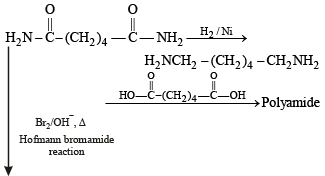
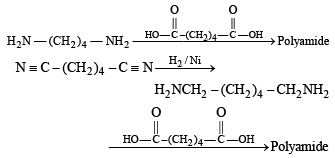
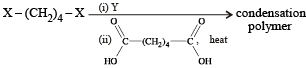
The correct functional group X and the reagent/reaction conditions Y in the following scheme are
Detailed Solution: Question 9

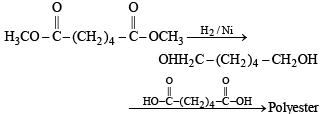
Condensation polymers are formed by condensation of a diol or diamine with a dicarboxylic acid.


*Multiple options can be correct
Test: MCQs (One or More Correct Option): Carbohydrates, Amino Acids, Polymers & Miscellaneous | JEE Advanced - Question 10

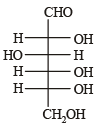
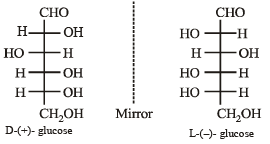
The structure of D-(+)-glucose is

The structure of L-(–)-glucose is

Detailed Solution: Question 10
*Multiple options can be correct
Test: MCQs (One or More Correct Option): Carbohydrates, Amino Acids, Polymers & Miscellaneous | JEE Advanced - Question 11

For ‘invert sugar’, the correct statement(s) is(are)
(Given : specific rotations of (+) -sucrose, (+)-maltose, L-(-)-glucose and L-(+) fructose in aqueous solution are + 66°, +140°, –52° and +92°, respectively) 

Detailed Solution: Question 11

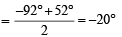
Invert sugar is an equimolar mixture of D-(+) glucose and D(–) glucose.

• Specific rotation of invert sugar = 

• D-glucose on oxidation with Br2-water pr oduces gluconic acid and not saccharic acid.

347 docs|185 tests
Information about Test: MCQs (One or More Correct Option): Carbohydrates, Amino Acids, Polymers & Miscellaneous | JEE Advanced Page
In this test you can find the Exam questions for Test: MCQs (One or More Correct Option): Carbohydrates, Amino Acids, Polymers & Miscellaneous | JEE Advanced solved & explained in the simplest way possible. Besides giving Questions and answers for Test: MCQs (One or More Correct Option): Carbohydrates, Amino Acids, Polymers & Miscellaneous | JEE Advanced, EduRev gives you an ample number of Online tests for practice
Download as PDF