You can prepare effectively for NEET Physics Class 11 with this dedicated MCQ Practice Test (available with solutions) on the important topic of "31 Year NEET Previous Year Questions: Mechanical Properties of Solids". These 15 questions have been designed by the experts with the latest curriculum of NEET 2026, to help you master the concept.
Test Highlights:
Sign up on EduRev for free to attempt this test and track your preparation progress.
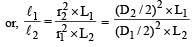
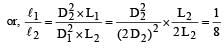
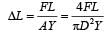
Two wires A and B are of the same material. Their lengths are in the ratio 1 : 2 and the diameter are in the ratio 2 : 1. If they are pulled by the same force, then increase in length will be in the ratio
Detailed Solution: Question 1
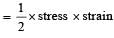
When an elastic material with Young’s modulus Y is subjected to stretching stress S, elastic energy stored per unit volume of the material is
Detailed Solution: Question 2
The following four wires are made of the same material. Which of these will have the largest extension when the same tension is applied ?
Detailed Solution: Question 3
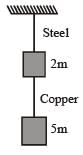
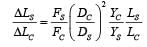
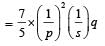
If the ratio of diameters, lengths and Young’s modulus of steel and copper wires shown in the figure are p, q and s respectively, then the corresponding ratio of increase in their lengths would be [2013]

Detailed Solution: Question 4
The stress-strain curves are drawn for two different materials X and Y. It is observed that the ultimate strength point and the fracture point are close to each other for material X but are far apart for material Y. We can say that materials X and Y are likely to be (respectively)
Detailed Solution: Question 5
A wire of length L, area of cross section A is hanging from a fixed support. The length of the wire changes to L1 when mass M is suspended from its free end. The expression for Young’s modulus is
Detailed Solution: Question 6
When a block of mass M is suspended by a long wireof length L, the length of the wire becomes (L + l).The elastic potential energy stored in the extended wire is
Detailed Solution: Question 7
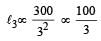
Two wires are made of the same material and have the same volume. The first wire has cross-sectional area A and the second wire has cross-sectional area 3A. If the length of the first wire is increased by Dl on applying a force F, how much force is needed to stretch the second wire by the same amount?
Detailed Solution: Question 8
The bulk modulus of a spherical object is ‘B’. If it is subjected to uniform pressure ‘p’, the fractional decrease in radius is
Detailed Solution: Question 9
The Young’s modulus of steel is twice that of brass. Two wires of same length and of same area of cross section, one of steel and another of brass are suspended from the same roof. If we want the lower ends of the wires to be at the same level, then the weights added to the steel and brass wires must be in the ratio of
Detailed Solution: Question 10
The approximate depth of an ocean is 2700 m. The compressibility of water is 45.4 × 10⁻¹¹ Pa–1 and density of water is 103 kg/m3. What fractional compression of water will be obtained at the bottom of the ocean?
Detailed Solution: Question 11
Copper of fixed volume V is drawn into wire of length l. When this wire is subjected to a constant force F, the extension produced in the wire is Dl. Which of the following graphs is a straight line?
Detailed Solution: Question 12
The following four wires are made of the same material. Which of these will have the largest extension when the same tension is applied?
Detailed Solution: Question 13
If the ratio of diameters, lengths and Young’s modulus of steel and copper wires shown in the figure are p, q and s respectively, then the corresponding ratio of increase in their lengths would be
Detailed Solution: Question 14
Two wires A and B are of the same materials. Their lengths are in the ratio 1:2 and the diameters are in the ratio 2:1. When stretched by force FA and FB respectively they get equal increase in their lengths. Then the ratio FA/FB should be:
Detailed Solution: Question 15
97 videos|376 docs|102 tests |