NEET Exam  >  NEET Test  >  Physics Class 11  >  31 Year NEET Previous Year Questions: Kinetic Theory - NEET MCQ

31 Year NEET Previous Questions: Kinetic Theory Free MCQ Practice Test


MCQ Practice Test & Solutions: 31 Year NEET Previous Year Questions: Kinetic Theory (19 Questions)

You can prepare effectively for NEET Physics Class 11 with this dedicated MCQ Practice Test (available with solutions) on the important topic of "31 Year NEET Previous Year Questions: Kinetic Theory". These 19 questions have been designed by the experts with the latest curriculum of NEET 2026, to help you master the concept.

Test Highlights:

  • - Format: Multiple Choice Questions (MCQ)
  • - Duration: 40 minutes
  • - Number of Questions: 19

Sign up on EduRev for free to attempt this test and track your preparation progress.

31 Year NEET Previous Year Questions: Kinetic Theory - Question 1

Two containers A and B are partly filled with water and closed. The volume of A is twice that of B and it contains half the amount of water in B. If both are at the same temperature, the water vapour in the containers will have pressure in the ratio of [1988]

Detailed Solution: Question 1

Vapour pressure  does not depend on the amount of substance. It depends on the temperature alone.

31 Year NEET Previous Year Questions: Kinetic Theory - Question 2

At constant volume, temperature is increased then

Detailed Solution: Question 2

As the temperature increases, the average velocity increases. So, the collisions are faster.

31 Year NEET Previous Year Questions: Kinetic Theory - Question 3

A polyatomic gas with n degrees of freedom has a mean energy per molecule given by [1989]

Detailed Solution: Question 3

According to law of equipartition of energy, the energy per degree of freedom is For a polyatomic gas with n degrees of freedom, the mean energy per molecule  =

31 Year NEET Previous Year Questions: Kinetic Theory - Question 4

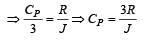
For a certain gas the ratio of specific heats is given to be γ = 1.5. For this gas [1990]
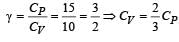
Detailed Solution: Question 4

31 Year NEET Previous Year Questions: Kinetic Theory - Question 5

According to kinetic theory of gases, at absolute zero temperature [1990]

Detailed Solution: Question 5

The average kinetic energy of a gas molecular is directly eruptional to absolute temperature only; this implies that all molecular motion stops if the temperature is reduced to absolute zero.

31 Year NEET Previous Year Questions: Kinetic Theory - Question 6

One mole of an ideal monoatomic gas requires 207 J heat to raise the temperature by 10 K when heated at constant pressure. If the same gas is heated at constant volume to raise the temperature by the same 10 K, the heat required is [Given the gas constant R = 8.3 J/ mol. K] [1990]
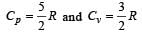
Detailed Solution: Question 6

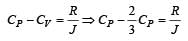
We know that  Qv = nCvΔT and Qp = nCpΔT

Given Qp = 207 J

31 Year NEET Previous Year Questions: Kinetic Theory - Question 7

Relation between pressure (P) and energy (E) of a gas is [1991]

Detailed Solution: Question 7

31 Year NEET Previous Year Questions: Kinetic Theory - Question 8

Three containers of the same volume contain three different gases. The masses of the molecules are m1, m2 and m3 and the number of molecules in their respective containers are N1, N2 and N3. The gas pressure in the containers are P1, P2 and P3 respectively. All the gases are now mixed and put in one of these containers.The pressure P of the mixture will be [1991]

Detailed Solution: Question 8

According to Dalton’s law of partial pressures, we have  P = P1 + P2 + P3

31 Year NEET Previous Year Questions: Kinetic Theory - Question 9

The number of translational degrees of freedom for a diatomic gas is [1993]

Detailed Solution: Question 9

Number of translational degrees of freedom are same for all types of gases.

31 Year NEET Previous Year Questions: Kinetic Theory - Question 10

The temperature of a gas is raised from 27°C to 927°C.The root mean square speed is [1994]

Detailed Solution: Question 10

As temperature increases from 300 K to 1200 K that is four times, so, crms will be doubled.

31 Year NEET Previous Year Questions: Kinetic Theory - Question 11

The equation of state, corresponding to 8g of O2 is[1994]

Detailed Solution: Question 11

8g of oxygen is equivalent to (1/4) mole.

31 Year NEET Previous Year Questions: Kinetic Theory - Question 12

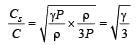
If Cs be the velocity of sound in air and C be the r.m.s velocity, then [1994]

Detailed Solution: Question 12

Velocity of sound  

R.M.S. velocity of gas molecules = 

31 Year NEET Previous Year Questions: Kinetic Theory - Question 13

At 0 K, which of the following properties of a gas will be zero? [1996]

Detailed Solution: Question 13

At 0 K, molecular motion stops. Hence, kinetic energy of molecules becomes zero.

31 Year NEET Previous Year Questions: Kinetic Theory - Question 14

The degree of freedom of a molecule of a triatomic ga s is[1999]

Detailed Solution: Question 14

No. of degree of freedom = 3 K – N where K is no. of atom and N is the number of relations between atoms. For triatomic gas, K = 3, N = 3C2 = 3
No. of degree of freedom = 3 (3) – 3 = 6

31 Year NEET Previous Year Questions: Kinetic Theory - Question 15

The equation of state for 5 g of oxygen at a pressure P and temperature T, when occupying a volume V, will be [2004]
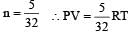
Detailed Solution: Question 15

  [∵ PV = nRT]

31 Year NEET Previous Year Questions: Kinetic Theory - Question 16

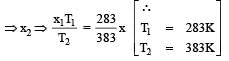
At 10° C the value of the density of a fixed mass of an ideal gas divided by its pressure is x. At 110°C this ratio is: [2008]

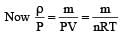
Detailed Solution: Question 16

Let the mass of the gas be m.
At a fixed temperature and pressure, volume is fixed.
Density of the gas,

 (By question)

31 Year NEET Previous Year Questions: Kinetic Theory - Question 17

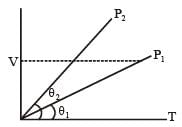
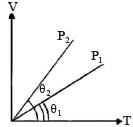
In the given (V – T) diagram, what is the relation between pressure P1 and P2 ? [NEET 2013]
Detailed Solution: Question 17

P1 > P2

As V = constant ⇒ P ∝ T
Hence from V–T graph P1 > P2

31 Year NEET Previous Year Questions: Kinetic Theory - Question 18

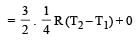
The amount of heat energy required to raise the temperature of 1g of Helium at NTP, from T1K to T2K is [NEET 2013]

Detailed Solution: Question 18

From first law of thermodynamics ΔQ = ΔU + ΔW

31 Year NEET Previous Year Questions: Kinetic Theory - Question 19

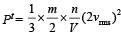
In a vessel, the gas is at a pressure P. If the mass of all the molecules is halved and their speed is doubled, then the resultant pressure will be [NEET Kar. 2013]

Detailed Solution: Question 19

When mass is halved and speed is doubled then Resultant pressure,= 2 P.

97 videos|376 docs|102 tests
Information about 31 Year NEET Previous Year Questions: Kinetic Theory Page
In this test you can find the Exam questions for 31 Year NEET Previous Year Questions: Kinetic Theory solved & explained in the simplest way possible. Besides giving Questions and answers for 31 Year NEET Previous Year Questions: Kinetic Theory, EduRev gives you an ample number of Online tests for practice
97 videos|376 docs|102 tests
Download as PDF