Mechanical Engineering Exam  >  Mechanical Engineering Test  >  SSC JE Mechanical Mock Test Series 2026  >  Thermodynamics - 1 - Mechanical Engineering MCQ

SSC JE Mechanical Thermodynamics - 1 Free Online Test 2026


MCQ Practice Test & Solutions: Thermodynamics - 1 (20 Questions)

You can prepare effectively for Mechanical Engineering SSC JE Mechanical Mock Test Series 2026 with this dedicated MCQ Practice Test (available with solutions) on the important topic of "Thermodynamics - 1". These 20 questions have been designed by the experts with the latest curriculum of Mechanical Engineering 2026, to help you master the concept.

Test Highlights:

  • - Format: Multiple Choice Questions (MCQ)
  • - Duration: 12 minutes
  • - Number of Questions: 20

Sign up on EduRev for free to attempt this test and track your preparation progress.

Thermodynamics - 1 - Question 1

A thermodynamic cycle is composed of four processes. The heat added, and the work done in each process are as follows:
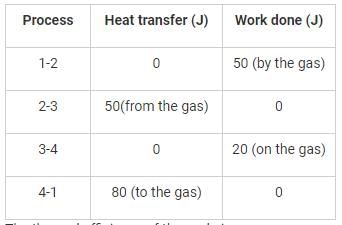
The thermal efficiency of the cycle is

Detailed Solution: Question 1

Thermal efficiency is defined as 
Where Q2 is the heat rejected from the system and Qt is the heat added to the system.
Here Q2 = 50 J 
Q1 = 80 J

Thermodynamics - 1 - Question 2

A heat reservoir is maintained at 927 °C. If the ambient temperature is 27 °C, the availability of heat from the reservoir is limited to

Detailed Solution: Question 2

Availability is the maximum useful work that can be extracted from the system working between two reservoirs.

Availability of Heat = 

Thermodynamics - 1 - Question 3

Which of the following devices complies with the Clausius statement of the second law of thermodynamics?

Detailed Solution: Question 3

Clausius statement: No device can operate on a cycle and produce effect that is solely the heat transfer from a lower-temperature body to a higher-temperature body.

Clausius statement is related to refrigerator and heat pump whereas gas turbines works on Brayton Cycle.

Thermodynamics - 1 - Question 4

Two reversible engines are connected in series between a heat source and a sink. The efficiencies of these engines are 60% and 50%, respectively. If these two engines are replaced by a single reversible engine, the efficiency of this engine will be

Detailed Solution: Question 4
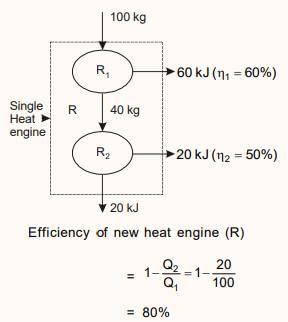
Thermodynamics - 1 - Question 5

The entropy of water at 0 K is assumed to be

Detailed Solution: Question 5

Absolute zero (0 K) is the temperature at which the entropy of a perfectly crystalline substance becomes zero.

In mathematical term,

S = k ln W

Where, S is entropy

k is Boltzmann constant

W is thermodynamic probability

When W = 1, it represents the greatest order, S = 0. This occurs only at T = 0 K.

This statement is also known as Third law of thermodynamics.

Thermodynamics - 1 - Question 6

The property of a working system which changes as the heat is supplied to the working fluid in a reversible manner is known as ________.

Detailed Solution: Question 6

Entropy is the thermodynamic property defined for a reversible process as:

dS = δQrev / T

It uniquely relates the change in a property to the heat supplied in a reversible manner. When heat is added reversibly to a system, its entropy increases, and when heat is removed, its entropy decreases.

Thermodynamics - 1 - Question 7

Two reversible heat engines operating between temperatures 2000 K and T K and T K and 500 K respectively. What is the intermediate temperature, if the efficiency of both the cycles is same?

Detailed Solution: Question 7
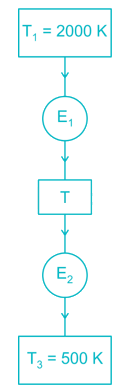
 

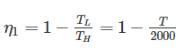
Efficiency of first engine (E1), 

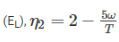
Efficiency of second engine

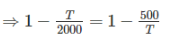
As efficiency of both engine is same,

So, η1 = η2

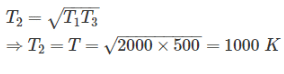
⇒ T2 = 2000 × 50

Short Trick:

When efficiency of both engines are equal, then intermediate temperature

Thermodynamics - 1 - Question 8

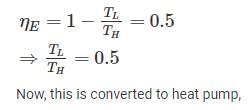
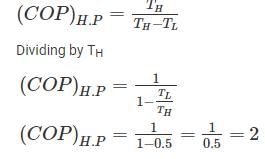
A Carnot heat engine is working with an efficiency of 50%. If the cycle is converted into a heat pump after reversing, then what is the coefficient of performance of the heat pump?

Detailed Solution: Question 8
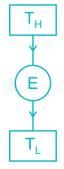
Efficiency of Carnot engine (ηE) = 50%

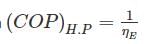
Short trick:

If a Carnot heat engine which is operating between two temperature limits is converted to heat pump then 

Thermodynamics - 1 - Question 9

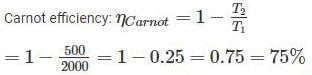
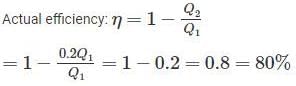
An inventor says, he has invented an engine which will reject 20% of heat absorbed from the source and the engine operates between 2000 K and 500 K. What kind of engine it is?

Detailed Solution: Question 9
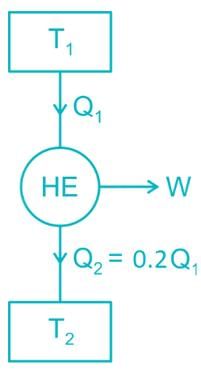
T1 = 2000 K

T2 = 500 K


Since, the actual efficiency is more than the Carnot efficiency, so this engine has an impossible cycle.

Thermodynamics - 1 - Question 10

In a cyclic process, the work done by the system is 20 kJ, -30 kJ, -5 kJ and 10 kJ. What is the net heat (kJ) for the cyclic process?

Detailed Solution: Question 10

dQ = dW + ΔU (As per first law)

For the cyclic process,

ΔU = 0

∴∫dW=∫dQ∴∫dW=∫dQ

∴ W = 20 - 30 - 5 + 10

= -5 kJ

Thermodynamics - 1 - Question 11

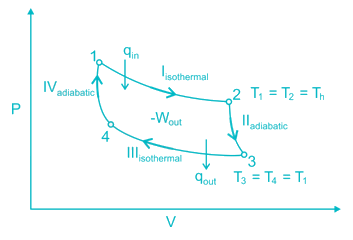
The heat rejection takes place in Carnot cycle at _______.

Detailed Solution: Question 11

A Carnot cycle consists of the four processes:

  1. Reversible isothermal heat addition
  2. Isentropic (reversible adiabatic) expansion
  3. Reversible isothermal heat rejection
  4. Isentropic compression of the gas

Thermodynamics - 1 - Question 12

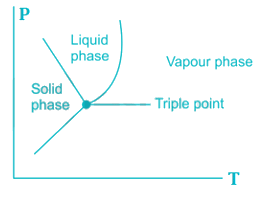
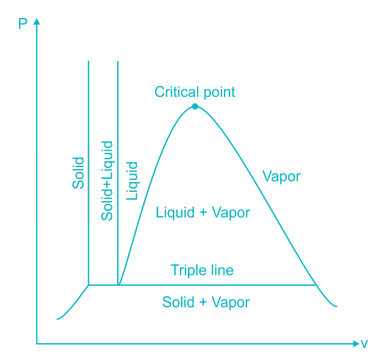
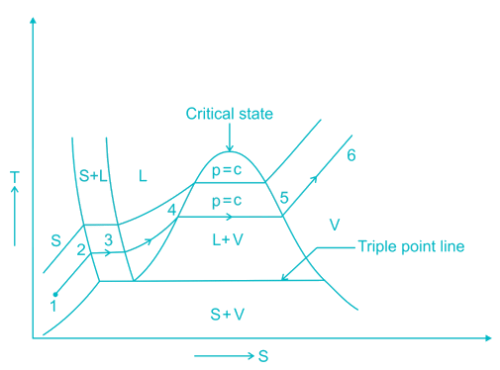
The triple point on a T-s diagram is ________.

Detailed Solution: Question 12

The pressure and temperature at which three phases of a pure substance coexist is called triple point. The triple point is merely the point of intersection of the sublimation and vaporization curves. It has been found that on a ‘p-T’ diagram the triple point is represented by a point and on a ‘p-v’ and T-s diagram it is a line, and on a ‘u-v’ diagram it is a triangle. In the case of ordinary water, the triple point is at a pressure of 4.58 mm Hg and a temperature of 0.01OC.

Thermodynamics - 1 - Question 13

Which gas can attain the highest efficiency for the same compression rise?

Detailed Solution: Question 13
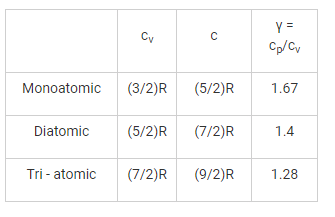
γmonoatomic> γdiatomic> γtriatomic

As efficiency is directly proportional to the ratio of specific heat (γ), so monoatomic will have the highest efficiency.

Thermodynamics - 1 - Question 14

A tank containing air is stirred by a paddle wheel. The work input to the paddle wheel is 9000 kJ and heat transferred to the surroundings from the tank is 3000 kJ. The external work done by the system is:

Detailed Solution: Question 14

First law of thermodynamics:

δQ=ΔU+δWδQ=ΔU+δW

(-3000) = ΔU + (-9000)

ΔU = 6000 kJ

As there is 9000 kJ work done on the system, no work will be done by the system. Energy will be stored in the system as internal energy.

Thermodynamics - 1 - Question 15

If pressure at any point in the liquid approaches the vapor pressure, liquid starts vaporising and creates pockets or bubbles of dissolved gases and vapours. This phenomenon is ________.

Detailed Solution: Question 15

Correct Answer :- C

Explanation : Cavitation is a phenomenon in which rapid changes of pressure in a liquid lead to the formation of small vapor-filled cavities in places where the pressure is relatively low.

When subjected to higher pressure, these cavities, called "bubbles" or "voids", collapse and can generate a shock wave that is strong very close to the bubble, but rapidly weakens as it propagates away from the bubble.

Therefore, If pressure at any point in the liquid approaches the vapor pressure, liquid starts vaporising and creates pockets or bubbles of dissolved gases and vapours. This phenomenon is Cavitation.

Thermodynamics - 1 - Question 16

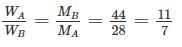
Two gases A and B with their molecular weights 28 and 44 respectively, expand at constant pressures through the same temperature range. The ratio of quantity of work done by the two gases (A : B) is ________.

Detailed Solution: Question 16

Work done, W = P2V2 - P1V1


Thermodynamics - 1 - Question 17

A series of operations, which takes place in a certain order and restore the initial conditions at the end, is known as

Detailed Solution: Question 17

Correct Answer :- c

Explanation : A series of operations, which takes place in a certain order and restores the initial conditions at the end, is known as thermodynamic cycle.

Thermodynamics - 1 - Question 18

Specific heat of a gas, Cp = Cv, at

Detailed Solution: Question 18

The specific heats of solids, liquids, and ideal gases are primarily functions of temperature. According to the Third Law of Thermodynamics, as the temperature approaches absolute zero (0 K), the specific heat also approaches zero.

However, at exactly 0 K, the system is in its ground state and no finite process can change its temperature. As temperature increases from 0 K, the specific heat increases due to increased molecular energy modes, and hence more energy is required for a unit rise in temperature.

Thermodynamics - 1 - Question 19

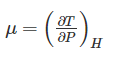
Joule-Thompson coefficient for an ideal gas is

Detailed Solution: Question 19

Joule Thomson Coefficient:-

For an ideal gas, μ = 0, because ideal gases neither warm not cool upon being expanded at constant enthalpy.

Thermodynamics - 1 - Question 20

A thermometer works on the principle of

Detailed Solution: Question 20

A thermometer works on the principle of Zeroth law of Thermodynamics.

According to Zeroth Law of thermodynamics, if two bodies are in thermal equilibrium with a third body then the two bodies are also in thermal equilibrium with each other.

Thermometer are based on the principle of finding the temperature by measuring the thermometric property.

The measurement of temperature is performed by the thermometer by using mercury, which - when heated - expands, and contracts in response to a fall in temperature. This causes the length of the liquid column to be longer or shorter depending on the temperature.

3 videos|1 docs|55 tests
Information about Thermodynamics - 1 Page
In this test you can find the Exam questions for Thermodynamics - 1 solved & explained in the simplest way possible. Besides giving Questions and answers for Thermodynamics - 1, EduRev gives you an ample number of Online tests for practice
Download as PDF