NEET Exam  >  NEET Test  >  Chemistry Class 11  >  31 Year NEET Previous Year Questions: Structure of Atom - 2 - NEET MCQ

31 Year NEET Previous Questions: Structure of Atom - 2 Free MCQ Practice


MCQ Practice Test & Solutions: 31 Year NEET Previous Year Questions: Structure of Atom - 2 (30 Questions)

You can prepare effectively for NEET Chemistry Class 11 with this dedicated MCQ Practice Test (available with solutions) on the important topic of "31 Year NEET Previous Year Questions: Structure of Atom - 2". These 30 questions have been designed by the experts with the latest curriculum of NEET 2026, to help you master the concept.

Test Highlights:

  • - Format: Multiple Choice Questions (MCQ)
  • - Duration: 60 minutes
  • - Number of Questions: 30

Sign up on EduRev for free to attempt this test and track your preparation progress.

31 Year NEET Previous Year Questions: Structure of Atom - 2 - Question 1

The spectrum of He is expected to be similar to that[1988]

Detailed Solution: Question 1

Both He and Li+ contain 2 electrons each therefore their spectrum will be similar.

31 Year NEET Previous Year Questions: Structure of Atom - 2 - Question 2

The number of spherical nodes in 3p orbitals are    [1988]

Detailed Solution: Question 2

No. of radial nodes in 3p-orbital = (n – ℓ – 1) [for p ortbital ℓ = 1] = 3 – 1 – 1 = 1

31 Year NEET Previous Year Questions: Structure of Atom - 2 - Question 3

If r is the radius of the first orbit, the radius of nth orbit of H-atom is given by [1988]

Detailed Solution: Question 3

According to Bohr's Model:
r ∝n2/Z
So, radius of nth orbit is rn=rn2, as Z=1 for H atom.

31 Year NEET Previous Year Questions: Structure of Atom - 2 - Question 4

Which of the following statements do not form a part of Bohr ’s model of hydrogen atom ? [1989]

Detailed Solution: Question 4

is uncertainty principle which was given by Hiesenberg and not Bohr’s postulate

31 Year NEET Previous Year Questions: Structure of Atom - 2 - Question 5

Number of unpaired electrons in N2+ is [1989]
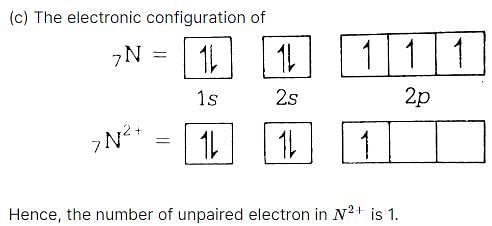
Detailed Solution: Question 5

31 Year NEET Previous Year Questions: Structure of Atom - 2 - Question 6

The maximum number of electrons in a subshell is given by the expression [1989]

Detailed Solution: Question 6

No. of orbitals in a sub-shell = 2 ℓ + 1

⇒ No. of electrons = 2(2ℓ + 1) = 4ℓ + 2

31 Year NEET Previous Year Questions: Structure of Atom - 2 - Question 7

The total number of electrons that can be accommodated in all the orbitals having principal quantum number 2 and azimuthal quantum number 1 is [1990]

Detailed Solution: Question 7

n = 2, l = 1 means 2 p – orbital. Electrons that can be accommodated = 6 as p sub-shell has 3 orbital and each orbital contains 2 electrons.

31 Year NEET Previous Year Questions: Structure of Atom - 2 - Question 8

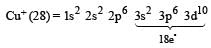
An ion has 18 electrons in the outermost shell, it is[1990]
Detailed Solution: Question 8

Cu+ = 29 – 1 = 28 e thus the electronic confingration of Cu+ is

31 Year NEET Previous Year Questions: Structure of Atom - 2 - Question 9

In a given atom no two electrons can have the same values for all the four quantum numbers.This is called [1991]

Detailed Solution: Question 9

This is as per the definiti on of Paul i’s Exclusion princieple.

31 Year NEET Previous Year Questions: Structure of Atom - 2 - Question 10

For azimuthal quantum number ℓ = 3, the maximum number of electrons will be [1991]

Detailed Solution: Question 10

ℓ = 3 means f-subshell. Maximum no. of electrons = 4ℓ + 2 = 4 × 3 + 2 = 14

31 Year NEET Previous Year Questions: Structure of Atom - 2 - Question 11

The order of filling of electrons in the orbitals of an atom will be [1991]

Detailed Solution: Question 11

The sub-shell with lowest value of (n + ℓ) is filled up first. When two or more sub-shells have same (n + ℓ) value the subshell with lowest value of 'n' is filled up first therefore the correct order is

31 Year NEET Previous Year Questions: Structure of Atom - 2 - Question 12

The energy of an electron in then the Bohr orbit of hydrogen atom is [1992]

Detailed Solution: Question 12

Energy of an electron in Bohr's orbit is given by the relationship. 

31 Year NEET Previous Year Questions: Structure of Atom - 2 - Question 13

Which of the following species has four lone pairs of electrons?

Detailed Solution: Question 13

Lone pair of electron means 2 electron(since it is pair)
For 4 lone pair electrons, we need 8 electrons in the outer shell. This is possible only with Cl- as it neutral Cl has 7 electrons and with addition of an electron they are 8 in number or 4 lone pairs of electrons.

31 Year NEET Previous Year Questions: Structure of Atom - 2 - Question 14

If ionization potential for hydrogen atom is 13.6 eV, then ionization potential for He+ will be
Detailed Solution: Question 14

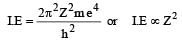
The ionization energy of any hydrogen like species (having one electron only) is given by the equation

Since the atomic number of H is 1 and that of He is 2, therefore, the I.E. of He+ is four times (22) the I.E. of H i.e., 13.6 × 4 = 54.4 eV

31 Year NEET Previous Year Questions: Structure of Atom - 2 - Question 15

For which one of the following sets of four quantium numbers, an electron will have the heighst energy? [1994]
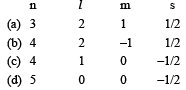
Detailed Solution: Question 15

The sub-shell are 3d, 4d, 4p and 4s, 4d has highest energy as n + ℓ value is maximum for this.

31 Year NEET Previous Year Questions: Structure of Atom - 2 - Question 16

Which of the following is never true for cathode rays ?[1994]

Detailed Solution: Question 16

Cathode r ays are never electromagnetic waves.

31 Year NEET Previous Year Questions: Structure of Atom - 2 - Question 17

The electron was shown experimentally to have wave properties by [1994]

Detailed Solution: Question 17

Wave nature of electr on was shown by Davisson and Germer. Davission and germer demonstrated the physical reality of the wave nature of electrons by showing that a beam of electrons could also diffracted by crystals just like light of x-rays.

31 Year NEET Previous Year Questions: Structure of Atom - 2 - Question 18

When an electron of charge e and mass m moves with a velocity v about the nuclear charge Ze is circular orbit of radius r, the potential energy of the electrons is given by [1994]
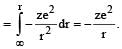
Detailed Solution: Question 18

P.E. = work done  

31 Year NEET Previous Year Questions: Structure of Atom - 2 - Question 19

In the photo-electron emission, the energy of the emitted electron is [1994]

Detailed Solution: Question 19

K.E. of emitted electron = hν - hν0 (i.e. smaller than hν ).

31 Year NEET Previous Year Questions: Structure of Atom - 2 - Question 20

If electron has spin quantum number  + 1/2 and a magnetic quantum number – 1, it cannot be present in [1994]

Detailed Solution: Question 20

It cannot be present in s-orbital.

31 Year NEET Previous Year Questions: Structure of Atom - 2 - Question 21

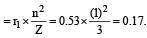
The radius of hydrogen atom in the ground state is 0.53 Å. The radius of Li2+ ion (atomic number = 3) in a similar state is [1995]
Detailed Solution: Question 21

State of hydrogen atom (n) = 1 (due to ground state) Radius of hydrogen atom (r) = 0.53 Å.
Atomic number of Li (Z) = 3.
Radius of Li2+ ion

31 Year NEET Previous Year Questions: Structure of Atom - 2 - Question 22

Uncertainty in position of an electron (mass = 9.1 × 10⁻²⁸ g) moving with a velocity of 3 × 104 cm/s accurate upto 0.001% will be (use h/4π) in uncertainty expression where h  = 6.626 ×10⁻²⁷ erg-second) [1995]

Detailed Solution: Question 22

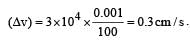
Given mass of an electron(m) = 9.1x10 -28g; Velocity of electron (v) = 3 x104cm/s;

Accuracy in velocity  = 0.001%

Actual velocity of the electron

.Planck’s constant (h) = 6.626×10⁻²⁷erg-sec.

∴  Uncertainty in the position of the electron

=1.93cm

31 Year NEET Previous Year Questions: Structure of Atom - 2 - Question 23

The orbitals are called degenerate when [1996]

Detailed Solution: Question 23

The orbitals which have same energy are called degenerate orbitals eg. px , py , pz .

31 Year NEET Previous Year Questions: Structure of Atom - 2 - Question 24

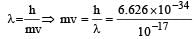
The momentum of a particle having a de Broglie wavelength of 10–17 metres is [1996] (Given h = 6.625 × 10⁻³⁴ Js)
Detailed Solution: Question 24

Acc. to deBroglie

.

⇒   p = 6.626 × 10⁻¹⁷ kg m/s

31 Year NEET Previous Year Questions: Structure of Atom - 2 - Question 25

The ion that is isoelectronic with CO is [1997]

Detailed Solution: Question 25

We know that ions which have th e same number of electrons are called isoelectronic.
We also know that both CO and CNhave 14 electrons, therefore these are isoelectronic.

31 Year NEET Previous Year Questions: Structure of Atom - 2 - Question 26

The Bohr orbit radius for the hydrogen atom (n = 1) is approximately 0.530 Å. The radius for the first excited state (n = 2) orbit is (in Å) [1998]
Detailed Solution: Question 26

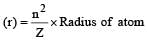
Given : Radius of hydrogen atom = 0.530 Å,
Number of excited state (n) = 2 and atomic number of hydrogen atom (Z) = 1. We know that the Bohr radius.

= 4 x 0.530 = 2.12 Å

31 Year NEET Previous Year Questions: Structure of Atom - 2 - Question 27

The position of both , an electron and a helium atom is known within 1.0 nm. Further the momentum of the electron is known within 5.0 × 10⁻²⁶ kg ms–1. The minimum uncertainty in the measurement of the momentum of the helium atom is [1998]

Detailed Solution: Question 27

By Heisenberg uncertainty Principle

(which is constant)

As Δx for electron and helium atom is same thus momentum of electron and helium will also be same therefore the momentum of helium atom is equal to 5 × 10–26 kg. m.s–1.

31 Year NEET Previous Year Questions: Structure of Atom - 2 - Question 28

According to Bohr ’s theory the energy required for an electron in the Li2+ ion to be emitted from n = 2 state is (given that the ground state ionization energy of hydrogen atom is 13.6 eV)

Detailed Solution: Question 28

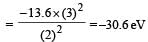
Energy of electron in 2nd or bit of Li+2

Energy required = 0 – (–30.6) = 30.6 eV

31 Year NEET Previous Year Questions: Structure of Atom - 2 - Question 29

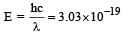
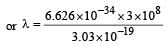
If the energy of a photon is given as : = 3.03 × 10⁻¹⁹ J then, the wavelength (λ) of the photon is :
Detailed Solution: Question 29

The energy of photon,

31 Year NEET Previous Year Questions: Structure of Atom - 2 - Question 30

Set of isoelectronic species is [2000]

Detailed Solution: Question 30

The molecule which contains same number of electrons are called isoelectronic. eg.

101 videos|250 docs|76 tests
Information about 31 Year NEET Previous Year Questions: Structure of Atom - 2 Page
In this test you can find the Exam questions for 31 Year NEET Previous Year Questions: Structure of Atom - 2 solved & explained in the simplest way possible. Besides giving Questions and answers for 31 Year NEET Previous Year Questions: Structure of Atom - 2, EduRev gives you an ample number of Online tests for practice
101 videos|250 docs|76 tests
Download as PDF