NEET Exam  >  NEET Test  >  Chemistry Class 12  >  31 Years NEET Previous Year Questions: Solutions - 2 - NEET MCQ

31 Years NEET Previous Year Questions: Solutions - 2 - Free MCQ Test


MCQ Practice Test & Solutions: 31 Years NEET Previous Year Questions: Solutions - 2 (30 Questions)

You can prepare effectively for NEET Chemistry Class 12 with this dedicated MCQ Practice Test (available with solutions) on the important topic of "31 Years NEET Previous Year Questions: Solutions - 2". These 30 questions have been designed by the experts with the latest curriculum of NEET 2026, to help you master the concept.

Test Highlights:

  • - Format: Multiple Choice Questions (MCQ)
  • - Duration: 60 minutes
  • - Number of Questions: 30

Sign up on EduRev for free to attempt this test and track your preparation progress.

31 Years NEET Previous Year Questions: Solutions - 2 - Question 1

An ideal solution is formed when its components [1988]

Detailed Solution: Question 1

For ideal solution,

31 Years NEET Previous Year Questions: Solutions - 2 - Question 2

All form ideal solution except [1988]

Detailed Solution: Question 2

C2H5I and C2H5OH form non-ideal solution.

31 Years NEET Previous Year Questions: Solutions - 2 - Question 3

The relative lowering of the vapour pressure is equal to the ratio between the number of [1991]

Detailed Solution: Question 3

According to Raoult's law, the relative lowering in vapour pressure of a dilute solution is equal to the mole fraction of the solute present in the solution.

 mole fraction of solute

31 Years NEET Previous Year Questions: Solutions - 2 - Question 4

Which of the following aqueous solution has minimum freezing point ? [1991]

Detailed Solution: Question 4

ΔTf = i × Kf × m Van't Hoff factor, i = 2 for NaCl, hence ΔTf = 0.02 Kf which is maximum in the present case.
Hence ΔTf is maximum or freezing point is minimum.

31 Years NEET Previous Year Questions: Solutions - 2 - Question 5

 Blood cells retain their normal shape in solution which are [1991]

Detailed Solution: Question 5

Blood cells neither swell n or shrink in isotonic solution. As isotonic solutions have equal concentration therefore there is no flow of solvent is found and hence solvent neither enters nor flow out of the blood cells.

31 Years NEET Previous Year Questions: Solutions - 2 - Question 6

Which of the following modes of expressing concentration is independent of temperature ? [1992,1995]

Detailed Solution: Question 6

The molality involves weights of the solute and the solvent. Since weight does not change with the temperature, therefore molality does not depend upon the temperature.

31 Years NEET Previous Year Questions: Solutions - 2 - Question 7

Which one is a colligative property ? [1992]

Detailed Solution: Question 7

Osmotic pressure is a colligative property.

31 Years NEET Previous Year Questions: Solutions - 2 - Question 8

If 0.1 M solution of glucose and 0.1 M solution of urea are placed on two sides of the semipermeable membrane to equal heights, then it will be correct to say that [1992]

Detailed Solution: Question 8

As both the solutions are isotonic hence there is no net movement of the solvent through the semipermeable membrane between two solutions.

31 Years NEET Previous Year Questions: Solutions - 2 - Question 9

At 25°C, the highest osmotic pressure is exhibited by 0.1 M solution of [1994]

Detailed Solution: Question 9

Conc. of particles in CaCl2 sol. will be max. as i = 3 is max.
Note : Glucose and Urea do not dissociate into ions, as they are nonelectrolytes.

31 Years NEET Previous Year Questions: Solutions - 2 - Question 10

Which one of the following salts will have the same value of the van’t Hoff factor (i) as that of K4[Fe (CN)6]. [1994]

Detailed Solution: Question 10

K4[Fe (CN)6] dissociates into 4 K+ and 1 [Fe (CN)6]4-    .

 It dissociates to give 5 ions or i = 5

 Similarly, Al2(SO4)3 dissociates into 2 Al3+ and 3 SO42-, also yielding 5 ions.

Since the van't Hoff factor is defined as the number of ions produced upon dissociation, the two salts have the same value, which is why option a) is the correct answer.

Wrong option:

NaCl gives 2 ions

Al (NO3)3 gives 4 ions

Na2SO4.gives 3 ions

31 Years NEET Previous Year Questions: Solutions - 2 - Question 11

The number of moles of oxygen in one litre of air containing 21% oxygen by volume, in standard conditions, is [1995]

Detailed Solution: Question 11
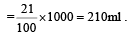
Percentage volume of oxygen = 21%. (Given)
∵ 100 ml of air contains = 21ml of O2
∴ Volume of oxygen in one litre of air

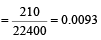
Therefore no. of moles 

(∵ volume of 1 litre of gas at S.T.P. is 22400 ml)

31 Years NEET Previous Year Questions: Solutions - 2 - Question 12

Vapour pressure of benzene at 30°C is 121.8 mm.When 15 g of a non volatile solute is dissolved in 250 g of benzene its vapour pressure decreased to 120.2 mm. The molecular weight of the solute (Mo. wt. of solvent = 78) [1995]

Detailed Solution: Question 12

Give vapour pressure of  pur e solute (P0) = 121.8 mm;
Weight of solute (w) = 15 g
Weight of solvent (W) = 250 g;
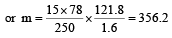
Vapour pressure of pure solvent (P) = 120.2 mm and Molecular weight of solvent (M) = 78 From Raoult’s law

31 Years NEET Previous Year Questions: Solutions - 2 - Question 13

According to Raoult's law, relative lowering of vapour pressure for a solution is equal to  [1995

Detailed Solution: Question 13

Relative lowering of vapour pressure depends upon the mole fraction of solute.

mole fraction of solute

31 Years NEET Previous Year Questions: Solutions - 2 - Question 14

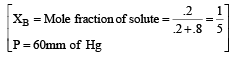
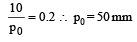
The vapour pressure at a given temperature of an ideal solution containing 0.2 mol of a nonvolatile solute and 0.8 mol of solvent is 60 mm of Hg. The vapour pressure of the pure solvent at the same temperature is [1996]

Detailed Solution: Question 14

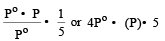
According to Raoult's law

31 Years NEET Previous Year Questions: Solutions - 2 - Question 15

Which of the following 0.10 m aqueous solutions will have the lowest freezing point ? [1997]

Detailed Solution: Question 15

Depression in F.P. ∝ No. of particles.
Al2(SO4)3 provides five ions on ionisation

while KCl provides two ions
KCl     K    Cl
C6H12O6 and C12H22O11 are not ionised so they have single particle.
Hence, Al2(SO4)3 have maximum value of depression in F.P or lowest F.P

31 Years NEET Previous Year Questions: Solutions - 2 - Question 16

A 5% solution of cane sugar (mol. wt. =342) is isotonic with 1% solution of a substance X. The molecular weight of X is [1998]

Detailed Solution: Question 16
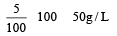
Osmotic pressure of 5% cane sugar solution 5% cane sugar solution means 100ml of solution contain cane sugar = 5g

∴    1000 of solution contain cane sugar

Similarily 1% is solution  

Osmotic pressure of 1% solution of susbtance  (π2)

As both are isotonic, So
π1 = π2

∴  M (mol. wt. of X) 

31 Years NEET Previous Year Questions: Solutions - 2 - Question 17

The vapour pressure of a solvent decreased by 10mm of mercury when a non-volatile solute was added to the solvent. The mole fraction of the solute in the solution is 0.2. What should be the mole fraction of the solvent if the decrease in the vapour pressure is to be 20mm of mercury?

Detailed Solution: Question 17

According to Raoult's law

 (mole fraction of solute)

For other solution of same solvent

(Mole fraction of solute)

mole fraction of solute

⇒   Mole fraction of solute = 0.4 As mole praction of solute + mole traction of solvent = 1

Hence, mole fraction of solvent = 1 – 0.4    = 0.6

31 Years NEET Previous Year Questions: Solutions - 2 - Question 18

Which of the following statements, regarding the mole fraction (x) of a component in solution, is incorrect? [1999]

Detailed Solution: Question 18
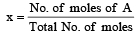
Mole fraction of any component A

As total no. of moles > no. of moles of A thus x can never be equal to one on zero.

31 Years NEET Previous Year Questions: Solutions - 2 - Question 19

Which of the following colligative property can provide molar mass of proteins (or polymers or colloids) with greatest precision ? [2000]

Detailed Solution: Question 19

Molecular masses of polymers are best determined by osmotic pressure method .
Firstly because other colligative properties give so low values that they cannot be measured accurately and secondly, osmotic pressure measurements can be made at room temperature and do not require heating which may change the nature of the polymer.

31 Years NEET Previous Year Questions: Solutions - 2 - Question 20

The beans are cooked earlier in pressure cooker, because [2001]

Detailed Solution: Question 20

The beans are cooked earlier in a pressure cooker because:

  • The boiling point increases with rising pressure.

  • The internal energy remains consistent while cooking in a pressure cooker.

  • The additional pressure helps to soften the beans.

31 Years NEET Previous Year Questions: Solutions - 2 - Question 21

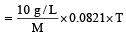
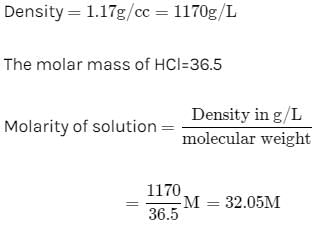
Molarity of liquid HCl will be, if density of solution is 1.17 gm/cc [2001]

Detailed Solution: Question 21
31 Years NEET Previous Year Questions: Solutions - 2 - Question 22

1 M, 2.5 litre NaOH solution is mixed with another 0.5 M, 3 litre NaOH solution. Then find out the molarity of resultant solution [2002]

Detailed Solution: Question 22
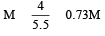
From molarity equation M1V1 + M2V2 = MV
1× 2.5 + 0.5 × 3 = M × 5.5

31 Years NEET Previous Year Questions: Solutions - 2 - Question 23

A solution contains non - volatile solute of molecular mass M2. Which of the following can be used to calculate the molecular mass of solute in terms of osmotic pressure ? [2002]

Detailed Solution: Question 23
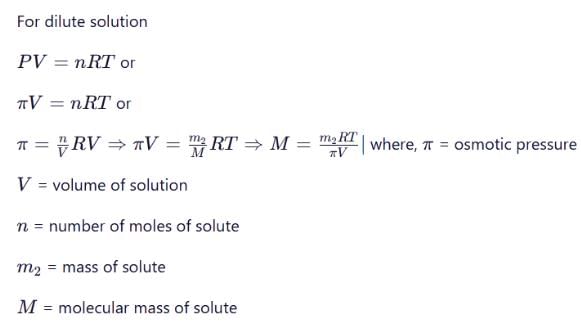
31 Years NEET Previous Year Questions: Solutions - 2 - Question 24

A solution containing components A and B follows Raoult's law when [2002]

Detailed Solution: Question 24

These two components A and B follows the condition of Raoult’s law if the force of attraction between A and B is equal to the force of attraction between A and A or B and B.

31 Years NEET Previous Year Questions: Solutions - 2 - Question 25

Formation of a solution from two components can be considered as [2003]
(i) Pure solvent → separated solvent                              molecules, ΔH1
(ii) Pure solute   → separated solute                               molecules, ΔH2
(iii) Separted solvent & solute molecules → Solution,  ΔH3
Solution so formed will be ideal if

(a) ΔHsoln = ΔH1 + ΔH2 - ΔH3

(b) ΔHsoln = ΔH1 + ΔH2 + ΔH3

(c) ΔHsoln = ΔH1 - ΔH2 - ΔH​​​​​​​3

(d) ΔHsoln = ΔH3 - ΔH1 - ΔH​​​​​​​2

Detailed Solution: Question 25

For an ideal solution, ΔHmixing = 0
  (Accroding to Hess's law) i.e., for ideal solutions there is no change in magnitude of the attractive forces in the two components present.

31 Years NEET Previous Year Questions: Solutions - 2 - Question 26

Camphoris often used in molecular mass determination because [2004]

Detailed Solution: Question 26

Solvent having high cryoscopic constant can be used in determination of molecular mass by cryoscopic method.

31 Years NEET Previous Year Questions: Solutions - 2 - Question 27

The vapour pressure of two liquids ‘P’ an d ‘Q’ are 80 and 60 torr, respectively. The total vapour pressure of solution obtained by mixing 3 mole of P and 2 mole of Q would be [2005]

Detailed Solution: Question 27
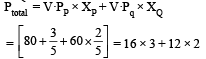
Given V.PP = 80 torr  V.PQ = 60 torr

Ptotal = 48 + 24 = 72 torr

31 Years NEET Previous Year Questions: Solutions - 2 - Question 28

A solution of urea (m ol. mass 56 g mol-1) boils at 100.18°C at the atmospheric pressure. If Kf and Kb for water are 1.86 and 0.512 K kg mol-1 respectively, the above solution will freeze at [2005]

Detailed Solution: Question 28
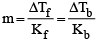
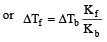
As ΔTf = Kf. m
ΔTb = Kb. m

 Hence, we have  

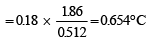
= [ΔTb = 100.18 - 100 = 0.18°C]

As the Freezing Point of pure water is 0°C,
ΔTf = 0 –Tf
0.654 = 0 – Tf
∴  Tf = – 0.654 thus the freezing point of solution will be – 0.654°C.

31 Years NEET Previous Year Questions: Solutions - 2 - Question 29

The mole fraction of the solute in one molal aqueous solution is: [2 00 5]

Detailed Solution: Question 29
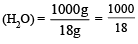
One molal solution means one mole solute present in 1 kg (1000 g) solvent i.e., mole of solute = 1

Mole of solvent 

Mole fraction of solute  =

31 Years NEET Previous Year Questions: Solutions - 2 - Question 30

A solution of acetone in ethanol [2006]

Detailed Solution: Question 30

A solution of acetone in ethanol shows positive deviation from Raoult's law. It is because ethanol molecules are strongly hydrogen bonded. When acetone is added, these molecules break the hydrogen bonds and ethanol becomes more volatile. Therefore its vapour pressure is increased.

54 videos|290 docs|74 tests
Information about 31 Years NEET Previous Year Questions: Solutions - 2 Page
In this test you can find the Exam questions for 31 Years NEET Previous Year Questions: Solutions - 2 solved & explained in the simplest way possible. Besides giving Questions and answers for 31 Years NEET Previous Year Questions: Solutions - 2, EduRev gives you an ample number of Online tests for practice
54 videos|290 docs|74 tests
Download as PDF