
Ray & Wave Optics | JEE Advanced - Free MCQ Practice Test with solutions,
MCQ Practice Test & Solutions: Test: Single Correct MCQs: Ray & Wave Optics | JEE Advanced (57 Questions)
You can prepare effectively for JEE Crack JEE with 35 Years of Previous Year Solved Papers with this dedicated MCQ Practice Test (available with solutions) on the important topic of "Test: Single Correct MCQs: Ray & Wave Optics | JEE Advanced". These 57 questions have been designed by the experts with the latest curriculum of JEE 2026, to help you master the concept.
Test Highlights:
- - Format: Multiple Choice Questions (MCQ)
- - Duration: 120 minutes
- - Number of Questions: 57
Sign up on EduRev for free to attempt this test and track your preparation progress.

When a ray of light enters a glass slab from air,
Detailed Solution: Question 1
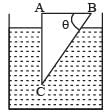
A glass prism of refractive index 1.5 is immersed in water (refractive index 4/3). A light beam incident normally on the face AB is totally reflected to reach on the face BC if
Detailed Solution: Question 2
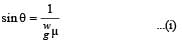
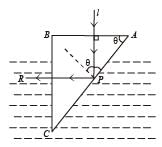
 ∴ sin θ should be greater than 8/9.
In Young’s double-slit experiment, the separation between the slits is halved and the distance between the slits and the screen is doubled. The fringe width is
Detailed Solution: Question 3

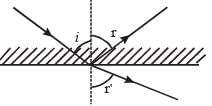
A ray of light from a denser medium strike a rarer medium at an angle of incidence i (see Fig). The reflected and refracted rays make an angle of 90° with each other. The angles of reflection and refraction are r and r’ The critical angle is
Detailed Solution: Question 4

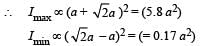
Two coherent monochromatic light beams of intensities I and 4 I are superposed. The maximum and minimum possible intensities in the resulting beam are
Detailed Solution: Question 5



Spherical aberration in a thin lens can be reduced by
Detailed Solution: Question 6
A beam of light of wave length 600 nm from a distance source falls on a single slit 1 mm wide and a resulting diffraction pattern is observed on a screen 2m away. The distance between the first dark fringes on either side of central bright fringe is
Detailed Solution: Question 7

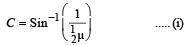
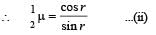
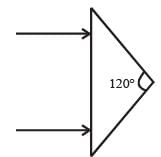
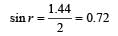
An isosceles prism of angle 120° has a refractive index 1.44. Two parallel monochromatic rays enter the prism parallel to each other in air as shown. The rays emerge from the opposite faces
Detailed Solution: Question 8

A diminished image of an object is to be obtained on a screen 1.0 m from it. This can be achieved by appropriately placing
Detailed Solution: Question 9
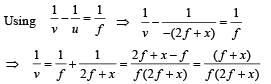
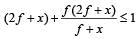
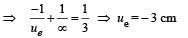
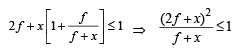 ⇒ (2f + x)2 < f + x. The above is true for f < 0.25 m.
The focal lengths of the objective and the eye piece of a compound microscope are 2.0 cm and 3.0 cm, respectively.
The distance between the objective and the eye piece is 15.0 cm. The final image formed by the eye piece is at infinity.
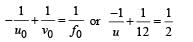
The two lenses are thin. The distance in cm of the object and the image produced by the objective, measured from the objective lens, are respectively
The distance between the objective and the eye piece is 15.0 cm. The final image formed by the eye piece is at infinity.
The two lenses are thin. The distance in cm of the object and the image produced by the objective, measured from the objective lens, are respectively
Detailed Solution: Question 10

Consider Fraunhoffer diffraction pattern obtained with a single slit illuminated at normal incidence. At the angular position of the first diffraction minimum the phase difference (in radians) between the wavelets from the opposite edges of the slit is
Detailed Solution: Question 11
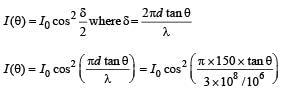
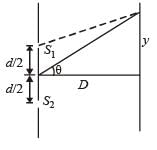
In an interference arrangement similar to Young’s doubleslit experiment, the slits S1 and S2 are illuminated with coherent microwave sources, each of frequency 106 Hz. The sources are synchronized to have zero phase difference.
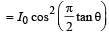
The slits are separated by a distance d = 150.0 m. The intensity I (θ) is measured as a function of θ, where θ is defined as shown. If I0 is the maximum intensity, then I (θ) for 0 < θ < 90° is given by
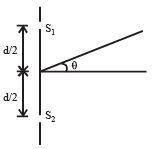
The slits are separated by a distance d = 150.0 m. The intensity I (θ) is measured as a function of θ, where θ is defined as shown. If I0 is the maximum intensity, then I (θ) for 0 < θ < 90° is given by
Detailed Solution: Question 12

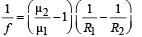
A concave lens of glass, refractive index 1.5 h as both surfaces of same radius of curvature R. On immersion in a medium of refractive index 1.75, it will behave as a
Detailed Solution: Question 13
 For concave lens as shown in figure in this case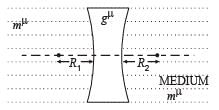

Yellow light is used in a single slit diffraction experiment with slit width of 0.6 mm. If yellow light is replaced by X– rays, then the observed pattern will reveal,
Detailed Solution: Question 14
A thin slice is cut out of a glass cylinder along a plane parallel to its axis. The slice is placed on a flat glass plate as shown in Figure.
The observed interference fringes from this combination shall be
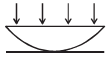
The observed interference fringes from this combination shall be
Detailed Solution: Question 15
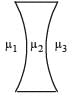
A hollow double concave lens is made of very thin transparent material. It can be filled with air or either of two liquids L1 or L2 having refractive indices μ1 and μ2 respectively (μ2 > μ1 > 1). The lens will diverge a parallel beam of light if it is filled with
Detailed Solution: Question 16
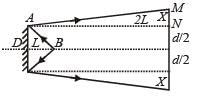
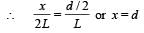
A point source of light B is placed at a distance L in front of the centre of a mirror of width 'd' hung vertically on a wall. A man walks in front of the mirror along a line parallel to the mirror at a distance 2L from it as shown in fig. The greatest distance over which he can see the image of the light source in the mirror is

Detailed Solution: Question 17
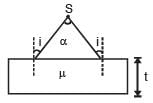
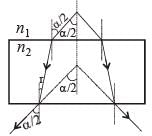
A diverging beam of light from a point source S having divergence angle α , falls symmetrically on a glass slab as shown. The angles of incidence of the two extreme rays are equal. If the thickness of the glass slab is t and the refractive index n, then the divergence angle of the emergent beam is
Detailed Solution: Question 18
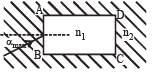
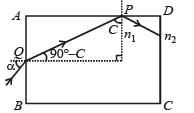
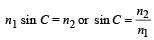
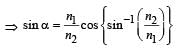
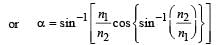
A rectangular glass slab ABCD of refractive index n1 is immersed in water of refractive index n2(n1 > n2). A ray of light is incident at the surface AB of the slab as shown. The maximum value of the angle of incidence αmax such that the ray comes out only from the other surface CD is given by
Detailed Solution: Question 19
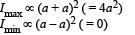
In a double slit experiment instead of taking slits of equal widths, one slit is made twice as wide as the other. Then, in the interference pattern
Detailed Solution: Question 20

In a compound microscope, the intermediate image is
Detailed Solution: Question 21
Two beams of light having intensities I and 4I interfere to produce a fringe pattern on a screen. The phase difference between the beams is π/2 at point A and π at point B. Then the difference between the resultant intensities at A and B is
Detailed Solution: Question 22




In a Young’s double slit experiment, 12 fringes are observed to be formed in a certain segment of the screen when light of wavelength 600 nm is used. If the wavelength of light is changed to 400 nm, number of fringes observed in the same segment of the screen is given by
Detailed Solution: Question 23

A ray of light passes through four transparent media with refractive indices μ1, μ2, μ3 and μ4 as shown in the figure.
The surfaces of all media are parallel. If the emergent ray CD is parallel to the incident ray AB, we must have
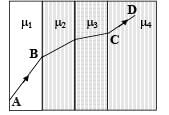
The surfaces of all media are parallel. If the emergent ray CD is parallel to the incident ray AB, we must have
Detailed Solution: Question 24
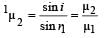 ...(1)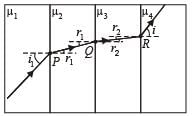


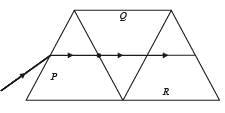
A given ray of light suffers minimum deviation in an equilateral prism P. Additional prism Q and R of identical shape and of the same material as P are now added as shown in the figure. The ray will now suffer
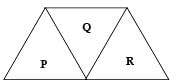
Detailed Solution: Question 25
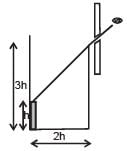
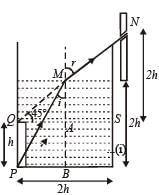
An observer can see through a pin-hole the top end of a thin rod of height h, placed as shown in the figure. The beaker height is 3h and its radius h. When the beaker is filled with a liquid up to a height 2h, he can see the lower end of the rod. Then the refractive index of the liquid is
Detailed Solution: Question 26
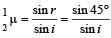
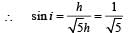 ...(ii)
Which one of the following spherical lenses does not exhibit dispersion? The radii of curvature of the surfaces of the lenses are as given in the diagrams.
Detailed Solution: Question 27
In the ideal double-slit experiment, when a glass-plate (refractive index 1.5) of thickness t is introduced in the path of one of the interfering beams (wave-lengh t λ), the intensity at the position where the central maximum occurred previously remains unchanged. The minimum thickness of the glass-plate is
Detailed Solution: Question 28
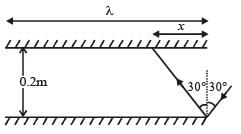
Two plane mirrors A and B are aligned parallel to each other, as shown in the figure. A light ray is incident at an angle 30° at a point just inside one end of A. The plane of incidence coincides with the plane of the figure. The maximum number of times the ray undergoes reflections (including the first one) before it emerges out is
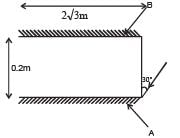
Detailed Solution: Question 29

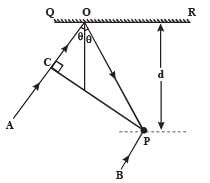
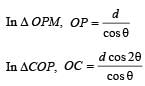
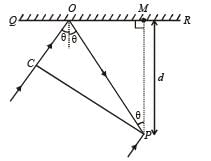
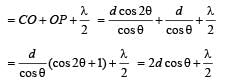
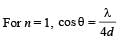
In the adjacent diagram, CP represents a wavefront and AO & BP, the corresponding two rays. Find the condition on θ for constructive interference at P between the ray BP and reflected ray OP.
Detailed Solution: Question 30

347 docs|185 tests |
