
MCQs (One or More Correct Option): Ray & Wave Optics | JEE Advanced - Free
MCQ Practice Test & Solutions: Test: MCQs (One or More Correct Option): Ray & Wave Optics | JEE Advanced (25 Questions)
You can prepare effectively for JEE Crack JEE with 35 Years of Previous Year Solved Papers with this dedicated MCQ Practice Test (available with solutions) on the important topic of "Test: MCQs (One or More Correct Option): Ray & Wave Optics | JEE Advanced". These 25 questions have been designed by the experts with the latest curriculum of JEE 2026, to help you master the concept.
Test Highlights:
- - Format: Multiple Choice Questions (MCQ)
- - Duration: 50 minutes
- - Number of Questions: 25
Sign up on EduRev for free to attempt this test and track your preparation progress.

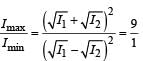
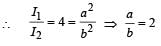
In the Young’ s double slit experiment, the interference pattern is found to have an intensity ratio between the bright and dark fringes as 9. This implies that
Detailed Solution: Question 1
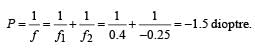
A convex lens of focal length 40 cm is in contact with a concave lens of focal length 25 cm . The power of the combination is
Detailed Solution: Question 2

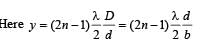
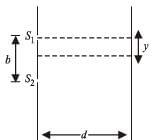
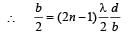
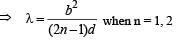
White light is used to illuminate the two slits in a Young’s double slit experiment. The separation between the slits is b and the screen is at a distance d (> b) from the slits. At a point on the screen directly in front of one of the slits, certain wavelengths are missing. Some of these missing wavelengths are
Detailed Solution: Question 3


A converging lens is used to form an image on a screen. When the upper half of the lens is covered by an opaque screen
Detailed Solution: Question 4
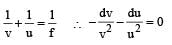
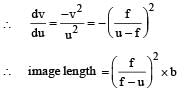
A short linear object of length b lies along the axis of a concave mirror of focal length f at a distanee u from the pole of the mirror. The size of the image is approximately equal to
Detailed Solution: Question 5
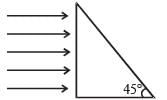
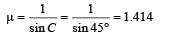
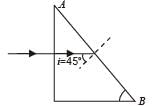
A beam of light consisting of red, green and blue colours is incident on a right angled prism, fig. The refractive indices of the material of the prism for the above red, green and blue wavelengths are 1.39, 1.44 and 1.47 respectively. The prism will
Detailed Solution: Question 6
An astronomical telescope has an angular magnification of magnitude 5 for distant objects. The separation between the objective and the eyepiece is 36 cm and the final image is formed at infinity. The focal length f0 of the objective and the focal length f0 of the eyepiece are
Detailed Solution: Question 7

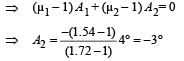
A thin prism P1 with angle 4° and made from glass of refractive index 1.54 is combined with another thin prism P2 made from glass of refractive index 1.72 to produce dispersion without deviation. The angle of the prism P2 is
Detailed Solution: Question 8
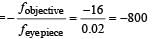
A planet is observed by an astronomical refracting telescope having an objective of focal length 16 m and an eyepiece of focal length 2 cm.
Detailed Solution: Question 9
Two thin convex lenses of focal lengths f1 and f2 are separated by a horizontal distance d (where d <f1, d< f2) and their centres are displaced by a vertical separation Δ as shown in the fig.
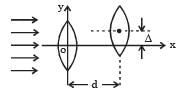
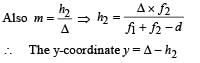
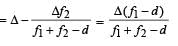
Taking the origin of coordinates O, at the centre of the first lens the x and y coordinates of the focal point of this lens system, for a parallel beam of rays coming from the left, are given by:
Detailed Solution: Question 10
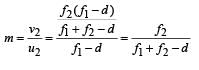
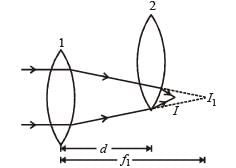 Applying lens formula for lens 2
 ∴ The horizontal distance of the image I from O is
Which of the following form(s) a virtual and erect image for all positions of the object ?
Detailed Solution: Question 11
A real image of a distant object is formed by a plano-convex lens on its principal axis. Spherical aberration
Detailed Solution: Question 12
A ray of light travelling in a transparent medium falls on a surface separating the medium from air at an angle of incidence of 45°. The ray undergoes total internal reflection. If n is the refractive index of the medium with respect to air, select the possible value(s) of n from the following :
Detailed Solution: Question 13

A parallel monochromatic beam of light is incident normally on a narrow slit. A diffraction pattern is formed on a screen placed perpendicular to the direction of the incident beam.
At the first minimum of the diffraction pattern, the phase difference between the rays coming from the two edges of the slit is
At the first minimum of the diffraction pattern, the phase difference between the rays coming from the two edges of the slit is
Detailed Solution: Question 14
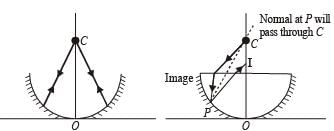
A concave mirror is placed on a horizontal table, with its axis directed vertically upwards. Let O be the pole of the mirror and C its centre of curvature. A point object is placed at C.
It has a real image, also located at C. If the mirror is now filled with water, the image will be.
It has a real image, also located at C. If the mirror is now filled with water, the image will be.
Detailed Solution: Question 15
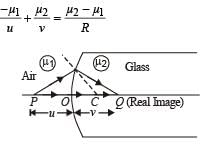
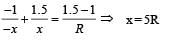
A spherical surface of radius of curvature R separates air (refractive index 1.0) from glass (refractive index 1.5). The centre of curvature is in the glass. A point object P placed in air is found to have a real image Q in the glass. The line PQ cuts the surface at a point O, and PO = OQ. The distance PO is equal to
Detailed Solution: Question 16
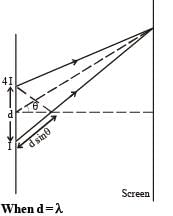
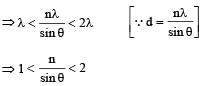
In a Young’s double slit experiment, the separation between the two slits is d and the wavelength of the light is l. The intensity of light falling on slit 1 is four times the intensity of light falling on slit 2. Choose the correct choice(s).
Detailed Solution: Question 17

A student performed the experiment of determination of focal length of a concave mirror by u-v method using an optical bench of length 1.5 meter. The focal length of the mirror used is 24 cm. The maximum error in the location of the image can be 0.2 cm. The 5 sets of (u, v) values recorded by the student (in cm) are :
(42, 56), (48, 48), (60, 40), (66, 33), (78, 39). The data set(s) that cannot come from experiment and is (are) incorrectly recorded, is (are)
Detailed Solution: Question 18
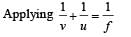

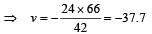

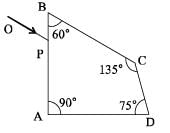
A ray OP of monochromatic light is incident on the face AB of prism ABCD near vertex B at an incident angle of 60° (see figure). If the refractive index of the material of the prism is √3, which of the following is (are) correct?
Detailed Solution: Question 19
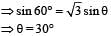
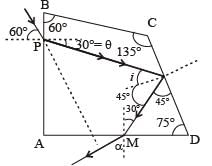
 which is less than 45°.
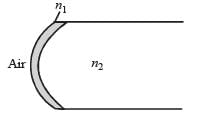
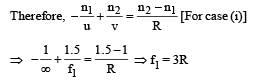
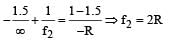
A transparent thin film of uniform thickness and refractive index n1 = 1.4 is coated on the convex spherical surface of radius R at one end of a long solid glass cylinder of refractive index n2 = 1.5, as shown in the figure. Rays of light parallel to the axis of the cylinder traversing through the film from air to glass get focused at distance f1 from the film, while rays of light traversing from glass to air get focused at distance f2 from the film, Then
Detailed Solution: Question 20
 ∴ (a) is a correct option
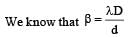
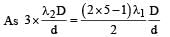
A light source, which emits two wavelength λ1 = 400 nm and λ2 = 600 nm, is used in a Young’s double slit experiment. If recorded fringe widths for λ1 and λ2 are β1 and β2 and the number of fringes for them within a distance y on one side of the central maximum are m1 and m2 respectively, then
Detailed Solution: Question 21
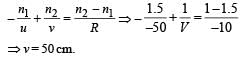
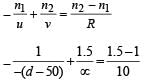
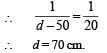
Two identical glass rods S1 and S2 (refractive index = 1.5) have one convex end of radius of curvature 10 cm. They are placed with the curved surfaces at a distance d as shown in the figure, with their axes (shown by the dashed line) aligned.
When a point source of light P is placed inside rod S1 on its axis at a distance of 50 cm from the curved face, the light rays emanating from it are found to be parallel to the axis inside S2. The distance d is
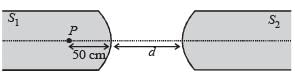
When a point source of light P is placed inside rod S1 on its axis at a distance of 50 cm from the curved face, the light rays emanating from it are found to be parallel to the axis inside S2. The distance d is
Detailed Solution: Question 22
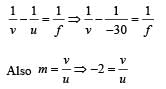
A plano–convex lens is made of a material of refractive index n. When a small object is placed 30 cm away in front of the curved surface of the lens, an image of double the size of the object is produced. Due to reflection from the convex surface of the lens, another faint image is observed at a distance of 10 cm away from the lens. Which of the following statement(s) is(are) true?
Detailed Solution: Question 23
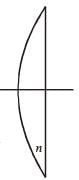
 The image formed by convex side is faint erect and virtual.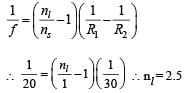
A transparent slab of thickness d has a refractive index n(z) that increases with z. Here z is the vertical distance inside the slab, measured from the top. The slab is placed between two media with uniform refractive indices n1 and n2 (> n1), as shown in the figure. A ray of light is incident with angle θi, from medium 1 and emerges in medium 2 with refraction angle θt with a lateral displacement l.
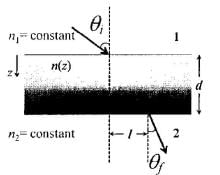
Which of the following statement(s) is(are) true?
Detailed Solution: Question 24
While conducting the Young’s double slit exper iment, a student replaced the two slits with a large opaque plate in the x-y plane containing two small holes that act as two coherent point sources (S1, S2) emitting light of wavelength 600 nm. The student mistakenly placed the screen parallel to the x-z plane (for z > 0) at a distance D = 3 m from the midpoint of S1S2, as shown schematically in the figure. The distance between the sources d = 0.6003 mm. The origin O is at the intersection of the screen and the line joining S1S2.
Which of the following is(are) true of the intensity pattern on the screen?
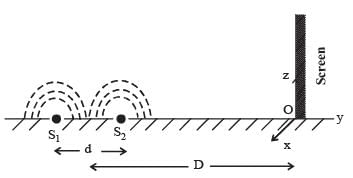
Which of the following is(are) true of the intensity pattern on the screen?
Detailed Solution: Question 25
347 docs|185 tests |
