Civil Engineering (CE) Exam  >  Civil Engineering (CE) Test  >  GATE 2027 Mock Test Series  >  Test: Environmental Engineering- 4 - Civil Engineering (CE) MCQ

GATE Civil Engineering (CE) 2027 Test: Environmental Engineering- 4 Free


MCQ Practice Test & Solutions: Test: Environmental Engineering- 4 (10 Questions)

You can prepare effectively for Civil Engineering (CE) GATE Civil Engineering (CE) 2027 Mock Test Series with this dedicated MCQ Practice Test (available with solutions) on the important topic of "Test: Environmental Engineering- 4". These 10 questions have been designed by the experts with the latest curriculum of Civil Engineering (CE) 2026, to help you master the concept.

Test Highlights:

  • - Format: Multiple Choice Questions (MCQ)
  • - Duration: 30 minutes
  • - Number of Questions: 10

Sign up on EduRev for free to attempt this test and track your preparation progress.

Test: Environmental Engineering- 4 - Question 1

Arrange the given lakes in the descending order of their productivity level

Mesotrophic Lakes

Oligotrophic Lakes

Eutrophic Lakes

Detailed Solution: Question 1

Eutrophic Lakes: These are the lakes of high productivity level, hence support high growth of algae.

Mesotrophic Lakes: These are the lakes of intermediate productivity level, hence support intermediate growth of algae. 

Oligotrophic Lakes: These are the lakes of least productivity level, hence support negligible growth of algae.

Test: Environmental Engineering- 4 - Question 2

The following zones are formed in a polluted river.

(1) zone of clear water

(2) zone of active decomposition

(3) zone of recovery

(4) zone of pollution

The correct sequence in which these zones occur progressively downstream in a polluted river is

Detailed Solution: Question 2


Test: Environmental Engineering- 4 - Question 3

In conventional activates sludge process, the mean cell residence time in the aeration tank is–

Detailed Solution: Question 3

Mean cell residence time in activated sludge process in aeration tank is in range of 4 to 15 days.

Test: Environmental Engineering- 4 - Question 4

The ultimate BOD value of a waste -

Detailed Solution: Question 4

The ultimate BOD value of waste is the amount of biodegradable organic matter presents in the sewage sample. At any temperature the amount of organic matter present does not change, so the ultimate BOD will remain same for any temperature.

*Answer can only contain numeric values
Test: Environmental Engineering- 4 - Question 5

Deoxygenation constant [kD] at 40o C ----- per day. Assume kD at 20o C is 0.13 per day.


Detailed Solution: Question 5

[kD]To= [kD]20o[1.047]T - 20               

[kD]40oC = 0.13 [1.047]40 - 20               

[kD]40oC = 0.13 [1.047]20               

[kD]40oC = 0.326 per day

Test: Environmental Engineering- 4 - Question 6

The technique utilized for the disposal of biomedical waste​, in which it is in contact with steam under controlled pressure and temperature condition with the end goal to complete sterilization is

Detailed Solution: Question 6

Autoclaving:- The method used for the disposal of biomedical waste is , in which it is brought in closed contact with steam under controlled pressure and temperature condition in order to carry out disinfection.

Pulverization and Shredding: Basically this is not a method of disposal but in these method heavier solids are broken into the lighter one either by cutting action or by grinding action.

Pulverization refers to the action of crushing and grinding, whereas shredding refers to the action of cutting and tearing.

Pyrolysis: is a method of disposal of the refuse in which burning of refuse is generally done at high temperature in the almost absence of oxygen.

Test: Environmental Engineering- 4 - Question 7

The ultimate BOD of wastewater is 300 mg/L and the reaction rate constant (to the base ‘e’) at 20°C is 0.3585/day, then the 5 days BOD at 20oC will be.

Detailed Solution: Question 7

Concept:

Ultimate BOD = Lo

BOD5­ = 5day BOD, of water/waste water

BOD at any time ‘t’ is (Lt)
Lt = Lo(1 − e−kDt)

Where Lo = ultimate BOD

KD = Rate constant

Calculation:

Lt = 300 × (1 – e-0.3585 × t)

L5 = BOD5 = 300 × (1 – e-0.3585 × 5)

= 250 mg/L

*Answer can only contain numeric values
Test: Environmental Engineering- 4 - Question 8

The percentage of the relative stability of a test conducted for the determination of relative conductivity at 20°C when the incubation was done for 20 days is _____


Detailed Solution: Question 8

Relative stability (Sr) at 20°C
Sr = 100 [1 − (0.794)t]
= 100 [1− (0.794)20]
= 99.01%

*Answer can only contain numeric values
Test: Environmental Engineering- 4 - Question 9

A domestic sewage has a BOD of 90 gm per capita. The waste is flowing at a rate of 0.9 MLD having a BOD of 200 mg/l. The population equivalent of the waste is _____.


Detailed Solution: Question 9
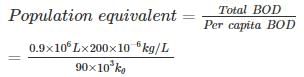
Q = 0.9 MLD

5 day BOD, Y5 = 200 mg/L

= 2000

Test: Environmental Engineering- 4 - Question 10

A large stream has a reoxygenation constant of 0.45 per day and at a point at which organic pollutant is discharged, it is saturated with oxygen at 12 mg/L (Do = 0). Below the outfall, the ultimate demand for oxygen is found to be 19 mg/l and the Deoxygenation Constant is 0.2 per day. Calculate, the D.O at 36 km downstream Assume velocity of the stream to be 1.2 m/s.

Detailed Solution: Question 10
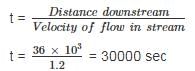
Time required for certain amount of D.O at 36 km downstream is given by

t = 0.3472 days

Oxygen deficit after time t


Dt = 2.35 mg/l

D.O at 36 km downstream = 12 - 2.35

= 9.65 mg/l

33 docs|280 tests
Information about Test: Environmental Engineering- 4 Page
In this test you can find the Exam questions for Test: Environmental Engineering- 4 solved & explained in the simplest way possible. Besides giving Questions and answers for Test: Environmental Engineering- 4, EduRev gives you an ample number of Online tests for practice
Download as PDF
