Electronics and Communication Engineering (ECE) Exam  >  Electronics and Communication Engineering (ECE) Test  >  GATE ECE (Electronics) Mock Test Series 2027  >  Test: Electronic Devices - 4 - Electronics and Communication Engineering (ECE) MCQ

GATE ECE (Electronics) Test: Electronic Devices - 4 Free Online Test 2026


MCQ Practice Test & Solutions: Test: Electronic Devices - 4 (10 Questions)

You can prepare effectively for Electronics and Communication Engineering (ECE) GATE ECE (Electronics) Mock Test Series 2027 with this dedicated MCQ Practice Test (available with solutions) on the important topic of "Test: Electronic Devices - 4". These 10 questions have been designed by the experts with the latest curriculum of Electronics and Communication Engineering (ECE) 2026, to help you master the concept.

Test Highlights:

  • - Format: Multiple Choice Questions (MCQ)
  • - Duration: 30 minutes
  • - Number of Questions: 10

Sign up on EduRev for free to attempt this test and track your preparation progress.

Test: Electronic Devices - 4 - Question 1

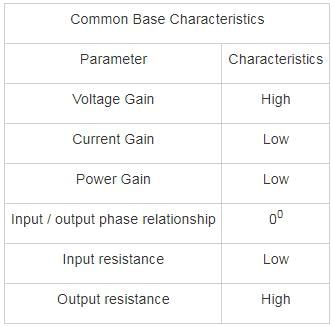
For a single stage BJT common base amplifier.

Detailed Solution: Question 1


∴ Voltage gain can be greater than unity but current gain is always less than unity.

*Answer can only contain numeric values
Test: Electronic Devices - 4 - Question 2

A bipolar transistor has an emitter current of 1 mA. The emitter injection efficiency is 0.99, base transit factor is 0.995 and depletion region recombination factor of 0.998. The base current flowing through the transistor is _____μA.


Detailed Solution: Question 2

The common emitter current gain is given by:

α = γ ∗ β ∗ δ

= 0.99 × 0.995 × 0.998 = 0.983

Collector current

Ic = αIE = 0.983 mA

Base current

IB = IE – IC

= 17 μA 

*Answer can only contain numeric values
Test: Electronic Devices - 4 - Question 3

In a Bi-polar junction transistor the base width is 0.54 μm and base diffusion constant is DB = 25 cm2/sec. The Base transit time time is ________ × 10-10 sec


Detailed Solution: Question 3
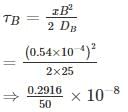
The Base transit time

⇒ 0.5832 × 10⁻¹⁰

*Answer can only contain numeric values
Test: Electronic Devices - 4 - Question 4

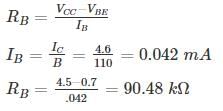
Find the value of bias resistor (in kΩ) if quiescent collector current and voltage value are 4.6 mA and 2.2 V. The transistor has DC gain 110, VBE = 0.7 V and VCC = 4.5 V.
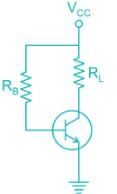

Detailed Solution: Question 4
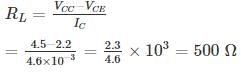
Applying KVL in collector to emitter loop

VCC = RLIC + VCE


Now applying KVL in collector to base loop

IBRB + VBE = VCC

Test: Electronic Devices - 4 - Question 5

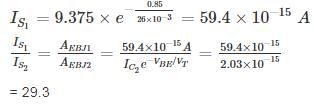
Consider two pnp bipolar junction transistors. For the first transistor when emitter to collector voltage is 5 V, VEB is 0.85 V and emitter current is 10 A. (The β for this transistor is 15). Second BJT conducts with a collector current of 1 mA and VEB = 0.70. The ratio of emitter-base junction area of the first transistor to the second transistor is ______.

(Assume KT = 26 mV)

Detailed Solution: Question 5
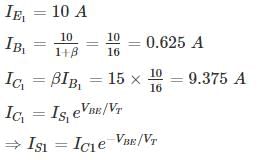
Given: VEC = 5V-, this means pnp transistor is operating in the active node

*Answer can only contain numeric values
Test: Electronic Devices - 4 - Question 6

The leakage current of a transistor with usual notation are ICEO = 410 μA, ICBO = 5 μA, and IB = 30μA. Calculate the IC ________mA


Detailed Solution: Question 6

ICEO = 410 μA, ICBO = 5 μA, IB = 30 μA

IC­ = βIB + (1 + β) ICBO

ICEO = (1 + β) ICBO

410 = (1 + β)5

β = 81

IC = 81 × 30 + 82 × 5

IC = 2.84 mA

Test: Electronic Devices - 4 - Question 7

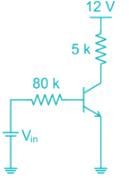
For what value of current gain β , the given transistor will be in saturation

(Assume Vin = 5V, VBE(SAT) = 0.8 V , VCE(SAT) = 0.2V)
Detailed Solution: Question 7

Apply kVL in base emitter loop

at saturation VBE(sat) = 0.8

substituting the value of VBE

IB = 0.0525 mA

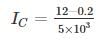
Apply Kvl , Form the collector to emitter

5 × 10³ × I+ VCE = 12 V

= 2.36 mA

At the edge of saturation

Hence for β value greater than 45 the transistor will be in saturation

*Answer can only contain numeric values
Test: Electronic Devices - 4 - Question 8

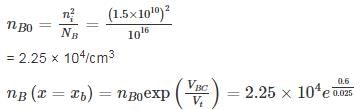
An npn bipolar transistor having uniform doping of NE = 1018 cm-3 NB = 1016 cm-3 and NC = 6 × 1015 cm-3 is operating in the inverse-active mode with VBE = -2V and VBC = 0.6 V. The geometry of transistor is shown
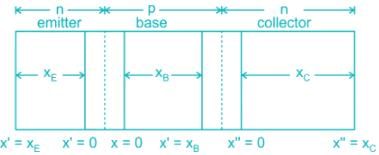
The minority carrier concentration at x = xB is _____ × 1014 cm-3

(Assume n = 1.5 × 10¹⁰/cm3, Vt ­= 25 mV)


Detailed Solution: Question 8


= 5.96 × 1014 cm-3

Test: Electronic Devices - 4 - Question 9

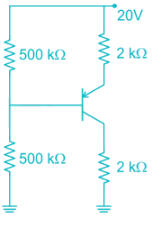
The common emitter forward current gain of the transistor shown is β = 100
The transistor is operating in
Detailed Solution: Question 9
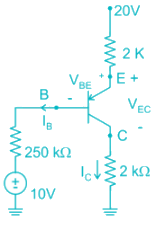

Assume Transistor in Active region

20 – 2 (IB + IC) – 0.7 – 250 IB – 10 = 0

20 – 2 × 101 IB – 0.7 – 250 IB – 10 = 0

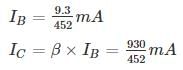
10 – 452 IB – 0.7 = 0

20 – 2 (IB + IC) - VEC – 2IC = 0

20 – 202 IB - VEC = 0


VEC = 11.68 V

VCB = VCE + VEB = -VEC + VEB = - 11.68 + .7

VCB = -10.98

∴ Collector base junction is Reverse Biased

∴ Transistor is operating in forward active region


Second Method

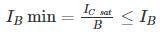
Assume transistor in saturation region

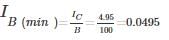
IB min ≤ IB

i) VEB (sat) = 0.8 V

ii) VEC (sat) = 0.2 V


IC ≠ βIB ----- Because it is valid only active region

20 – 2 (IB + IC) – 0.8 - 250 IB – 10 = 0

20 – 2 IB – 2IC – 0.8 – 250 IB – 10 = 0

10 – 252 IB – 2IC – 0.8 = 0

252 IB + 2I= 9.2      -------- (1)

20 – 2 (IB + IC) – VEC(sat) – 2IC = 0

20 – 2IB – 2IC – 0.2 – 2IC = 19.8      -------- (2)

By solving equation (1) and (2)

IB = 0.00278 mA

IC = 4.95 mA

∴ IB(min) > IB

∴ Transistor is operating in forward active region

Test: Electronic Devices - 4 - Question 10

In a silicon PNP transistor the mobility of charge carries is μ4 = 1300 cm2/V-s and μp = 450 cm2/V-s and carrier life time τp = 0.10 μs. The most appropriate base width for effective transistor function is (Take T = 300° k)

Detailed Solution: Question 10

Given μn = 1300 cm2/V-s and μp = 450 cm2/V-s

Dp = 450 × 0.0259

= 11.655 cm2/s

Base diffusion length  = 1.08 mm

For injected holes from emitter to reach the collector they should not be recombined in base. Hence the base width should be very less compared to base diffusion length.

W ≪ LP

In all options the base width is significant compared to base diffusion length.

26 docs|263 tests
Information about Test: Electronic Devices - 4 Page
In this test you can find the Exam questions for Test: Electronic Devices - 4 solved & explained in the simplest way possible. Besides giving Questions and answers for Test: Electronic Devices - 4, EduRev gives you an ample number of Online tests for practice
Download as PDF