NEET Exam  >  NEET Test  >  Chemistry Class 12  >  R.C. Mukherjee Test: Solutions - NEET MCQ

Solutions - NEET Chemistry Class 12 Free MCQ Test


MCQ Practice Test & Solutions: R.C. Mukherjee Test: Solutions (30 Questions)

You can prepare effectively for NEET Chemistry Class 12 with this dedicated MCQ Practice Test (available with solutions) on the important topic of "R.C. Mukherjee Test: Solutions". These 30 questions have been designed by the experts with the latest curriculum of NEET 2026, to help you master the concept.

Test Highlights:

  • - Format: Multiple Choice Questions (MCQ)
  • - Duration: 45 minutes
  • - Number of Questions: 30

Sign up on EduRev for free to attempt this test and track your preparation progress.

R.C. Mukherjee Test: Solutions - Question 1

Select correct statement -

Detailed Solution: Question 1

For 1 molal NaCl, van’t Hoff factor i is 2, so ΔTb = i × Kb × m = 2 × Kb × 1 = 2Kb. For 1 molal sucrose, i = 1, so ΔTb = 1 × Kb × 1 = Kb. Therefore, the boiling point elevation of NaCl solution is twice that of sucrose solution. For 1 molal KCl, i = 2, and for 1 molal glucose, i = 1, so ΔTb for glucose is half that for KCl. Boiling point elevation is a colligative property because it depends only on the number of solute particles and not their identity.

R.C. Mukherjee Test: Solutions - Question 2

Total vapour pressure of mixture of 1 mol volatile component A(pº= 100 mmHg) and 3 mol of volatile component B (pº= 60 mmHg) is 75 mm. For such case -

Detailed Solution: Question 2

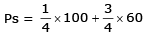
As, we know that

= 25 + 45 mm Hg
= 70 mm Hg
To mm Hg < 75 mm Hg thus there is positive deviation from Raoults law,
so (A) is correct
(B) If v.p. is increasing boiling point will be lowered in that case
(C) is correct that force of attraction between A & B is smaller than that between A and A or between B and B.
So All statement are corrrect

R.C. Mukherjee Test: Solutions - Question 3

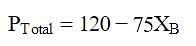
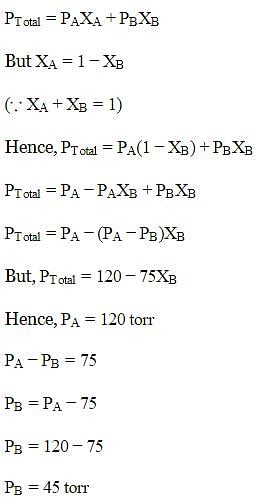
At a given temperature, total vapour pressure in Torr of a mixture of volatile components A and B is given by
​​​​​​
hence, vapour pressure of pure A and B respectively (in Torr) are -
Detailed Solution: Question 3


R.C. Mukherjee Test: Solutions - Question 4

Van't Hoff factors of aqueous solutions of X, Y, Z are 1.8, 0.8 and 2.5. Hence, their (assume equal concentrations in all three cases) then correct order is :-

Detailed Solution: Question 4

As van't Holf factor increases RLVP increases i.e.,V,P. decreases y > x > z

R.C. Mukherjee Test: Solutions - Question 5

Decimolar solution of potassium ferricyanide, K3[Fe(CN)6] has osmotic pressure of 3.94 atm at 27ºC. Hence percent ionisation of the solute is -


Detailed Solution: Question 5

π = iCRT
K3[Fe(CN)6] = 3k+ + [Fe(CN)6]3–

i = (1 + 3α)

α = 0.2
so  20%

R.C. Mukherjee Test: Solutions - Question 6

An aqueous solution of urea containing 18 g urea in 1500 cm3 of solution has a density of 1.052 g/cm3. If the molecular weight of urea is 60, then the molality of solution is-

Detailed Solution: Question 6

The correct answer is Option B.

Density is the ratio of mass to volume.
Density is 1.052 g/ml.
1500 ml of solution corresponds to       
= 1.052 g/ml×1500ml
= 1578 g     
Molar mass of urea is 60 g/mol. Number of moles of urea is the ratio of mass to molar mass. It is 18g / 60g/mol = 0.3mol
 
Molality of solution is the ratio of the number of moles of urea to the mass of solvent in kg.
Mass of water =1578 g − 18 g
                          =1560g
                          =1.560kg (as 1 kg = 1000g)
Molality = 0.3 / 1.560
              = 0.192m
 

R.C. Mukherjee Test: Solutions - Question 7

2.56 g of sulphur in 100 g of CShas depression in f.p. of 0.010º, K= 0.1º (molal)-1. Hence, atomicity of sulphur is -

Detailed Solution: Question 7


M = 256
M = 8 × 32
Thus atomicity = 8

R.C. Mukherjee Test: Solutions - Question 8

Consider following solutions -

I : 1 M a glucose II. : 1 M a sodium chloride

III. : 1 M benzoic acid in benzene IV. : 1 M ammonium phosphate

Select incorrect statement -

Detailed Solution: Question 8

(A) All solutions are not isotonic because all solution are not at equal concentration so (A) is incorrect
(B) As benzoic acid dimerises so III is hypotonic of I, II, IV
(C) Is also correct as I, II & IV are hypertonic of III
(D) As ammoniun sulphate has maximum number of particale so it will be hypertonic of I, II, III

R.C. Mukherjee Test: Solutions - Question 9

The relationship between osmotic pressure at 273 K when 10 g glucose (P1) 10 g urea (P2) and 10 g sucrose (P3) are dissolved in 250 ml of water is -

Detailed Solution: Question 9

As number of moles is maximum in case urea > glucose > sucrose
π = CRT
It depends on number of moles so osmotic pressure
P2 > P1 > P3

R.C. Mukherjee Test: Solutions - Question 10

The osmotic pressure of a solution of benzoic acid dissolved in benzene is less than expected because-

Detailed Solution: Question 10

As benzoic acid dimerises so number of moles decreases so osmotic pressure of benzoic acid is less than benzene.

R.C. Mukherjee Test: Solutions - Question 11

Assuming each salt to be 90% dissociated, which of the following will have highest osmotic pressure

Detailed Solution: Question 11

Higher the number of particles higher will be osmoatic pressure so (A) will be answer in case of (D) precipitaiton will take place so number of particles will decrease.

R.C. Mukherjee Test: Solutions - Question 12

Which one of the following pairs of solution can we expect to be isotonic at the same temperature-

Detailed Solution: Question 12

Isotonic means equal osmotic pressure so, π1 = π2
i1C1RT = i2C2RT
so i1C1 = i2C2
In case of (D) both the volume of (i) & (C) are equal.

R.C. Mukherjee Test: Solutions - Question 13

For a solution containing non-volatile solute, the relative lowering of vapour pressure is 0.2. If the solution contains 5 moles in all, which of the following are true ?

I. Mole fraction of solute in the solution is 0.2
II. No. of moles of solute in the solution is 0.2
III. No. of moles of solvent in the solution is 4
IV. Mole fraction of solvent is 0.2 -

Detailed Solution: Question 13


As we know relative lowering of v.p. is equal to the mole fraction of the solute so (I) is correct it doesn’t depend upon the number of moles so (II) is wrong mole fraction of solvent will be 0.8 so number of moles of solvent will be 4 so (III) will be correct, (IV) will be also wrong so I & III will be correct

R.C. Mukherjee Test: Solutions - Question 14

A complex containing K+, Pt (IV) and Clis 100% ionised giving i = 3. Thus, complex is

Detailed Solution: Question 14

In option (B) oxidaton state of platinum is (iv)
x – 6 = –2
x = + 4

R.C. Mukherjee Test: Solutions - Question 15

If pK= -log K= 4, and K= Cαthen van't Hoff factor for weak monobasic acid when C = 0.01 M is-

Detailed Solution: Question 15

i = 1 + α
10–4 = Cα2

i = 1 + 2 = 1 + 0.1 = 1.1

R.C. Mukherjee Test: Solutions - Question 16

pH of 1M HA (weak acid) is 2. Hence van't Hoff factor is -
Detailed Solution: Question 16

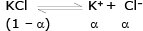
HA = H+ + A
(1 – α) α       α
PH = 2 = [H+]  : 10–2  = C2
a = 0.1
i = 1 + α = 1 + 0.1 = 1.01

R.C. Mukherjee Test: Solutions - Question 17

In which case van't Hoff factor is maximum

Detailed Solution: Question 17

(a) As we know
 i = 1 + α

i = 1 + α =  50 % dissociation
i = 1.5

1 + Zα ,  α = .4
i = 1.8

1 + 3α
i = 1.9

1 + 4α
i = 1.8

R.C. Mukherjee Test: Solutions - Question 18

If 18 gram of glucose (C6H12O6) is present in 1000 gram of an aqueous solution of glucose it is said to be-

Detailed Solution: Question 18

18 gm of glucose means 0.1mole of glucose as it present in 1000 gm of solvent so it is 0.1 mole

R.C. Mukherjee Test: Solutions - Question 19

What is the molarity of H2SO4 solution that has a density of 1.84 gm/cc at 350C and contains 98% by weight-
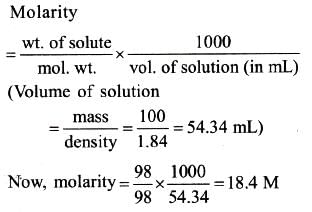
Detailed Solution: Question 19

R.C. Mukherjee Test: Solutions - Question 20

In order to prepare 100 cm3 of 0.250 M barium chloride solution the amount of BaCl2·2H2O required will be-

Detailed Solution: Question 20

Correct answer: D.

Number of moles required (n) = M × V (with V in litres).

n = 0.250 × 0.100 = 0.0250 mol.

Molar mass of BaCl2·2H2O = 137.33 + 2×35.45 + 2×(2×1.008 + 16.00) = 244.26 g mol-1.

Mass required = n × Molar mass = 0.0250 × 244.26 = 6.1065 g ≈ 6.11 g.

Rounded to the precision given in the options, this is 6.1 g, so option D is correct.

R.C. Mukherjee Test: Solutions - Question 21

25 mL of 3 M HCl were added to 75 mL of 0.05 M HCl. The molarity of HCl in the resulting solution is approximately-

Detailed Solution: Question 21

Mole of HCl = 25 × 3 +75 × 0.05 = 75 + 3.75 = 78.75

R.C. Mukherjee Test: Solutions - Question 22

0.2 mole of HCl and 0.1 mole of CaCl2 were dissolved in water to have 500 ml of solution, the molarity of Cl- ions is?

Detailed Solution: Question 22

Option B is correct.

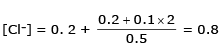
Each HCl molecule gives one chloride ion, so moles of Cl- from HCl = 0.2 mol.

Each CaCl2 formula unit gives two chloride ions, so moles of Cl- from CaCl2 = 0.1 × 2 = 0.2 mol.

Total moles of Cl- = 0.2 + 0.2 = 0.4 mol.

Volume in litres = 500 ml = 0.5 L.

[Cl-] = 0.4 mol ÷ 0.5 L = 0.8 M.

Final answer: 0.8 M (Option B).

R.C. Mukherjee Test: Solutions - Question 23

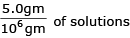
When 5.0 gram of BaCl2 is dissolved in water to have 106 gram of solution. The concentration of solution is-
Detailed Solution: Question 23


so concentration of solution = 5 ppm

R.C. Mukherjee Test: Solutions - Question 24

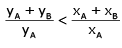
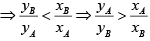
For an ideal binary liquid solution with , which relation between XA(molefraction of A in liquid phase) and YA (mole fraction of A in vapour phase) is correct?

Detailed Solution: Question 24


R.C. Mukherjee Test: Solutions - Question 25

Mole fraction of A vapours above the solution in mixture of A and B(XA = 0.4) will be

[Given :  = 100 mm Hg and  = 200 mm Hg]

Detailed Solution: Question 25


= 40 + 120 = 160

π 40 = yA × 160
⇒ yA = ¼

R.C. Mukherjee Test: Solutions - Question 26

The exact mathematical expression of Raoult's law is

Detailed Solution: Question 26

The exact mathematical expression of Raoult's law is 
Here, Po represents the vapour pressure of the pure solvent, P represents the vapour pressure of the solution, n represents the number of moles of solute and N represents the number of moles of the solvent.

R.C. Mukherjee Test: Solutions - Question 27

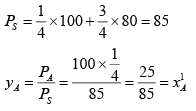
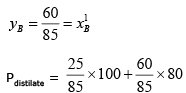
A mixture contains 1 mole of volatile liquid A (P°A = 100 mm Hg) and 3 moles of volatile liquid B (P°B = 80 mm Hg). If the solution behaves ideally, the total vapour pressure of the distillate is
Detailed Solution: Question 27

Option A is correct.

For an ideal solution use Raoult's law: PA = xA × P°A and PB = xB × P°B.

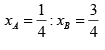
Liquid mole fractions: xA = 1/4 and xB = 3/4.

Partial pressures: PA = (1/4) × 100 = 25 mm Hg and PB = (3/4) × 80 = 60 mm Hg.

Total vapour pressure = PA + PB = 25 + 60 = 85 mm Hg.


R.C. Mukherjee Test: Solutions - Question 28

Which of the following aqueous solution will show maximum vapour pressure at 300 K?

Detailed Solution: Question 28

less no of particle of solute means maximum vapour pressure.

R.C. Mukherjee Test: Solutions - Question 29

The Van't Hoff factor for a dilute aqueous solution of glucose is

Detailed Solution: Question 29

Glucose does not dissociate
⇒ i = 1

R.C. Mukherjee Test: Solutions - Question 30

The correct relationship between the boiling points of very dilute solution of AlCl3(T1K) and CaCl2(T2K) having the same molar concentration is

Detailed Solution: Question 30

AlCl3 = no. of particle = 4
CaCl2 = no. of particle = 3
(vapour pressure of AlCl3) < (vapour pressure of CaCl2 solution)
TB.P. (AlCl3) > TB.P. (CaCl2)
T1 > T2

56 videos|296 docs|82 tests
Information about R.C. Mukherjee Test: Solutions Page
In this test you can find the Exam questions for R.C. Mukherjee Test: Solutions solved & explained in the simplest way possible. Besides giving Questions and answers for R.C. Mukherjee Test: Solutions, EduRev gives you an ample number of Online tests for practice
56 videos|296 docs|82 tests
Download as PDF