
General Properties of Group-17 (Halogens) - Free MCQ Practice Test
MCQ Practice Test & Solutions: Test: General Properties of Group-17 (Halogens) (25 Questions)
You can prepare effectively for NEET Chemistry Class 12 with this dedicated MCQ Practice Test (available with solutions) on the important topic of "Test: General Properties of Group-17 (Halogens)". These 25 questions have been designed by the experts with the latest curriculum of NEET 2026, to help you master the concept.
Test Highlights:
- - Format: Multiple Choice Questions (MCQ)
- - Duration: 35 minutes
- - Number of Questions: 25
Sign up on EduRev for free to attempt this test and track your preparation progress.

Direction (Q. Nos. 1-10) This section contains 10 multiple choice questions. Each question has four choices (a), (b), (c) and (d), out of which ONLY ONE is correct.
Q.
Which of the following property decreases down the group in the halogens?
Detailed Solution: Question 1
Which of the following represents the decreasing order of van der Waals’ forces in halogens ?
Detailed Solution: Question 2

The correct order of in creasing order of radiiions Br- , F-, O2- and S2- is as follow
Detailed Solution: Question 3
The correct order for the percentage of ionic character is
Detailed Solution: Question 4
Which of the following statement is incorrect ?
Detailed Solution: Question 5
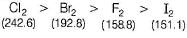
Which option is incorrect among the following for the given property?
Detailed Solution: Question 6
When Cl2 gas reacts with hot and concentrated sodium hydroxide solution, the oxidation number of chlorine changes from
Detailed Solution: Question 7

Which of the following does not exist?
Detailed Solution: Question 8
One gas bleaches the colour of flowers by reduction and another gas by oxidation. The gases respectively are
Detailed Solution: Question 9
Detailed Solution: Question 10
Direction (Q. Nos. 11-15) This section contains 5 multiple choice questions. Each question has four choices (a), (b), (c) and (d), out of which ONE or MORE THAN ONE are correct.
Q.
The fluoride ores are
Detailed Solution: Question 11
Which one of the following arrangements do not give the correct picture of the trends indicated against it?
Detailed Solution: Question 12
Which of the following are insoluble in water?
Detailed Solution: Question 13
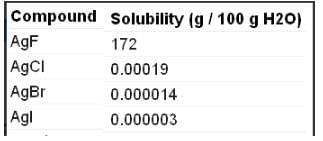
Detailed Solution: Question 14
When chlorine reacts with hot, cone. NaOH, the products formed are
Detailed Solution: Question 15
 + 3H2O
Direction (Q. Nos. 16 and 17) This section contains a paragraph, describing theory, experiments, data, etc. Two questions related to the paragraph have been given. Each question has only one correct answer among the four given options (a), (b), (c) and (d).
Passage
Group 17 elements are known as halogens ( sea salt forming). Their general configuration is ns2np5 where, n = 2 to 7. Fluorine is the first member of the group differs in several ways from the rest of the group. Halogens are highly reactive elements having strong affinity for hydrogen. All the halogens form both ionic and covalent compounds .Fluorine is always monovalent and shows -1 oxidation state in its compounds .The other halogens exhibit 1, 3, 5, 7 valencies in their compounds and show - 1 to + 7 oxidation states.
Q. Valence shell configuration that belongs to most reactive non-metal is
Detailed Solution: Question 16
Passage
Group 17 elements are known as halogens ( sea salt forming). Their general configuration is ns2np5 where, n = 2 to 7. Fluorine is the first member of the group differs in several ways from the rest of the group. Halogens are highly reactive elements having strong affinity for hydrogen. All the halogens form both ionic and covalent compounds .Fluorine is always monovalent and shows -1 oxidation state in its compounds .The other halogens exhibit 1, 3, 5, 7 valencies in their compounds and show - 1 to + 7 oxidation states.
Q.
In which of the following chlorine has different oxidation states?
Detailed Solution: Question 17
Direction (Q. No. 18 and 19) Choices for the correct combination of elements from Column I and Column II are given as options (a), (b), (c) and (d), out of which one is correct.
Q.
Match the Column I with Column II and mark the correct option from the codes given below.
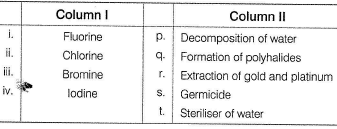
Detailed Solution: Question 18

Match the Column I with Column II and mark the correct option from the codes given below.
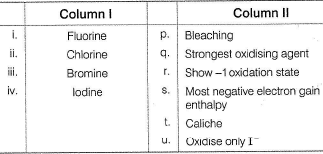
Detailed Solution: Question 19

Direction (Q, Nos. 20-24) This section contains 5 questions. When worked out will result in an integer from 0 to 9 (both inclusive).
Q.
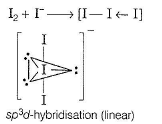
The num ber of lone pair of electrons present on the central iodine in I-3 ion is
Detailed Solution: Question 20
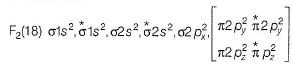
In the MOT of F2 molecule, number of electrons occupying antibonding orbitals are
Detailed Solution: Question 21
The total number of positive oxidation states shown by fluorine is
Detailed Solution: Question 22
When carnallite is dissolved in water the number of ions formed are
Detailed Solution: Question 23

The number of water insoluble salts among
AgF, AgCI, AgBr, Agl BeF2, CaF2,KF, PbCI2, HgCI2
Detailed Solution: Question 24
Direction (Q. No. 25) This section is based on Statement I and Statement II. Select the correct answer from the codes given below.
Q.
Statement I : All halogens are coloured.
Statement II : Halogens absorbs part of the light in the visible region.
Detailed Solution: Question 25
54 videos|290 docs|74 tests |
