CBSE Class 7  >  Class 7 Test  >  Mathematics Olympiad   >  Olympiad Test: Dice - 2 - Class 7 MCQ

Olympiad Test: Dice - 2 - Free MCQ with solutions Class 7 Mathematics


MCQ Practice Test & Solutions: Olympiad Test: Dice - 2 (10 Questions)

You can prepare effectively for Class 7 Mathematics Olympiad Class 7 with this dedicated MCQ Practice Test (available with solutions) on the important topic of "Olympiad Test: Dice - 2". These 10 questions have been designed by the experts with the latest curriculum of Class 7 2026, to help you master the concept.

Test Highlights:

  • - Format: Multiple Choice Questions (MCQ)
  • - Duration: 20 minutes
  • - Number of Questions: 10

Sign up on EduRev for free to attempt this test and track your preparation progress.

Olympiad Test: Dice - 2 - Question 1

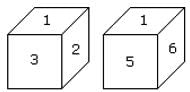
Two positions of a cube with its numbered surfaces are shown below. When the surface 4 touches the bottom, which surface will be on the top?
Detailed Solution: Question 1

In these 2 positions one common face with number 1 is in the same position. Hence according to the rule number (3), 2 is opposite 6 and 3 is opposite to 5. Therefore opposite to 4 is 1.

Olympiad Test: Dice - 2 - Question 2

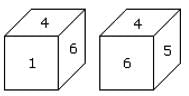
Two positions of a dice are shown below. When number ‘1’ is on the top. What number will be at the bottom?
Detailed Solution: Question 2

According to the rule (2) when ‘one’ is at the top, then 5 will be at the bottom.

Olympiad Test: Dice - 2 - Question 3

Which number is on the face opposite to 6?

Detailed Solution: Question 3

As the numbers 2, 3, 4 and 5 are adjacent to 6. Hence the number on the face opposite to 6 is 1.

Olympiad Test: Dice - 2 - Question 4

Six dice with upper faces erased are shown as:
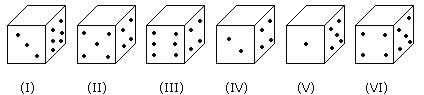
The sum of the numbers of dots on the opposite face is 7.
Q. If even numbered dice have even number of dots on their top faces, then what would be the total number of dots on the top faces of their dice?

Detailed Solution: Question 4

Even numbered dice are: (II), (IV) and (VI)
No. of dots on the top face of (II) dice = 6
No. of dots on the top face of (IV) dice = 6
and No. of dots on the top face of (VI) dice = 6
Therefore required total = 6 + 6 + 6 = 18

Olympiad Test: Dice - 2 - Question 5

How many points will be on the face opposite to the face which contains 2 points?
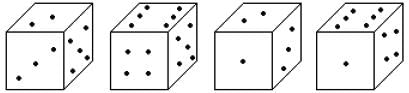
Detailed Solution: Question 5
In first two positions of dice one common face containing 5 is same. Therefore according to Rule no. (3) the face opposite to the face which contains 2 point will contain 6 points.
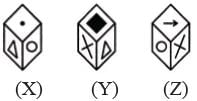
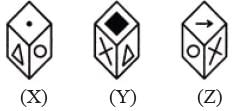
A cube has six different symbols drawn over its six faces. The symbols are dot, circle, triangle, square, cross and arrow. Three different positions of the cube are shown in figures X, Y, and Z.

Olympiad Test: Dice - 2 - Question 6

Which symbol is opposite the arrow?

Detailed Solution: Question 6

From figures X and Y, we conclude that dot, circle, square and cross lie adjacent to the triangle. Therefore, the arrow must lie opposite the triangle. From figures X and Z, we conclude that dot, triangle, arrow and cross lie adjacent to the circle. Therefore, the square must lie opposite the circle. Thus, the arrow lies opposite the triangle, the square lies opposite the circle and consequently, the cross lies opposite the dot.
As analysed above, the symbol opposite the arrow is triangle.

Olympiad Test: Dice - 2 - Question 7

Given below are three different positions of a dice. Find the number of dots on the face opposite the face bearing 3 dots.
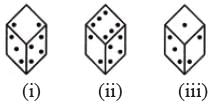
Detailed Solution: Question 7

From figures (i), (ii) and (iii), we conclude that 3, 4, 6 and 1 dots appear adjacent to 2 dots. Therefore, 5 dots appear opposite 2 dots. Now, from figures (i) and (iii), we conclude that 2, 4 and 1 dots appear adjacent to 3 dots. Therefore, either 5 or 6 dots appear opposite 3 dots. Since, 5 dots appear opposite 2 dots, it follows that 6 dots appear opposite 3 dots.

Olympiad Test: Dice - 2 - Question 8

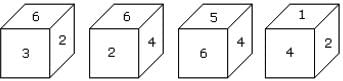
Which number is on the face opposite 4, if the four different positions of a dice are as shown in the figure given below.
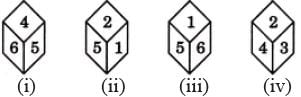
Detailed Solution: Question 8

From figures (i) and (iv) we conclude that 6, 5, 2 and 3 lie adjacent to 4. It follows that 1 lies opposite 4.

Olympiad Test: Dice - 2 - Question 9

A cube has six different symbols drawn over its six faces. The symbols are dot, circle, triangle, square, cross and arrow. Three different positions of the cube are shown in figures X, Y, and Z.
Q. Which symbol occurs at the bottom of fig.(Y)?
Detailed Solution: Question 9

From figures X and Y, we conclude that dot, circle, square and cross lie adjacent to the triangle. Therefore, the arrow must lie opposite the triangle. From figures X and Z, we conclude that dot, triangle, arrow and cross lie adjacent to the circle. Therefore, the square must lie opposite the circle. Thus, the arrow lies opposite the triangle, the square lies opposite the circle and consequently, the cross lies opposite the dot.
Since the square lies at the top of figure (Y) and the circle lies opposite the square (as analysed above), so the circle occurs at the bottom of figure (Y).

Olympiad Test: Dice - 2 - Question 10

A dice is numbered from 1 to 6 in different ways.
Q. If 1 is adjacent to 2, 4 and 6, then which of the following statements is necessarily true?

Detailed Solution: Question 10

If 1 is adjacent to 2, 4 and 6, then either 3 or 5 lies opposite to 1. So, the numbers 3 and 5 cannot lie opposite to each other. Hence, 3 is adjacent to 5 (necessarily).

28 videos|105 docs|48 tests
Information about Olympiad Test: Dice - 2 Page
In this test you can find the Exam questions for Olympiad Test: Dice - 2 solved & explained in the simplest way possible. Besides giving Questions and answers for Olympiad Test: Dice - 2, EduRev gives you an ample number of Online tests for practice
28 videos|105 docs|48 tests
Download as PDF