Computer Science Engineering (CSE) Exam  >  Computer Science Engineering (CSE) Test  >  Theory of Computation  >  Test: Turing Machine: RE, REC & Undecidability- 1 - Computer Science Engineering (CSE) MCQ

Turing Machine: RE, REC & Undecidability- 1 - Free MCQ Practice Test


MCQ Practice Test & Solutions: Test: Turing Machine: RE, REC & Undecidability- 1 (10 Questions)

You can prepare effectively for Computer Science Engineering (CSE) Theory of Computation with this dedicated MCQ Practice Test (available with solutions) on the important topic of "Test: Turing Machine: RE, REC & Undecidability- 1". These 10 questions have been designed by the experts with the latest curriculum of Computer Science Engineering (CSE) 2026, to help you master the concept.

Test Highlights:

  • - Format: Multiple Choice Questions (MCQ)
  • - Duration: 30 minutes
  • - Number of Questions: 10

Sign up on EduRev for free to attempt this test and track your preparation progress.

Test: Turing Machine: RE, REC & Undecidability- 1 - Question 1

Which of the following functions are computable with Turning Machine?

Detailed Solution: Question 1

All the above functions are total recursive functions. The total recursive functions are like recursive language. Turing machine halts on each and every input of recursive language. All of the above functions are turing computable.

Test: Turing Machine: RE, REC & Undecidability- 1 - Question 2

A countable union of countable sets is not

Detailed Solution: Question 2

A countable union of countable set is countable. Countably infinite and denumerable are alternate names of countable sets.

Test: Turing Machine: RE, REC & Undecidability- 1 - Question 3

∑* over {0,1} and 2∑* are respectively,

Detailed Solution: Question 3

Since ∑* is all the combinations of 0 and 1 and yet it is enumerable and belongs to the category of countably infinite. But 2∑* is the power set of ∑* which is infinite. By diagonalisation theorem, power set of any countably infinite set is always uncountable, hence 2∑*​ belongs to uncountably infinite set.

Test: Turing Machine: RE, REC & Undecidability- 1 - Question 4

Which of the following is undecidable?

Detailed Solution: Question 4

According to the decision properties of the CFL and Regular languages, Equivalence of regular languages and emptiness of regular languages are decidable. Also the finiteness of CFL is decidable. For each of above property an algorithm exist. But no algorithm exist for checking the equivalence of the two context-free language.

Test: Turing Machine: RE, REC & Undecidability- 1 - Question 5

The statement "ATM can’t solve halting problem’’ is

Detailed Solution: Question 5

ATM cannot solves the halting problem because it cannot find in finite time that for the given word the machine will halt or not.

Test: Turing Machine: RE, REC & Undecidability- 1 - Question 6

A PDA behaves like a TM when the number of auxiliary memory it has, is

Detailed Solution: Question 6

Auxiliary memory = memory used by the machine for calculations or swappings.
PDA with 2 or more stacks is equivalent to TM.

Test: Turing Machine: RE, REC & Undecidability- 1 - Question 7

Halting problem/language is

Detailed Solution: Question 7

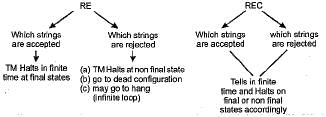
Halting problem belongs to the TM. The language in which halting problem belongs is recursively enumerable i.e. RE. In this TM can’t tell in finite time the word is rejected or not. Although it can tell in finite time that the given word is accepted or not. Although REC can tell in finite time and comes into halt about both i.e.

Test: Turing Machine: RE, REC & Undecidability- 1 - Question 8

The statement is

Detailed Solution: Question 8

The statement   is always true.

Test: Turing Machine: RE, REC & Undecidability- 1 - Question 9

If e1 and e2 are the RE denoting the languages Land L2 respectively, then which of the following is wrong?

Detailed Solution: Question 9

Choice (c) is wrong since “φ” is a regular. In fact  

*Multiple options can be correct
Test: Turing Machine: RE, REC & Undecidability- 1 - Question 10

Which of the following is in P?
PATH, HAMPATH, SAT, 3SAT

Detailed Solution: Question 10

SAT and PATH is in P while 3SAT and HAMPATH are NPC.

18 videos|95 docs|44 tests
Information about Test: Turing Machine: RE, REC & Undecidability- 1 Page
In this test you can find the Exam questions for Test: Turing Machine: RE, REC & Undecidability- 1 solved & explained in the simplest way possible. Besides giving Questions and answers for Test: Turing Machine: RE, REC & Undecidability- 1, EduRev gives you an ample number of Online tests for practice
18 videos|95 docs|44 tests
Download as PDF