Electrical Engineering (EE) Exam  >  Electrical Engineering (EE) Test  >  GATE Mock Test Series 2027  >  Test: Semiconductor Diodes - Electrical Engineering (EE) MCQ

GATE Electrical Engineering (EE) Test: Semiconductor Diodes Free Online


MCQ Practice Test & Solutions: Test: Semiconductor Diodes (10 Questions)

You can prepare effectively for Electrical Engineering (EE) GATE Electrical Engineering (EE) Mock Test Series 2027 with this dedicated MCQ Practice Test (available with solutions) on the important topic of "Test: Semiconductor Diodes". These 10 questions have been designed by the experts with the latest curriculum of Electrical Engineering (EE) 2026, to help you master the concept.

Test Highlights:

  • - Format: Multiple Choice Questions (MCQ)
  • - Duration: 30 minutes
  • - Number of Questions: 10

Sign up on EduRev for free to attempt this test and track your preparation progress.

Test: Semiconductor Diodes - Question 1

The barrier voltage (V0 or Vr) in a junction diode is the effect of

Detailed Solution: Question 1
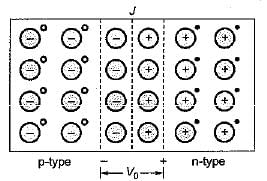

Due to the density gradient across the junction, holes will initially diffuse to the right across the junction, and electrons to the left. The positive holes which neutralizes the acceptor ions near the junction in the p-type silicon disappears as a result of combination with electrons which have diffused across the junction. Similarly, electrons in n-type semiconductor combines with holes.

Test: Semiconductor Diodes - Question 2

In a zener diode large reverse current is due to

Detailed Solution: Question 2

The large reverse current flow in zener diode is due to rupturing-off or tearing-off of covalent bends within the depletion layer. This phenomena is called zener breakdown phenomena, It is due to large electric field intensity.

Test: Semiconductor Diodes - Question 3

For thermionic emission

Detailed Solution: Question 3

The work function of a metal represents the minimum amount of energy that must be given to the fastest-moving electron at the absolute zero of temperature in order for this electron to be able to escape from the metal. Hence, low work function (Ew) is required for thermionic emission.

Test: Semiconductor Diodes - Question 4

The most commonly used type of electron emission in electron tubes is

Test: Semiconductor Diodes - Question 5

When forward bias is applied to a junction diode, it

Detailed Solution: Question 5

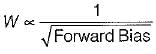
Width of depletion layer,  
Hence, when forward bias is applied to a p-n junction diode, width of the depletion layer is reduced i.e. potential barrier is decreased

Test: Semiconductor Diodes - Question 6

The emission of electrons in a vacuum diode is achieved by

Test: Semiconductor Diodes - Question 7

The main reason why electrons can tunnel through a p-n junction is that

Detailed Solution: Question 7

In a p-n junction tunnel diode, the depletion layer width is negligible and therefore, the charge carriers will be penetrating the depletion layer almost at the speed of light and this property is called tunnelling of charge carriers across the junction.

Test: Semiconductor Diodes - Question 8

The forbidden energy gap in semiconductors

Detailed Solution: Question 8

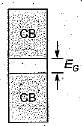
The energy level diagram for a semiconductor is shown below.

EG is called “band gap” or "forbidden energy gap” which lies between the valence band and the conduction band.

Test: Semiconductor Diodes - Question 9

The barrier voltage for germanium is _________ at 25°C.

Detailed Solution: Question 9

The barrier potential of the "Germanium" diode is 0.3 V.

Test: Semiconductor Diodes - Question 10

With the increase in temperature, the resistivity of an intrinsic semiconductor decreases. This is because, with the increase of temperature

Detailed Solution: Question 10
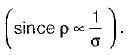
In an intrinsic semiconductor, as the temperature increases mobility is slightly reduced since mobility of charge carrier is inversely proportional to temperature. This will slightly reduce the conductivity. But, due to temperature effect, large number of covalent bonds are broken which creates electrons and holes and this increases the conductivity by a larger value. As a result of this resistivity is decreased 

26 docs|247 tests
Information about Test: Semiconductor Diodes Page
In this test you can find the Exam questions for Test: Semiconductor Diodes solved & explained in the simplest way possible. Besides giving Questions and answers for Test: Semiconductor Diodes, EduRev gives you an ample number of Online tests for practice
Download as PDF