Electrical Engineering (EE) Exam  >  Electrical Engineering (EE) Test  >  GATE Mock Test Series 2027  >  Test: Introduction to Signals - Electrical Engineering (EE) MCQ

GATE Electrical Engineering (EE) Test: Introduction to Signals Free Online


MCQ Practice Test & Solutions: Test: Introduction to Signals (10 Questions)

You can prepare effectively for Electrical Engineering (EE) GATE Electrical Engineering (EE) Mock Test Series 2027 with this dedicated MCQ Practice Test (available with solutions) on the important topic of "Test: Introduction to Signals". These 10 questions have been designed by the experts with the latest curriculum of Electrical Engineering (EE) 2026, to help you master the concept.

Test Highlights:

  • - Format: Multiple Choice Questions (MCQ)
  • - Duration: 30 minutes
  • - Number of Questions: 10

Sign up on EduRev for free to attempt this test and track your preparation progress.

Test: Introduction to Signals - Question 1

The signal x(t) = A cos(ωt + φ) is:

Detailed Solution: Question 1

All bounded periodic signals are power signals, because they do not converge to a finite value so their energy is infinite and their power is finite.

Test: Introduction to Signals - Question 2

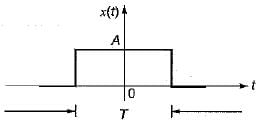
What is the total energy of the rectangular pulse shown in figure below?
Detailed Solution: Question 2

Test: Introduction to Signals - Question 3

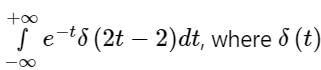
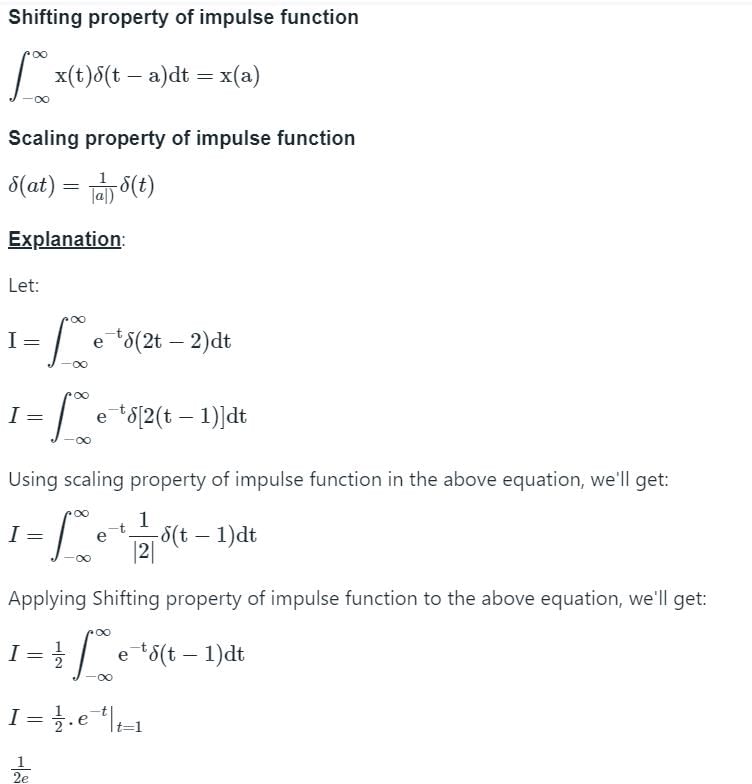
The value of  is the Dirac delta function, is

Detailed Solution: Question 3

Test: Introduction to Signals - Question 4

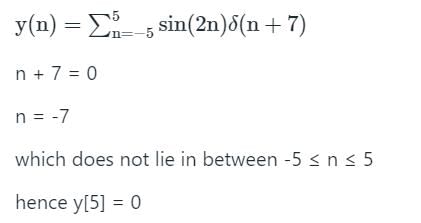
What is the simplified value of y(n) if

Detailed Solution: Question 4

Test: Introduction to Signals - Question 5

The sampling of a function f(t) = sin(2πf0t) starts from zero-crossing. The signal can be detected, if sampling time T is:

Detailed Solution: Question 5

Because fs ≤ 2f0,

Ts ≤ .

Test: Introduction to Signals - Question 6

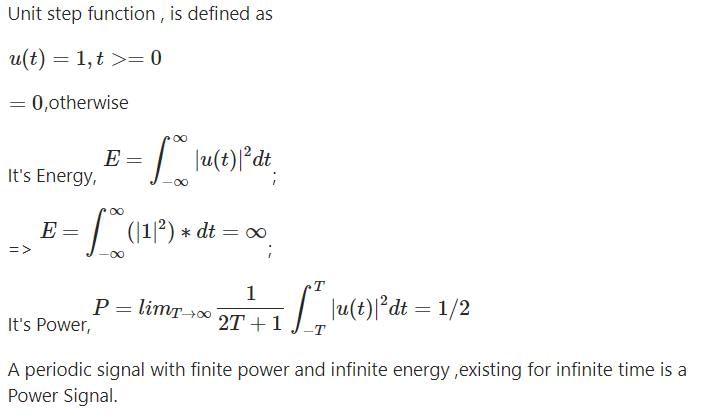
What is the power and energy of the unit step sequence u(n) respectively?

Detailed Solution: Question 6
Test: Introduction to Signals - Question 7

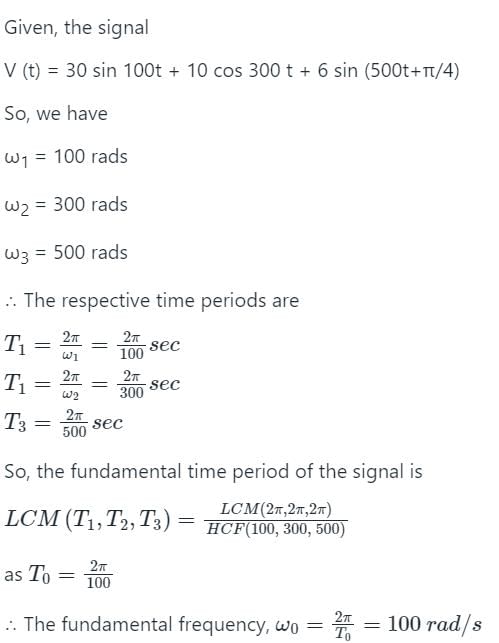
For a periodic signal v(t) = 30 sin100t + 10 cos300t + 6 sin(500t + π/4), the
fundamental frequency in rad/s is

Detailed Solution: Question 7
Test: Introduction to Signals - Question 8

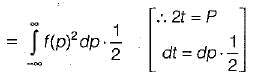
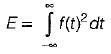
If a signal f(t) has energy ‘E’ the energy of the signal f(2t) is equal to:

Detailed Solution: Question 8

and 

⇒  

Test: Introduction to Signals - Question 9

Consider the sequence x[n] = [-4 - j5, 1 + j2, 4]. The conjugate anti-symmetric part of the sequence is:

Detailed Solution: Question 9

Option A is correct.

Assumption: the three samples are indexed as n = -1, 0, 1 (standard centring for a 3-point sequence).

The conjugate anti-symmetric part is given by x_a[n] = (x[n] - x^*[-n]) / 2.

For n = -1: x_a[-1] = (x[-1] - x^*[1]) / 2.

Substituting values: x_a[-1] = ((-4 - j5) - 4) / 2 = (-8 - j5) / 2 = -4 - j2.5.

For n = 0: x_a[0] = (x[0] - x^*[0]) / 2.

Substituting values: x_a[0] = (1 + j2 - (1 - j2)) / 2 = (j4) / 2 = j2.

For n = 1: x_a[1] = (x[1] - x^*[-1]) / 2.

Substituting values: x_a[1] = (4 - (-4 + j5)) / 2 = (8 - j5) / 2 = 4 - j2.5.

Therefore the conjugate anti-symmetric part is [-4 - j2.5, j2, 4 - j2.5], which matches Option A.

Test: Introduction to Signals - Question 10

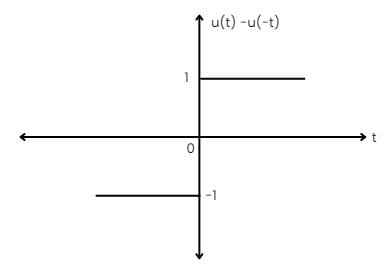
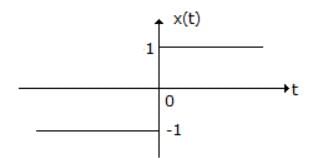
The function x(t) is shown in the figure. Even and odd parts of a unit step function u(t) are respectively:
Detailed Solution: Question 10
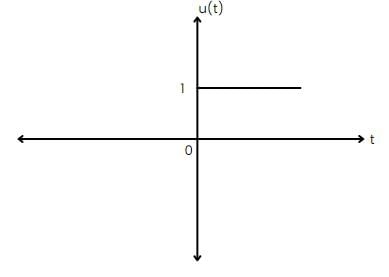
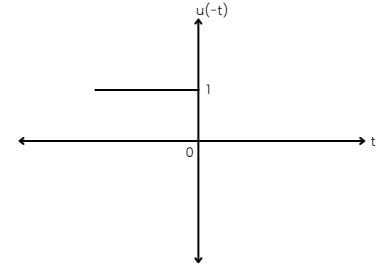
x(t) = u(t) - u(-t)

u(t) = 

u(-t) = 

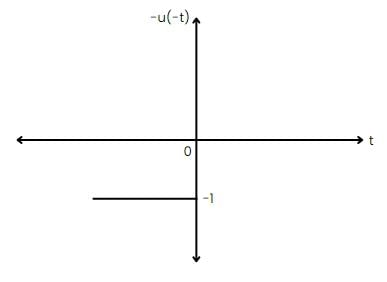
-u(-t) = 

Hence, 

x(t) = u(t) - u(-t)

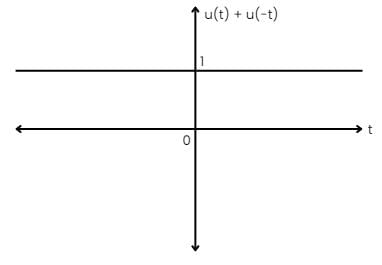
even part = [u(t) + u(-t)] / 2 = 1/2

odd part = [u(t) - u(-t)] / 2 = 1/2[x(t)]

26 docs|247 tests
Information about Test: Introduction to Signals Page
In this test you can find the Exam questions for Test: Introduction to Signals solved & explained in the simplest way possible. Besides giving Questions and answers for Test: Introduction to Signals, EduRev gives you an ample number of Online tests for practice
Download as PDF