Electrical Engineering (EE) Exam  >  Electrical Engineering (EE) Test  >  GATE Mock Test Series 2027  >  Test: Introduction to Systems - Electrical Engineering (EE) MCQ

GATE Electrical Engineering (EE) Test: Introduction to Systems Free Online


MCQ Practice Test & Solutions: Test: Introduction to Systems (10 Questions)

You can prepare effectively for Electrical Engineering (EE) GATE Electrical Engineering (EE) Mock Test Series 2027 with this dedicated MCQ Practice Test (available with solutions) on the important topic of "Test: Introduction to Systems". These 10 questions have been designed by the experts with the latest curriculum of Electrical Engineering (EE) 2026, to help you master the concept.

Test Highlights:

  • - Format: Multiple Choice Questions (MCQ)
  • - Duration: 30 minutes
  • - Number of Questions: 10

Sign up on EduRev for free to attempt this test and track your preparation progress.

Test: Introduction to Systems - Question 1

A function f(t) is an even function, if for all values of (t)

( T is the time-period of the function)

Detailed Solution: Question 1

For even function, f(t) = f(-t)

For odd function, f(t) = -f(-t)

Test: Introduction to Systems - Question 2

A control system transfer function is H(s) = 1/s3. Express its impulse response in terms of unit step signal

Detailed Solution: Question 2
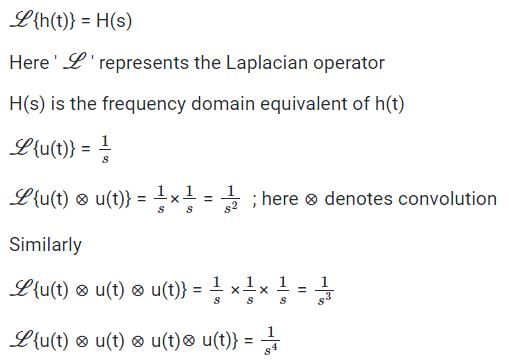
Convolution in the time domain implies multiplication in S(or frequency) domain

The Laplace transform of any signal h(t) is given by

So we observe that the H(s) = 1/s3, corresponds to a unit step signal convoluted with itself thrice.

Therefore the correct answer is option 1

Test: Introduction to Systems - Question 3

The unit impulse response of a linear time invariant system is the unit step function u(t) for t > 0, the response of the system to an excitation e-at u(t), a > 0 will be

Detailed Solution: Question 3
Given: h(t) = u(t)
x(t) = e–at u(t)

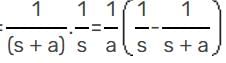
∴ Y(s) = X(s) H(s) =   

y(t) = 1/a (1 – e– at) u(t)

Test: Introduction to Systems - Question 4

A system with an input x(t) and output y(t) is described by the relation: y(t) = tx(t). This system is

Detailed Solution: Question 4

y(t) = tx(t)

y1(t) = t.x1(t) = r1(t)

y2(t) = tx2(t) = r2(t)

y1(t) + y2(t) = t(x1(t) + x2(t))

= r1(t) + r2(t)    ∴ linear

y(t) = t.x(t)

y( t - to) = (t - to) x ( t - to)

and for delayed input signal,

y(t) = t x (t - to)

y(t) ≠ y( t-to)

∴ Time varying signal

Test: Introduction to Systems - Question 5

If a function f(t) u(t) is shifted to the right side by t0, then the function can be expressed as

Detailed Solution: Question 5

Since f(t) u(t) = f(t) for t > 0 also we know

u ( t - to) = 1, for t > to

Here in right side shifting that means to > 0

by property on shifting right side,

Test: Introduction to Systems - Question 6

The impulse response of a causal, linear, time- invariant, continuous time system is h(t). The output y(t) of the same system to an input x(t). Where x(t) = 0 for t < -2 is

Detailed Solution: Question 6
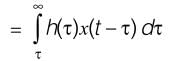
Since, causal system

h(t) = 0 for t < 0

Input y(t) = x(t) * h(t)

h(τ) = 0 for τ < 0

x ( t - τ) = 0, for t - τ < - 2

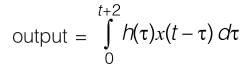
∴ τ > f + 2

Test: Introduction to Systems - Question 7

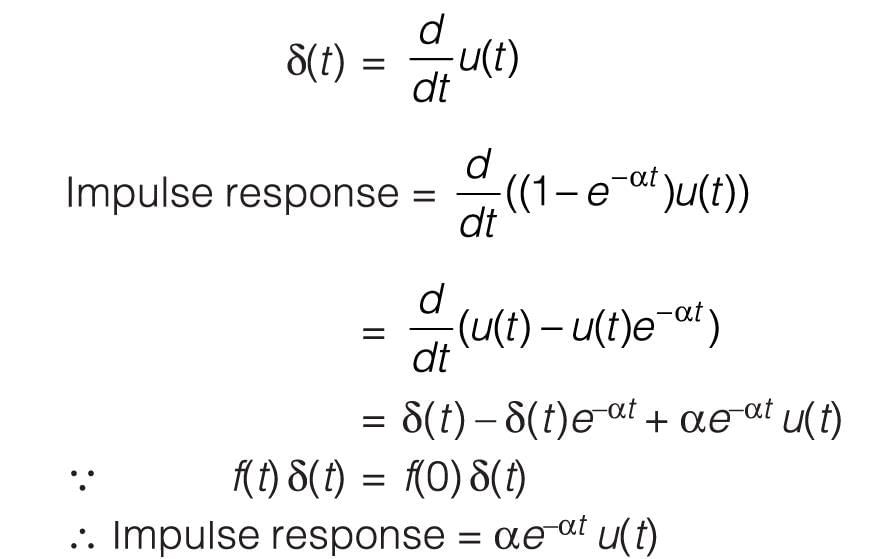
The unit step response of a system is given by (1 - e-αt) u(t), the impulse response is given by

Detailed Solution: Question 7
Test: Introduction to Systems - Question 8

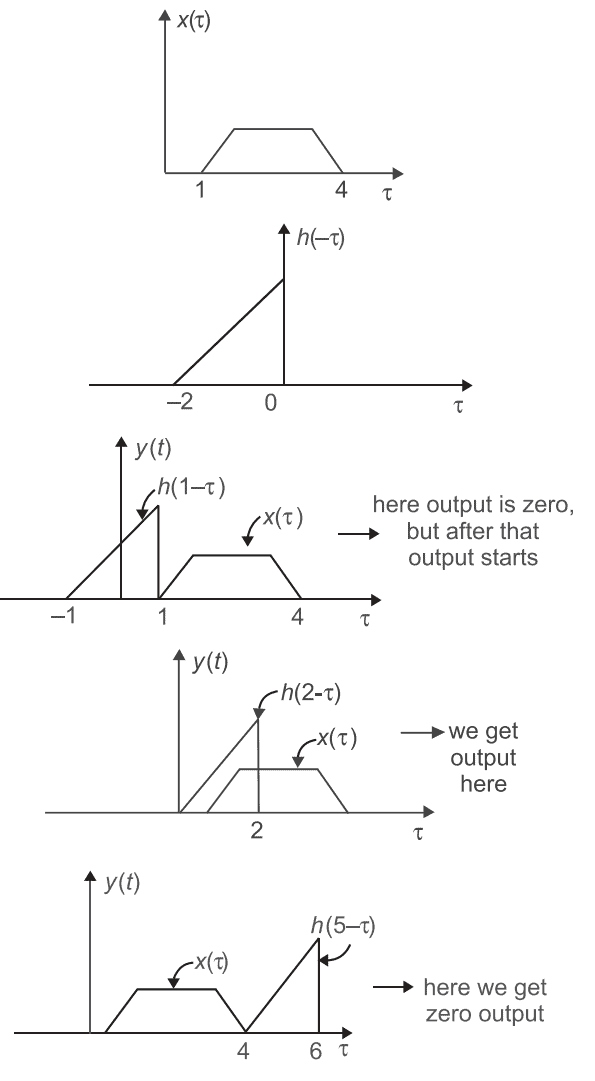
Figure I and Figure II, shows the input x(t) to a linear time invariant system and the impulse response h(t) of the system
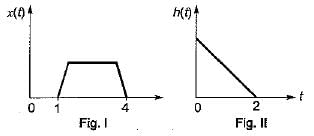
the output of the system is zero everywhere except for the time interval.

Detailed Solution: Question 8

Given x(t) and h(t) y(t) = x(t) * h(t)

y(t) =x(τ) h(t – τ)dτ– ∞

Thus, we conclude that the output of the system is zero everywhere except for the time interval.
1 < t < 5

Test: Introduction to Systems - Question 9

A signal f(t) = cos8πt + 0.5cos4πt is instantaneously sampled. The maximum allowable value of sampling interval Ts in sec is

Detailed Solution: Question 9

The problem involves a signal f(t) = cos8πt + 0.5cos4πt. To find the maximum allowable sampling interval, we utilise the Nyquist-Shannon sampling theorem, which states that the sampling rate must be at least twice the highest frequency present in the signal.

  • The signal consists of two cosine terms: cos8πt and 0.5cos4πt.
  • The frequencies of these terms are 4 Hz and 2 Hz respectively.
  • The highest frequency component is 4 Hz.
  • According to the sampling theorem, the minimum sampling rate is 2 × 4 Hz = 8 Hz.
  • The maximum allowable sampling interval Ts is the reciprocal of the sampling rate, thus 1/8 sec.

Test: Introduction to Systems - Question 10

The impulse response. h[n] of a linear time invariant system is given by h[n] = u[n + 3] + u[n - 3] - 2u[n - 7], the above system is

26 docs|247 tests
Information about Test: Introduction to Systems Page
In this test you can find the Exam questions for Test: Introduction to Systems solved & explained in the simplest way possible. Besides giving Questions and answers for Test: Introduction to Systems, EduRev gives you an ample number of Online tests for practice
Download as PDF