Electrical Engineering (EE) Exam  >  Electrical Engineering (EE) Test  >  GATE Mock Test Series 2027  >  Test: Electromechanical Indicating Instruments to Electrical & Electronics Measurements - Electrical Engineering (EE) MCQ

GATE Electrical Engineering (EE) Test: Electromechanical Indicating Instruments


MCQ Practice Test & Solutions: Test: Electromechanical Indicating Instruments to Electrical & Electronics Measurements (10 Questions)

You can prepare effectively for Electrical Engineering (EE) GATE Electrical Engineering (EE) Mock Test Series 2027 with this dedicated MCQ Practice Test (available with solutions) on the important topic of "Test: Electromechanical Indicating Instruments to Electrical & Electronics Measurements". These 10 questions have been designed by the experts with the latest curriculum of Electrical Engineering (EE) 2026, to help you master the concept.

Test Highlights:

  • - Format: Multiple Choice Questions (MCQ)
  • - Duration: 30 minutes
  • - Number of Questions: 10

Sign up on EduRev for free to attempt this test and track your preparation progress.

Test: Electromechanical Indicating Instruments to Electrical & Electronics Measurements - Question 1

A moving coil instrument has the following data:
Number of turns = 100
Width of the coil = 20 mm
Depth of the coil = 30 mm
Flux density in the gap = 0.1 Wb/m2
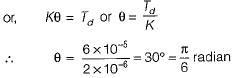
If the control spring constant is 2 x 10⁻⁶ N-m/ degree, then the deflection of the pointer when the coil carries a current of 10 mA is

Detailed Solution: Question 1

The deflecting torque,

At equilibrium,
Tc = Td

Thus, the deflection of the pointer  = π/6 radian.

Test: Electromechanical Indicating Instruments to Electrical & Electronics Measurements - Question 2

A PMMC uses a :

Detailed Solution: Question 2

A PMMC uses a moving coil and the magnet is permanent.

Test: Electromechanical Indicating Instruments to Electrical & Electronics Measurements - Question 3

A moving iron movement uses

Test: Electromechanical Indicating Instruments to Electrical & Electronics Measurements - Question 4

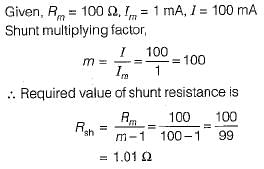
A 1 mA meter movement with an internal resistance of 100 Ω is to be converted into a 0-100 mA. The value of shunt resistant required is
Detailed Solution: Question 4

Test: Electromechanical Indicating Instruments to Electrical & Electronics Measurements - Question 5

Which of the following is not a desired characteristic of shunts used in PMMC instruments?

Detailed Solution: Question 5

Shunts used in PMMC instruments are made up of manganin or constantan since they have very low temperature coefficient of resistance.

Test: Electromechanical Indicating Instruments to Electrical & Electronics Measurements - Question 6

To select the range, a multirange ammeter uses a

Test: Electromechanical Indicating Instruments to Electrical & Electronics Measurements - Question 7

A D’Arsonval movement is

Test: Electromechanical Indicating Instruments to Electrical & Electronics Measurements - Question 8

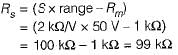
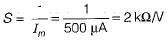
What is the value of multiplier resistance on the 50 V range of a dc voltmeter that uses a 500 μA meter movement with an internal resistance of 1 kΩ?
Detailed Solution: Question 8

The sensitivity of 500 μA meter movement is given by,

The value of the multiplier resistance can be obtained as

Test: Electromechanical Indicating Instruments to Electrical & Electronics Measurements - Question 9

Loading effect in a voltmeter can be avoided by

Detailed Solution: Question 9

Higher the sensitivity of the voltmeter, lower the loading effect and vice-versa.

Test: Electromechanical Indicating Instruments to Electrical & Electronics Measurements - Question 10

Assertion (A): Gravity control is not suited for indicating instruments in general and portable instruments in particular.
Reason (R): Gravity control is used in only vertically mounted instruments.

Detailed Solution: Question 10

Gravity control is not suited for indicating instruments in general and portable instruments in particular because for using this type of control, the instruments must be mounted in level position otherwise there will be a very serious zero error. Gravity control is used in only vertically mounted instruments. Hence, reason is also a true statement but, not a correct explanation of assertion.

26 docs|247 tests
Information about Test: Electromechanical Indicating Instruments to Electrical & Electronics Measurements Page
In this test you can find the Exam questions for Test: Electromechanical Indicating Instruments to Electrical & Electronics Measurements solved & explained in the simplest way possible. Besides giving Questions and answers for Test: Electromechanical Indicating Instruments to Electrical & Electronics Measurements, EduRev gives you an ample number of Online tests for practice
Download as PDF