GATE Computer Science Engineering(CSE) 2027 Test: Control Unit- 2 Free
MCQ Practice Test & Solutions: Test: Control Unit- 2 (15 Questions)
You can prepare effectively for Computer Science Engineering (CSE) GATE Computer Science Engineering(CSE) 2027 Mock Test Series with this dedicated MCQ Practice Test (available with solutions) on the important topic of "Test: Control Unit- 2". These 15 questions have been designed by the experts with the latest curriculum of Computer Science Engineering (CSE) 2026, to help you master the concept.
Test Highlights:
- - Format: Multiple Choice Questions (MCQ)
- - Duration: 45 minutes
- - Number of Questions: 15
Sign up on EduRev for free to attempt this test and track your preparation progress.

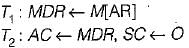
Which set of instruction transfers the memory word specified by the effective address to AC or Load to AC?
Detailed Solution: Question 1
Which of the following is not involved in a memory write operation?
Detailed Solution: Question 2

In Flynn’s classification of computers, the vector and array classes of machines belong to
Following are some statements associated with microprocessors. Identify the false statement.
Detailed Solution: Question 4
The following are four statements regarding what a CPU with only a set of 32 bit registers can perform.
1. Hold and operate on 32 bit integers.
2. Hold and operate on 16 bit integers.
3. Hold and operate on 64 bit floating point arithmetic.
4. Hold and operate on 16 bit UNICODE characters.
Which of the following is true about such a CPU?
1. Hold and operate on 32 bit integers.
2. Hold and operate on 16 bit integers.
3. Hold and operate on 64 bit floating point arithmetic.
4. Hold and operate on 16 bit UNICODE characters.
Detailed Solution: Question 5
The following are four statements about Reduced Instruction Set Computer (RISC) architectures.
1. The typical RISC machine instruction set is small, and is usually a subject of a CISC instruction set.
2. No arithmetic or logical instruction can refer to the memory directly.
3. A comparatively large number of user registers are available.
4. Instructions can be easily decoded through hard-wired control units.
Which of the above statements is true?
1. The typical RISC machine instruction set is small, and is usually a subject of a CISC instruction set.
2. No arithmetic or logical instruction can refer to the memory directly.
3. A comparatively large number of user registers are available.
4. Instructions can be easily decoded through hard-wired control units.
Detailed Solution: Question 6
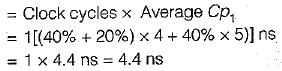
Consider an unpipelined processor assume that it has a 1 ns clock cycles and that it uses 4 cycles for ALU operation and branches and 5 cycles for memory operations. Assume that the relative frequencies of these operations are 40%, 20% and 40% respectively. Suppose due to clock skew and setup, pipelining the processor adds 0.2 ns of overhead to the clock, ignore any latency impact.
Q. What is the average instruction execution time for unpipelined processor?
Detailed Solution: Question 7
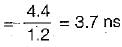
Consider an unpipelined processor assume that it has a 1 ns clock cycles and that it uses 4 cycles for ALU operation and branches and 5 cycles for memory operations. Assume that the relative frequencies of these operations are 40%, 20% and 40% respectively. Suppose due to clock skew and setup, pipelining the processor adds 0.2 ns of overhead to the clock, ignore any latency impact.
Q. What speedup gain after pipelined the processor?
Detailed Solution: Question 8
The following are the some of the sequences of operations in instruction cycle, which one is correct sequence?
Detailed Solution: Question 9
Consider the following situation and fill in the blanks:
The computer starts the tape moving by issuing a command: the processor then monitors the status of the tape by means of a _____. When the tape is in the correct position, the processor issues a _______.
Detailed Solution: Question 10
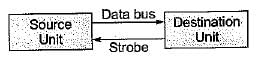
Asynchronous data transfer between two independent units requires that control signals be transmitted between the communicating units to indicate the time at which data is being transm itted, way of achieving this ______.
Detailed Solution: Question 11
Determine the width of Micro-instruction having the following control-signal fields in a vertical microprogrammed control unit.
1. Next Address field of 7 bits
2. ALU Function field selecting 1 out of 13 ALU functions
3. Register-in field selecting 1 out of 8 registers
4. Register-out field selecting 1 out of 8 registers
5. Shifter field selecting no shift, right shift or left shift
6. Auxiliary control field of 4 bits
Detailed Solution: Question 12
The disadvantage of hard-wired control units with flip-flops is ______.
Detailed Solution: Question 14
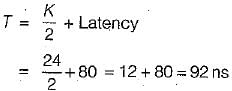
A CPU has a cache with block size 64 bytes. The main memory has k blocks, each block being c bytes wide. Consecutive c-byte chunks are mapped on consecutive blocks with warp-around. All the k blocks can be accessed in parallel, but two accesses to the same block must be serialized. A cache block access may involve multiple iterations of parallel block accesses depending on the amount of data obtained by accessing all the k-blocks in parallel. Each iteration requires decoding the block numbers to be accessed in parallel and this takes k/2 ns.
The latency of one block access is 80 ns. If c = 2 and k = 24, then latency of retrieving a cache block starting at address zero from main memory is
The latency of one block access is 80 ns. If c = 2 and k = 24, then latency of retrieving a cache block starting at address zero from main memory is
Detailed Solution: Question 15