CBSE Class 10  >  Class 10 Test  >  Mathematics (Maths)   >  RS Aggarwal Test: Probability - Class 10 MCQ

RS Aggarwal Test: Probability - Class 10 Maths Free MCQs with solutions


MCQ Practice Test & Solutions: RS Aggarwal Test: Probability (10 Questions)

You can prepare effectively for Class 10 Mathematics (Maths) Class 10 with this dedicated MCQ Practice Test (available with solutions) on the important topic of "RS Aggarwal Test: Probability". These 10 questions have been designed by the experts with the latest curriculum of Class 10 2026, to help you master the concept.

Test Highlights:

  • - Format: Multiple Choice Questions (MCQ)
  • - Duration: 10 minutes
  • - Number of Questions: 10

Sign up on EduRev for free to attempt this test and track your preparation progress.

RS Aggarwal Test: Probability - Question 1

Which of the following cannot be the probability of an event?

Detailed Solution: Question 1

To determine which of the following cannot be a probability:

- A: 1/3 is a valid probability as it falls between 0 and 1.
- B: 0.1 is also a valid probability, representing 10% likelihood.
- C: 3% can be converted to a decimal (0.03), making it a valid probability.
- D: 17/16 is greater than 1, violating the probability rule (must be between 0 and 1).

Therefore, D: 17/16 cannot be the probability of an event.

RS Aggarwal Test: Probability - Question 2

A card is drawn from a deck of 52 cards. The event E is that card is not an ace of hearts. The number of outcomes favourable to E is

Detailed Solution: Question 2

Total number of outcomes =52

we have only 1 ace of hearts , so the number of favourable outcomes of E ,

where E is card not an ace of hearts = 51.

RS Aggarwal Test: Probability - Question 3

Which of the following cannot be the probability of an event?

Detailed Solution: Question 3
Solution:

Probability of an event is a measure that quantifies the likelihood of the event occurring. It must satisfy the following conditions:

  • The probability must be between 0 and 1, inclusive. That is, 0 ≤ P(event) ≤ 1.
  • A probability of 0 means the event will never occur.
  • A probability of 1 means the event is certain to occur.

Now, let's analyze each option:

  • A. 1/4 = 0.25, which lies between 0 and 1, so it can be a probability.
  • B. 0 is the probability of an impossible event, so it is valid.
  • C. The option shows -1/2 or -0.5 (as seen in the image), which is less than 0. Probability cannot be negative, so this cannot be a probability.
  • D. 0.8 lies between 0 and 1, so it is a valid probability.

Therefore, the correct answer is option C.

RS Aggarwal Test: Probability - Question 4

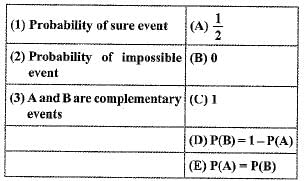
Match the columns:

Detailed Solution: Question 4

 Probability facts.

RS Aggarwal Test: Probability - Question 5

If P(A) denotes the probability of an event A, then

Detailed Solution: Question 5

The probability of an event A, denoted as P(A), must satisfy the axioms of probability. One key axiom states that the probability of any event is a non-negative number, and it cannot exceed 1. Therefore, the correct range for P(A) is 0 ≤ P(A) ≤ 1. Option A is incorrect because probabilities are never less than 0. Option B is incorrect because probabilities are never greater than 1. Option C is correct because it accurately represents the range of possible probability values. Option D is incorrect because probabilities cannot be negative, so the lower bound should not be -1. Thus, the correct answer is C.

RS Aggarwal Test: Probability - Question 6

When a die is thrown once, the probability of getting an odd number less than 3 is

Detailed Solution: Question 6

The possible outcomes when rolling a die are 1, 2, 3, 4, 5, and 6.

An odd number less than 3 is:

  • 1

Therefore, there is:

  • One favourable outcome
  • Out of six possible outcomes

This results in a probability of:

1/6

RS Aggarwal Test: Probability - Question 7

The probability of getting a bad egg in a lot of 400 is 0.035. The number of bad eggs in the lot is

Detailed Solution: Question 7

It is given that

Total number of eggs = 400

Probability of getting a bad egg P(E) = 0.035

Consider x as the number of bad eggs

The formula to find the probability is

P(E) = Number of bad eggs/ Total number of eggs

Substituting the values

0.035 = x/400

By further calculation

35/1000 = x/400

x = 35/1000 x 400

x = 140/10

x = 14

Therefore, the number of bad eggs in the lot is 14.

RS Aggarwal Test: Probability - Question 8

A coin is tossed 1000 times and 640 times a ‘head’ occurs. The  probability of occurrence of a head in this case is

Detailed Solution: Question 8

To find the probability of getting a head, we divide the number of heads by the total number of tosses. The calculation is as follows:

  • P = Number of heads / Total number of tosses
  • P = 640 / 1000
  • P = 0.64

RS Aggarwal Test: Probability - Question 9

Two coins are tossed simultaneously. The probability of getting atmost one head is

Detailed Solution: Question 9

Two coin tossed
Total sample space = {HH, HT, TH, TT}
At most one head means 0 or 1 head
Sample space for getting atmost one head = {TT, TH, HT}
P(s) = 3/4 


​    

RS Aggarwal Test: Probability - Question 10

A card is selected from a deck of 52 cards. The probability of being a red face card is

Detailed Solution: Question 10
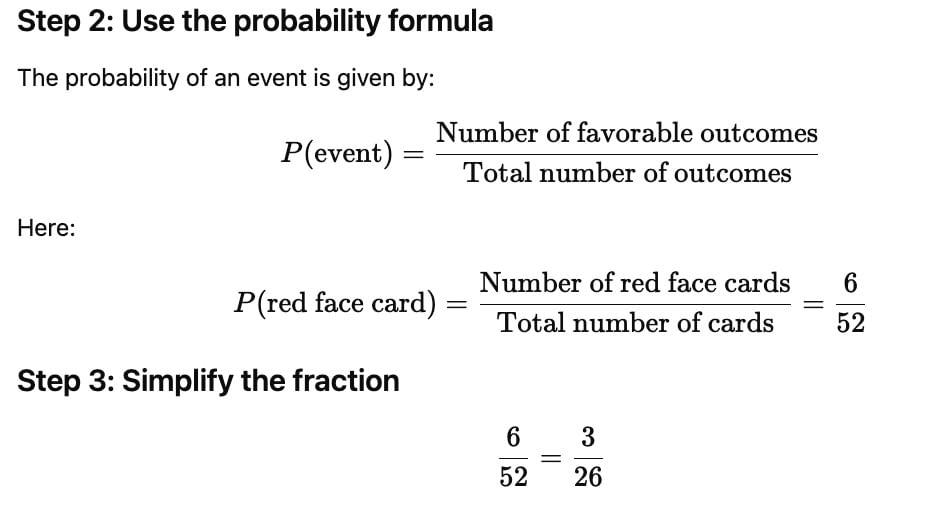
  • A standard deck of cards contains 52 cards.
  • There are two red suits: hearts and diamonds.
  • Each suit has 3 face cards (Jack, Queen, and King).
  • Therefore, there are 6 red face cards in total.

118 videos|526 docs|45 tests
Information about RS Aggarwal Test: Probability Page
In this test you can find the Exam questions for RS Aggarwal Test: Probability solved & explained in the simplest way possible. Besides giving Questions and answers for RS Aggarwal Test: Probability, EduRev gives you an ample number of Online tests for practice
118 videos|526 docs|45 tests
Download as PDF