
Boundary Layer Theory - 3 - Free MCQ Practice Test with solutions, GATE
MCQ Practice Test & Solutions: Test: Boundary Layer Theory - 3 (10 Questions)
You can prepare effectively for Mechanical Engineering Fluid Mechanics for Mechanical Engineering with this dedicated MCQ Practice Test (available with solutions) on the important topic of "Test: Boundary Layer Theory - 3". These 10 questions have been designed by the experts with the latest curriculum of Mechanical Engineering 2026, to help you master the concept.
Test Highlights:
- - Format: Multiple Choice Questions (MCQ)
- - Duration: 30 minutes
- - Number of Questions: 10
Sign up on EduRev for free to attempt this test and track your preparation progress.

The hydrodynamic boundary layer thickness is defined as the distance from the surface where the
Detailed Solution: Question 1
Laminar boundary layer thickness (δ) at any point x for flow over a flat plate is given by δ/x
Detailed Solution: Question 2


The velocity profile for turbulent layer over a flat plate is
Detailed Solution: Question 3

Detailed Solution: Question 4

According to Blasius, the local skin friction coefficient in the boundary layer over a flat plate is given by
Detailed Solution: Question 5

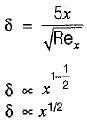
The thickness of laminar boundary layer at a distance 'x' from the leading edge over a flat plate varies as
Detailed Solution: Question 6
The Von-karman momentum integral equation expressed as (where θ is momentum thickness)
Detailed Solution: Question 7

Consider the following statements:
Boundary layer separation is caused by:
1. An adverse pressure gradient
2. Sudden entrapping of air
3. Reduction of pressure gradient to zero
4. Release of bubbles from the fluid when the pressure goes below the vapor pressure
Q. Which of the above statements is/are correct?
Boundary layer separation is caused by:
1. An adverse pressure gradient
2. Sudden entrapping of air
3. Reduction of pressure gradient to zero
4. Release of bubbles from the fluid when the pressure goes below the vapor pressure
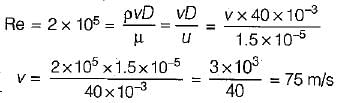
Air flows past a golf bail of 20 mm radius. It is observed that the boundary layer becomes turbulent at Reynolds number of 2 x 10⁵. If the kinematic viscosity of air is 1.5 x 10⁻⁵ m2/sec then the speed of air when the flow becomes turbulent is
Detailed Solution: Question 9
Blasius equation for a flat plate laminar boundary layer flow is a third order
56 videos|148 docs|75 tests |
