Mechanical Engineering Exam  >  Mechanical Engineering Test  >  Topicwise Question Bank  >  Test: Belt, Rope & Chain Drives - 3 - Mechanical Engineering MCQ

Belt, Rope & Chain Drives - 3 - Free MCQ Practice Test with solutions,


MCQ Practice Test & Solutions: Test: Belt, Rope & Chain Drives - 3 (20 Questions)

You can prepare effectively for Mechanical Engineering Topicwise Question Bank for Mechanical Engineering with this dedicated MCQ Practice Test (available with solutions) on the important topic of "Test: Belt, Rope & Chain Drives - 3". These 20 questions have been designed by the experts with the latest curriculum of Mechanical Engineering 2026, to help you master the concept.

Test Highlights:

  • - Format: Multiple Choice Questions (MCQ)
  • - Duration: 60 minutes
  • - Number of Questions: 20

Sign up on EduRev for free to attempt this test and track your preparation progress.

Test: Belt, Rope & Chain Drives - 3 - Question 1

Which of the following ropes will be most flexible?

Detailed Solution: Question 1

The wire rope of 6 x 7 construction consists of a few wires of relatively large size. It is too stiff for hoisting purposes. The 6 x 19 or 6x 37 constructions are flexible wire ropes, and are commonly used in hoists.

Test: Belt, Rope & Chain Drives - 3 - Question 2

It is usually preferable in chain drive to use

Detailed Solution: Question 2

Number of pitches should be ‘even’ and number of teeth on sprocket should always be ‘odd’.

Test: Belt, Rope & Chain Drives - 3 - Question 3

Which one of the following is positive drive

Detailed Solution: Question 3

In chain drive slip is almost negligible. Hence it is positive drive.

Test: Belt, Rope & Chain Drives - 3 - Question 4

The length of the belt in case of cross-belt drive is given in terms of centre distance between pulleys (C), diameter of the pulley D and d as:

Test: Belt, Rope & Chain Drives - 3 - Question 5

The length of belt in case of open-belt drive

Test: Belt, Rope & Chain Drives - 3 - Question 6

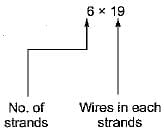
A 6 x 19 rope implies that there are

Detailed Solution: Question 6

Wire rope designation

Test: Belt, Rope & Chain Drives - 3 - Question 7

In case of belt drives, the effect of the centrifugal tension is to

Detailed Solution: Question 7

Note that centrifugal tension reduces the power transmission capacity but it is provided to keep the belt on pulley.

Test: Belt, Rope & Chain Drives - 3 - Question 8

In a belt drive the centrifugal tension is 1 kN. The ratio of tensions is 2 and runs at a linear speed of 10 m/s and has to transmits 20 kW. What should be the initial tension?

Test: Belt, Rope & Chain Drives - 3 - Question 9

The creep in a belt drive is due to the

Detailed Solution: Question 9

In Belt drives when the belt passes from the slack side to the tight side, a certain portion of the belt extends. Similarly, when the belt passes from the tight side to the slack side it contracts. Hence creep in belt drive is due to uneven extensions and contractions of the belt when it passes from tight side to slack side.
This phenomenon of alternative stretching and contraction of the belt results in relative motion between the belt and the pulley surface. This relative motion is called creep.

Test: Belt, Rope & Chain Drives - 3 - Question 10

Crowning of pulleys is generally done to

Detailed Solution: Question 10

There is a specific term crowning of pulley in flat-belt drive. The objective of providing crowining are as follows:
1. The crown on pulley helps to hold the belt on pulley in running condition.
2. The crown on pulley prevents the belt from running off the pulley.
3. The crown on pulley brings the belt to running equilibrium position near the midplane of the pulley.

Test: Belt, Rope & Chain Drives - 3 - Question 11

In V-belt, belt should contact groove at

Detailed Solution: Question 11

To increase the frictional resistance both the sides of the groove should be in contact with the belt.

Test: Belt, Rope & Chain Drives - 3 - Question 12

Given that W = weight of load handled, Wr = weight of rope and f = acceleration, the additional load in ropes of a hoist during starting is given by:

Detailed Solution: Question 12
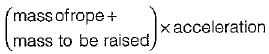

= inertia force acting as additional load

Test: Belt, Rope & Chain Drives - 3 - Question 13

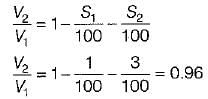
In flat belt drive, if the slip between the driver and the belt is 1%, that between belt and follower is 3% and driver and flower pulley diameters are equal, then the velocity ratio of the drive will be:

Detailed Solution: Question 13
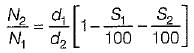

Test: Belt, Rope & Chain Drives - 3 - Question 14

Total slip will occur in a belt drive when

Test: Belt, Rope & Chain Drives - 3 - Question 15

The ratio of tension on the tight side to that slack side in a flat belt drive is

Detailed Solution: Question 15

Test: Belt, Rope & Chain Drives - 3 - Question 16

A 50 KW motor using six V belts is used in a pulp mill. If one of the belts breaks after a month ofcontinuous running, then

Detailed Solution: Question 16

If one of the belt in multi-belt drive is breaks then all the belts should be replaced by new set of belt to ensure uniform stress in all the belt.

Test: Belt, Rope & Chain Drives - 3 - Question 17

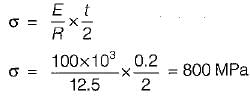
A 0.2 thick tape goes over a frictionless pulley of 25 mm diameter. If E of the material is 100 GPa, then the maximum stress induced in the tape is
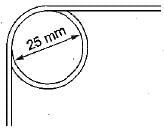
Detailed Solution: Question 17
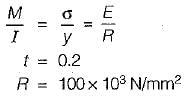
From the equation


Test: Belt, Rope & Chain Drives - 3 - Question 18

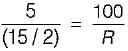
What diameter should the driving pulley have on which a rubber belt runs so that bending stress in belt is limited to 5 N/mm2 (the belt cross-section is a rectangle 15 mm thick x 110 mm wide, E for belt material is 100 N/mm2)

Detailed Solution: Question 18


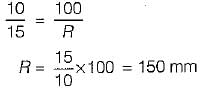
D = 300 mm

Test: Belt, Rope & Chain Drives - 3 - Question 19

The following data refers to an open belt drive
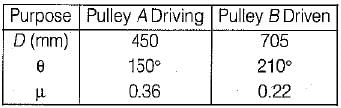
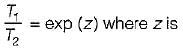
Ratio of tensions may be calculated using relation
Detailed Solution: Question 19



Since μθB < μθA
Hence we choose μθ

Test: Belt, Rope & Chain Drives - 3 - Question 20

In a cone pulley, if the sum of radii of the pulleys on the driving and driven shafts is constant, then

Detailed Solution: Question 20

In a cross belt drive, both the pulleys rotate in opposite directions. If sum of the radii of the two pulleys be constant, then length of the belt required will also remain constant, provided the distance between centres of the pulleys remain unchanged.

45 videos|314 tests
Information about Test: Belt, Rope & Chain Drives - 3 Page
In this test you can find the Exam questions for Test: Belt, Rope & Chain Drives - 3 solved & explained in the simplest way possible. Besides giving Questions and answers for Test: Belt, Rope & Chain Drives - 3, EduRev gives you an ample number of Online tests for practice
Download as PDF