Mechanical Engineering Exam  >  Mechanical Engineering Test  >  Topicwise Question Bank  >  Test: Structural of Metals & Alloys - 3 - Mechanical Engineering MCQ

Structural of Metals & Alloys - 3 - GATE ME Free MCQ Test with solutions


MCQ Practice Test & Solutions: Test: Structural of Metals & Alloys - 3 (20 Questions)

You can prepare effectively for Mechanical Engineering Topicwise Question Bank for Mechanical Engineering with this dedicated MCQ Practice Test (available with solutions) on the important topic of "Test: Structural of Metals & Alloys - 3". These 20 questions have been designed by the experts with the latest curriculum of Mechanical Engineering 2026, to help you master the concept.

Test Highlights:

  • - Format: Multiple Choice Questions (MCQ)
  • - Duration: 60 minutes
  • - Number of Questions: 20

Sign up on EduRev for free to attempt this test and track your preparation progress.

Test: Structural of Metals & Alloys - 3 - Question 1

When atoms are displaced in two separate planes perpendicular to each other, the defect so produced is known as

Detailed Solution: Question 1

  • When atoms are displaced in two perpendicular planes, this creates a complex distortion in the crystal structure.
  • This type of defect is classified as a stacking fault, which occurs when the regular order of atomic layers is disrupted.
  • Stacking faults can lead to changes in the material's properties, such as strength and ductility.
  • Edge dislocations and screw dislocations involve different types of atomic displacements, while Schottky defects relate to vacancies.

Test: Structural of Metals & Alloys - 3 - Question 2

Atomic packing factor in case of Copper Crystal is

Detailed Solution: Question 2

Since Copper .is having FCC structure APF = 0.74

Test: Structural of Metals & Alloys - 3 - Question 3

The effective number of lattice points in the unit celi of simple cubic, body centered cubic and face centered cubic space lattices respectively are

Detailed Solution: Question 3

For simple cubic effective number of lattice point = 1
For B.C.C. effective number of lattice point = 2
For F.C.C. effective number of lattice point = 4

Test: Structural of Metals & Alloys - 3 - Question 4

Which of the following elements is not a metalloid?

Detailed Solution: Question 4

Correct option is A: Copper elements is not a metalloid. The known metalloids are boron, silicon, germanium.

Test: Structural of Metals & Alloys - 3 - Question 5

Which of the following material is not a ferromagnetic material?

Test: Structural of Metals & Alloys - 3 - Question 6

Which one of the following pairs of axis lengths (a, b, c) and inter axial angles (a, β, γ) represents the tetragonal crystal system?

Detailed Solution: Question 6

Test: Structural of Metals & Alloys - 3 - Question 7

The defect which takes place due to imperfect packing of atoms during crystallization is known as

Detailed Solution: Question 7

Point defects are where an atom is missing or is in an irregular place in the lattice structure.
Point defects include self interstitial atoms, interstitial impurity atoms, substitutional atoms and vacancies

Test: Structural of Metals & Alloys - 3 - Question 8

What is the movement of block of atoms along certain crystallographic phase and directions termed as

Detailed Solution: Question 8

Slip is defined as a irreversible shear displacement of one part of a crystal relative to another in a definite crystallographic direction and an a specific crystallographic plane.

Test: Structural of Metals & Alloys - 3 - Question 9

A screw dislocation
1. Lies parallel to its Burger’s vector
2. Lies perpendicular to its Burger’s vector
3. Moves in a perpendicular direction to the Burger’s vector
4. Moves in an inclined direction to the Burger’s vector
Q. Select the correct answer using the codes given below:

Detailed Solution: Question 9

Screw dislocation lies parallel to Burger vector and moves in perpendicular direction to Burger vector.
Edge dislocation - Burger vector in normal to dislocation line and movement will be parallel to Burger vector.

Test: Structural of Metals & Alloys - 3 - Question 10

The set of miller indices of the plane shown in the given figure is

Detailed Solution: Question 10

Intercept on y and z-axis is ∞. So taking reciprocal it will be 0, 0 on both y and z-axis. Intercept on x-axis is on the negative side of x-axis .

Test: Structural of Metals & Alloys - 3 - Question 11

Match List-I (Element) with List-ll (Crystal structure) and select the correct answer using the codes given below the lists:
List-I
A. Alpha Iron
B. Copper
C. Zinc
D. Glass
List-ll
1. Hexagonal closed packed
2. Body-centered cubic
3. Amorphous
4. Face-centered cubic
Codes:
    A B C D
(a) 2 3 1 4
(b) 1 4 2 3
(c) 2 4 1 3
(d) 1 3 2 4

Test: Structural of Metals & Alloys - 3 - Question 12

What is the planer density of (100) plane in FCC (face-centred cubic) crystal with unit cell side a equa! to?

Detailed Solution: Question 12

FCC on (100) plane

No. of atoms = 1/4 x 4 +1 = 2
Area = a x a = a2
Planar density = 2/a2

Test: Structural of Metals & Alloys - 3 - Question 13

A unit cell of a crystal is shown in given figure. The miller indices of the direction (arrow) shown in the figure is
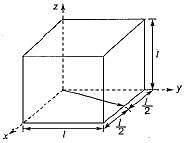

Detailed Solution: Question 13

Test: Structural of Metals & Alloys - 3 - Question 14

Match List-I (Miller indices) with List-ll (Denotes) and select the correct answer using the codes given below the lists:
List-I
A. (h, k l)
B. [h k l]
C. {h k l}
D. <h k l>
List-ll
1. direction
2. plane
3. family of direction
4. Family of planes
Codes:
    A B C D
(a) 1 2 3 4
(b) 1 2 4 3
(c) 2 1 4 3
(d) 2 1 3 4

Test: Structural of Metals & Alloys - 3 - Question 15

Planar density in BCC on (111) plane is

Detailed Solution: Question 15


Test: Structural of Metals & Alloys - 3 - Question 16

The linear density along the direction (110) will be equal to, if lattice constant of copper unit cell is 3.61 Å.

Detailed Solution: Question 16


= 3.91 x 10⁹ atoms/m
ρ = 3.91 x 10⁶ atoms/mm

Test: Structural of Metals & Alloys - 3 - Question 17

Miller indices of a plane will be whose intercepts are a, b/2 and 3c on x, y and z axes respectively in a simple cubic unit cell?

Test: Structural of Metals & Alloys - 3 - Question 18

Consider the following statements about screw dislocation
1. It forms when crystal displaces angulanly over the remaining parts
2. Burgers vector is parallel to screw dislocation line
3. Screw dislocations are symbolically represented by clockwise & anticiock-wise and reffered to negative & positive screw dislocation respectively
Q. Which of these statement are correct?

Test: Structural of Metals & Alloys - 3 - Question 19

Ratio of elastic strain energy of an edge dislocation to the screw dislocation is

Test: Structural of Metals & Alloys - 3 - Question 20

Which of the following best defines planar density in crystallography?

Detailed Solution: Question 20

Answer:
b) Number of atoms centered on a specific crystallographic plane divided by the area of that plane

Solution:

  • Planar density refers to how many atoms are effectively present per unit area on a particular plane of a crystal.

  • It is calculated as:
    Planar Density = (Number of atoms centered on the plane) / (Area of the plane)

  • It helps to analyze slip systems, deformation, and mechanical properties in materials.

45 videos|314 tests
Information about Test: Structural of Metals & Alloys - 3 Page
In this test you can find the Exam questions for Test: Structural of Metals & Alloys - 3 solved & explained in the simplest way possible. Besides giving Questions and answers for Test: Structural of Metals & Alloys - 3, EduRev gives you an ample number of Online tests for practice
Download as PDF