
Properties of Metals, Simple Stress Strain & Elastic Constants - 3 - Free
MCQ Practice Test & Solutions: Test: Properties of Metals, Simple Stress Strain & Elastic Constants - 3 (20 Questions)
You can prepare effectively for Civil Engineering (CE) Topicwise Question Bank for Civil Engineering with this dedicated MCQ Practice Test (available with solutions) on the important topic of "Test: Properties of Metals, Simple Stress Strain & Elastic Constants - 3". These 20 questions have been designed by the experts with the latest curriculum of Civil Engineering (CE) 2026, to help you master the concept.
Test Highlights:
- - Format: Multiple Choice Questions (MCQ)
- - Duration: 60 minutes
- - Number of Questions: 20
Sign up on EduRev for free to attempt this test and track your preparation progress.

The unit of elastic modulus is the same as those of
For a linearly elastic, isotropic and homogeneous material, the number of elastic constants required to relate stress and strain is

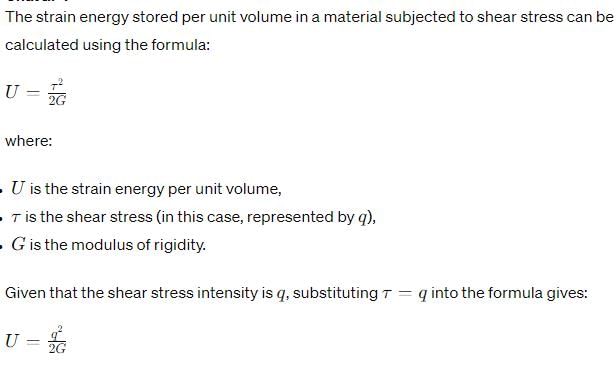
If the cross-section of a member is subjected to a uniform shear stress of intensity ‘q’, then the strain energy stored per unit volume is equal to (G = modulus of rigidity)
Detailed Solution: Question 3
In the case of an engineering material under unidirectional stress in the x-axis, the Poisson’s ratio is equal to (symbols have their usual meanings)
A 100 mm long and 50 mm diameter steel rod fits snugly between two rigid walls 100 mm apart at room temperature. Young's modulus of elasticity and coefficient of linear expansion of steel are 2 x 10⁵ N/mm2 and 12 x 10-6/°C respectively. The stress developed in the rod due to a 100°C rise in temperature will be
Detailed Solution: Question 5
During tensile testing of a specimen using a Universal Testing Machine, the parameters actually measured include
If the value of Poisson’s ratio is zero, then it means that
Detailed Solution: Question 7

The stretch in a steel rod of circular section, having a length ℓ subjected to a tensile load P and tapering uniformly from a diameter d1, at one end to a 'diameter d2 at the other end, is given by
If Poisson’s ratio for a material is 0.5, then the elastic modulus for the material is
Detailed Solution: Question 9
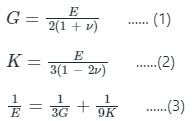
The Poisson’s ratio of a material which has Young’s modulus of 120 GPa, and shear modulus of 50 GPa, is
Detailed Solution: Question 10
A rod of material E = 200 x 103 MPa and α = 10-3 mm/mm/°C is fixed at both the ends. It is uniformly heated such that the increase in temperature is 30°C. The stress developed in the rod is
Detailed Solution: Question 11
The deformation of a bar under its own weight as compared to that when subjected to a direct axial load equal to its own weight will be
The number of independent elastic constants required to express the stress-strain relationship for linearly elastic isotropic materia! is
Detailed Solution: Question 13
A tapering bar (diameters of end sections being d1 and d2) and a bar of uniform cross-section ‘d' have the same length and are subjected to the same axial pull. Both the bars will have the same extension if ‘ d ’ is equal to
Detailed Solution: Question 14

The number of elastic constants for a completely anisotropic elastic material which follows Hooke’s law is
For a given material, the modulus of rigidity is 100 GPa and Poisson’s ratio is 0.25. The value of modulus of elasticity in GPa is
Detailed Solution: Question 16
A cube having each side of length ‘a’ is constrained in all directions and is heated uniformly so that the temperature is raised to T°C. If α is the thermal coefficient of expansion of the cube material and E is the modulus of elasticity, the stress developed in the cube is
Detailed Solution: Question 17

Toughness for mild steel under uniaxial tensile loading is given by the shaded portion of the stress-strain diagram as shown in
Detailed Solution: Question 18
Which one of the following is correct in respect of Poisson’s ratio (v) limits for an isotropic elastic solid?
Detailed Solution: Question 19
A bar of copper and steel form a composite system. They are heated to a temperature of 40°C. What type of stress is induced in the copper bar?
Detailed Solution: Question 20
