
Mechanical Properties of Materials - 3 - Free MCQ Practice Test with solutions,
MCQ Practice Test & Solutions: Test: Mechanical Properties of Materials - 3 (30 Questions)
You can prepare effectively for Mechanical Engineering Strength of Materials (SOM) with this dedicated MCQ Practice Test (available with solutions) on the important topic of "Test: Mechanical Properties of Materials - 3". These 30 questions have been designed by the experts with the latest curriculum of Mechanical Engineering 2026, to help you master the concept.
Test Highlights:
- - Format: Multiple Choice Questions (MCQ)
- - Duration: 90 minutes
- - Number of Questions: 30
Sign up on EduRev for free to attempt this test and track your preparation progress.

A material capable of absorbing large amount of energy before fracture is known as
Detailed Solution: Question 1
Detailed Solution: Question 2

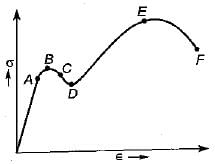
The following figure shows the stress-strain curve for tensile test on a mild steel specimen.
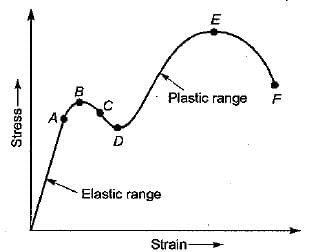
Q. The upper yield point is represented by the point
Detailed Solution: Question 3
Select the proper sequence
1. Proportional limit
2. Elastic limit
3. Yielding
4. Failure
1. Proportional limit
2. Elastic limit
3. Yielding
4. Failure
Detailed Solution: Question 4
The stress-strain curve for glass during tensile test would exhibit
Detailed Solution: Question 5
The impact strength of a material is an index of its
Detailed Solution: Question 6
Detailed Solution: Question 7
What are the materials which show direction dependent properties?
Detailed Solution: Question 8
A material has identical properties in all directions, it is said to be
Detailed Solution: Question 9
Detailed Solution: Question 10
Detailed Solution: Question 11
The material in which large deformation is possible before the absolute failure or rupture is termed as
Detailed Solution: Question 12
What is the phenomenon of progressive extension of the material i.e. strain increasing with the time at a constant load, called?
Detailed Solution: Question 13
The stress level, below which a material has a high probability of not failing under reversal of stress, is known as
Detailed Solution: Question 14
The energy absorbed in a body, when it is strained within the elastic limits, is known as
Detailed Solution: Question 15
Toughness for mild steel under uniaxial tensile loading is given by the shaded portion of the stress-strain diagram as shown in
Detailed Solution: Question 16
Detailed Solution: Question 17
Which one of the following pairs is NOT correctly matched?
Detailed Solution: Question 18
The linear relation between the stress and strain of a material is valid until
Detailed Solution: Question 19
Detailed Solution: Question 20
Limit of proportionality depends upon
Detailed Solution: Question 21
The stress-strain curve for an ideally plastic materia! is
Detailed Solution: Question 22
Match List-I (Materials) with List-II (Stress-Strain curves) and select the correct answer using the codes given below the lists:
List-I
A. Mild steel
B. Pure copper
C. Cast iron
D. Pure aluminium
List-II
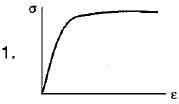
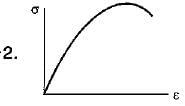
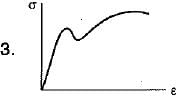
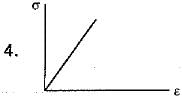
Codes:
A B C D
(a) 3 1 4 1
(b) 3 2 4 2
(c) 2 4 3 1
(d) 3 2 4 1
List-I
A. Mild steel
B. Pure copper
C. Cast iron
D. Pure aluminium
List-II
Codes:
A B C D
(a) 3 1 4 1
(b) 3 2 4 2
(c) 2 4 3 1
(d) 3 2 4 1
Detailed Solution: Question 23
Match list - I with list - II and select the correct answer using the codes below:
List - I
A. Ductility
B. Brittleness
C. Tenacity
D. Toughness
List - II
1. Failure without warning
2. Drawn permanently over great changes of shape without rupture.
3. Absorption of energy at high stress without rupture.
4. High tensile strength
Detailed Solution: Question 24
Which one of the following properties cannot be evaluated by static tension test?
Detailed Solution: Question 25
The percentage elongation of a material as obtained from static tension test depends upon the
Detailed Solution: Question 26
Detailed Solution: Question 27
Modular ratio of two materials is the ratio of
Detailed Solution: Question 28
Proof resilience per unit volume of a material is known as .
Detailed Solution: Question 29
An axial residual compressive stress due to a manufacturing process is present on the outer surface of a rotating shaft subjected to bending. Under a given bending load, the fatigue life of the shaft in the presence of the residual compressive stress is
Detailed Solution: Question 30
37 videos|105 docs|47 tests |
