CUET Commerce Exam  >  CUET Commerce Test  >  General Test Preparation for CUET UG  >  CAT Practice: Time & Work - 1 - CUET Commerce MCQ

CAT Practice: Time & Work - 1 - Free MCQ Test with solutions for CUET Commerce


MCQ Practice Test & Solutions: CAT Practice: Time & Work - 1 (15 Questions)

You can prepare effectively for CUET Commerce General Test Preparation for CUET UG with this dedicated MCQ Practice Test (available with solutions) on the important topic of "CAT Practice: Time & Work - 1". These 15 questions have been designed by the experts with the latest curriculum of CUET Commerce 2026, to help you master the concept.

Test Highlights:

  • - Format: Multiple Choice Questions (MCQ)
  • - Duration: 25 minutes
  • - Number of Questions: 15

Sign up on EduRev for free to attempt this test and track your preparation progress.

CAT Practice: Time & Work - 1 - Question 1

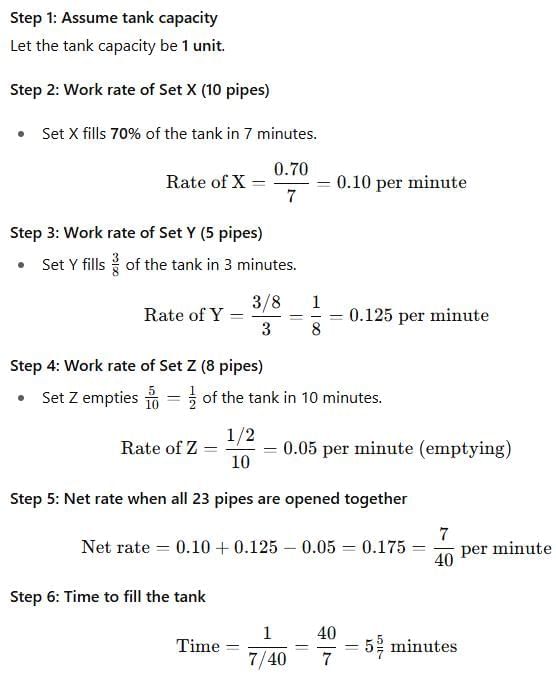
Directions for Question: A set of 10 pipes (set X) can fill 70% of a tank in 7 minutes. Another set of 5 pipes (set Y) fills 3/8 of the tank in 3 minutes. A third set of 8 pipes (set Z) can empty 5/10 of the tank in 10 minutes.

Q. How many minutes will it take to fill the tank if all the 23 pipes are opened at the same time?

Detailed Solution: Question 1
CAT Practice: Time & Work - 1 - Question 2

2 men and a woman can complete a task in a certain number of days. If 13 men and 12 women work on the same task they can complete it in 1/8th of days required earlier. The number of days taken by 13 men and 12 women is equal to the number of days taken by 4 men and 27 children to finish the same task.
If 2 children and a man can complete another task in 12 days. What is the minimum number of days required by 3 women and 1 child to do the same task?
Even if they have to work for a fraction of a day, it will be counted as a whole day. 

Detailed Solution: Question 2
Let the amount of work done by a man in 1 day be "m" units and the amount of work done by a woman in 1 day be "w" units. Let's assume they take N days to complete
As per the first line we can say that 
(2m + w) x N = (N/8)(13m + 12w)
On cancelling the common factors and rearranging we get
(2m + w) x 8  = (13 m + 12w)
Which implies 16m + 8w = (13m + 12w)
or 3m = 4w ...(I)
It is also given that it is equal to 4 men and 27 children. Let a child to "c" units of work in a day
Then
(N/8) (13m + 12w) = (N/8)(4m +27c)
Or, 13m + 12w = 4m + 27c
Putting value of w from (I)
13m+9m=4m+27c
or, 18m=27c or 2m = 3c...(II)
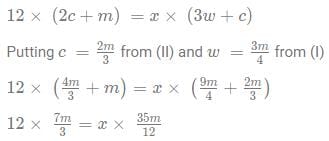
Given that another task takes 12 days to be completed by 2 children and a man. Let us assume that it takes x days to be completed by 3 women and 1 child. Equating the amount of work done

Cancelling m and cross multiplying

9.6 days is needed. 10 is the next biggest number .

CAT Practice: Time & Work - 1 - Question 3

A can build a wall in 12 days. B can break it in 20 days and C can build it in 10 days. If they work in the order A, B, C and no two workers work on the same day, then on which day will the wall be built completely?

Detailed Solution: Question 3

Let us consider the total work to be done as 60 units (LCM of 12, 20 and 10). Now let us break it down into blocks of 3 days. On first day A builds 5 units of wall

On second day B breaks 3 unit of wall and on third day C builds 6 units of wall.

So in 3 days 8 units of wall are built.

Now in this way 56 units of wall will be built in 7 such blocks, i.e. 21 days.

On 22 day A will complete the construction of the wall.

CAT Practice: Time & Work - 1 - Question 4

Ajit, Rajat and Abhay can do a piece of work in 10, 12 and 15 days respectively. Ajit works for two days and then Rajat joins him. They together work for some days and then leave. Abhay completes the remaining work. If work gets completed in 35/4 days and they get ₹ 5000 for the work, find the share of Abhay in the money.

Detailed Solution: Question 4

Let the total units of work to be done be 60 units(LCM of 10,12 and 15)

Now Ajit does 6 units in 1 day, Rajat 5 and Abhay 4.

Now Initially Ajit worked for 2 two days so he would have completed 12 units of work.

So remaining work is 48 units and time is 35/4 - 2 = 27/4

11x + 4y = 48

x + y = 27/4

on solving we get x= 3 and y = 15/4

So in 15/4 Days Abhay will do 15/4 x 4 = 15 units of work.

So Abhay's share in work = 15/60 = 25%

So his share would be 25*5000/100 = Rs 1250.

*Answer can only contain numeric values
CAT Practice: Time & Work - 1 - Question 5

Working alone, the times taken by Anu, Tanu and Manu to complete any job are in the ratio 5 : 8 : 10. They accept a job which they can finish in 4 days if they all work together for 8 hours per day. However, Anu and Tanu work together for the first 6 days, working 6 hours 40 minutes per day. Then, the number of hours that Manu will take to complete the remaining job working alone is


*Answer can only contain numeric values
CAT Practice: Time & Work - 1 - Question 6

Amar, Akbar and Anthony are working on a project. Working together Amar and Akbar can complete the project in 1 year, Akbar and Anthony can complete in 16 months, Anthony and Amar can complete in 2 years. If the person who is neither the fastest nor the slowest works alone, the time in months he will take to complete the project is


Detailed Solution: Question 6

Let the total work be 48 units. Let Amar do 'm' work, Akbar do 'k' work, and Anthony do 'n' units of work in a month.
Amar and Akbar complete the project in 12 months. Hence, in a month they do 48/12 = 4units of work.
m+k = 4.
Similarly, k+n = 3, and m+n = 2.
Solving the three equations, we get 
Here, Amar works neither the fastest not the slowest, and he does 1.5 units of work in a month. Hence, to complete the work, he would take 48/1.5 = 32 months.

CAT Practice: Time & Work - 1 - Question 7

Anil can paint a house in 60 days while Bimal can paint it in 84 days. Anil starts painting and after 10 days, Bimal and Charu join him. Together, they complete the painting in 14 more days. If they are paid a total of ₹ 21000 for the job, then the share of Charu, in INR, proportionate to the work done by him, is

Detailed Solution: Question 7

Let Entire work be W
Now Anil worked for 24 days
Bimal worked for 14 days and Charu worked for 14 days .
Now Anil Completes W in 60 days
so in 24 days he completed 0.4W
Bimal completes W in 84 Days
So in 14 Days Bimal completes = W/6
Therefore work done by charu = 
Therefore proportion of Charu = 

*Answer can only contain numeric values
CAT Practice: Time & Work - 1 - Question 8

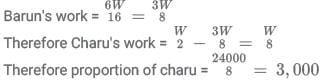
Anil can paint a house in 12 days while Barun can paint it in 16 days. Anil, Barun, and Chandu undertake to paint the house for ₹ 24000 and the three of them together complete the painting in 6 days. If Chandu is paid in proportion to the work done by him, then the amount in INR received by him is


Detailed Solution: Question 8
Now Anil Paints in 12 Days
Barun paints in 16 Days
Now together Arun , Barun and Chandu painted in 6 Days
Now let total work be W
Now each worked for 6 days
So Anil's work = 0.5W

*Answer can only contain numeric values
CAT Practice: Time & Work - 1 - Question 9

Renu would take 15 days working 4 hours per day to complete a certain task whereas Seema would take 8 days working 5 hours per day to complete the same task. They decide to work together to  complete this task. Seema agrees to work for double the number of hours per day as Renu, while Renu agrees to work for double the number of days as Seema. If Renu works 2 hours per day, then the number of days Seema will work, is


Detailed Solution: Question 9

Let Renu and Seema do r and s 
units of work daily.

ATQ,
r × 15 × 4 = s × 8 × 5
r / s = 2 / 3
Let the total number of work be 120 units.
So, Renu’s one day’s work = 2 units
Seema’s one day’s work = 3 units
Now, according to new agreement:
Renu works 2 hours a day for 2d while Seema works 4 hours a day for d days.
So,
2 × 2 × 2d + 3 × 4 × d = 120
20d = 120
d = 6 days
Hence, Seema works for 6 days.

CAT Practice: Time & Work - 1 - Question 10

Arun, Varun and Tarun, if working alone, can complete a task in 24, 21, and 15 days, respectively. They charge Rs 2160, Rs 2400, and Rs 2160 per day, respectively, even if they are employed for a partial day. On any given day, any of the workers may or may not be employed to work. If the task needs to be completed in 10 days or less, then the minimum possible amount, in rupees, required to be paid for the entire task is

Detailed Solution: Question 10
Let's assume that Total work = 1
If the work is entirely carried by each one of them it would cost
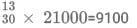
Arun: 2160 × 24 = 51840
Varun: 2400 × 21 = 50400 
Tarun: 2160 × 15 = 32400 
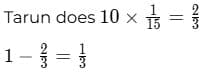
The cheapest worker is Tarun. He can finish the work in 15 days. But we need the work completed in 10 days.

Complete the remaining (1/3) work using the next cheapest worker, which is Varun.

Total cost = Amount paid for Tarun + Amount paid for Varun = 10 × 2160 + 7 × 2400 = 38400 

CAT Practice: Time & Work - 1 - Question 11

Directions for Question : A set of 10 pipes (set X) can fill 70% of a tank in 7 minutes. Another set of 5 pipes (set Y) fills 3/8 of the tank in 3 minutes. A third set of 8 pipes (set Z) can empty 5/10 of the tank in 10 minutes.

Q. If only half the pipes of set X are closed and only half the pipes of set Y are open and all other pipes are open, how long will it take to fill 49% of the tank?

Detailed Solution: Question 11

►Set X will do 5% per minute and Set Y will do 6.25% per minute, while set Z will do 5% per minute (negative work).

►Hence, Net work will be 6.25% per minute. To fill 49% it will take slightly less than eight minutes and the value will be a fraction.

►None of the first three options matches this requirement. 

CAT Practice: Time & Work - 1 - Question 12

Directions for Question: A set of 10 pipes (set X) can fill 70% of a tank in 7 minutes. Another set of 5 pipes (set Y) fills 3/8 of the tank in 3 minutes. A third set of 8 pipes (set Z) can empty 5/10 of the tank in 10 minutes.

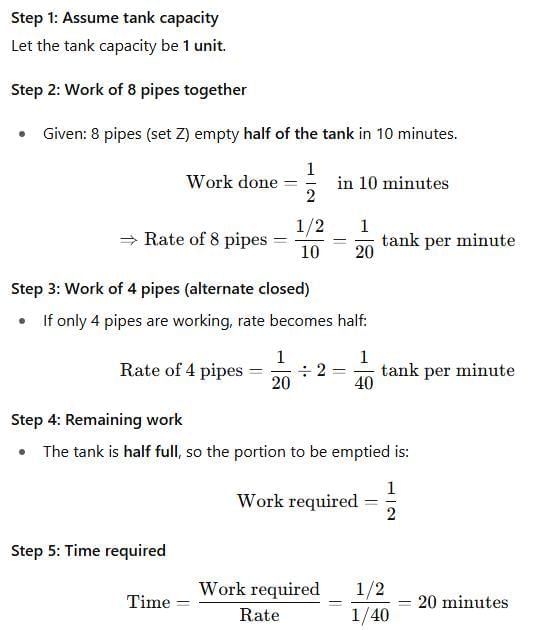
Q. If the tank is half full and set X and set Y are closed, how many minutes will it take for set Z to empty the tank if alternate taps of set Z are closed.

Detailed Solution: Question 12
CAT Practice: Time & Work - 1 - Question 13

Direction for Question: Refer to the data below and answer the questions that follow: 

Anoop was writing the reading comprehension sections in the SIP entrance examinations. There were four passages of exactly equal length in terms of number of words and the four passages had 5, 8, 8 and 6 questions following each of them, respectively. It is known that Anoop can answer exactly 12 questions in the time he takes to read any one of the the four passages. Assume that his rate of reading and answering questions remains the same throughout the section.

Q. Anoop took 13 min more to finish the first three passages than the time he took to finish the last passage. Assuming that Anoop answered all the questions in each passage, what percentage of the total time did he spent on the first passage?

Detailed Solution: Question 13

Step 1: Define variables

  • R = time to read one passage

  • A = time to answer one question

Given: In time R, he answers 12 questions
→ A = R/12

Step 2: Questions per passage

  • Passage 1 → 5 questions

  • Passage 2 → 8 questions

  • Passage 3 → 8 questions

  • Passage 4 → 6 questions

Step 3: Time per passage

  • T1 = R + 5A = R + 5(R/12) = (17/12)R

  • T2 = R + 8A = R + 8(R/12) = (20/12)R

  • T3 = R + 8A = (20/12)R

  • T4 = R + 6A = R + 6(R/12) = (18/12)R

Step 4: Condition given
Time for first three passages exceeds time for last passage by 13 minutes:

T1 + T2 + T3 − T4 = 13
⇒ (17 + 20 + 20 − 18)/12 × R = (39/12)R = 13
⇒ R = 13 × (12/39) = 4 minutes

Step 5: Total time
Ttotal = T1 + T2 + T3 + T4
= (17 + 20 + 20 + 18)/12 × R
= (75/12)R
= (75/12) × 4 = 25 minutes

Step 6: Time on first passage
T1 = (17/12)R = (17/12) × 4 = 17/3 ≈ 5.67 minutes

Step 7: Percentage of total
(T1 / Ttotal) × 100
= (5.67 / 25) × 100 ≈ 22.67% ≈ 22.6%

CAT Practice: Time & Work - 1 - Question 14

Direction for Question: Refer to the data below and answer the questions that follow: 

Anoop was writing the reading comprehension sections in the SIP entrance examinations. There were four passages of exactly equal length in terms of number of words and the four passages had 5, 8, 8 and 6 questions following each of them, respectively. It is known that Anoop can answer exactly 12 questions in the time he takes to read any one of the the four passages. Assume that his rate of reading and answering questions remains the same throughout the section.

Q. By what per cent should Anoop increase his reading speed if he has to cut down on his total time spent on the section by 20%? Assume that the time spent on answering the questions is constant and as given in the directions.

Detailed Solution: Question 14

Step 1: Define variables
Let T be the time Anoop takes to read one passage.
In this time T, he can answer 12 questions.

Step 2: Total questions
Passages = 4
Questions per passage = 5, 8, 8, 6
Total questions = 5 + 8 + 8 + 6 = 27

Step 3: Time for answering questions

  • He answers 12 questions in time T → time per question = T/12

  • For 27 questions → time = 27 × (T/12) = 27T/12

Step 4: Original total time

  • Reading time = 4T

  • Answering time = 27T/12

Total time = 4T + 27T/12
= (48T + 27T)/12 = 75T/12

Step 5: New target time
Target = 20% less than original
= 0.8 × (75T/12) = 60T/12 = 5T

Step 6: Allowed reading time
Answering time is fixed = 27T/12

So, allowed reading time = 5T − 27T/12
= (60T − 27T)/12 = 33T/12

Original reading time = 4T = 48T/12

Reduction = from 48T/12 to 33T/12 → factor = 33/48

Step 7: Required speed increase
Reading speed must increase by reciprocal factor:
= 48/33 = 16/11

Percentage increase = (16/11 − 1) × 100%
= (5/11) × 100% ≈ 45.45%

CAT Practice: Time & Work - 1 - Question 15

P, Q and R each complete a certain work in 16, 20 and 30 days, respectively. The three of them start the work together. P leaves after 4 days;  Q leaves 4 days before the work is finished? How long did the work last?

Detailed Solution: Question 15

Let the total work = 1 unit.

Rates of work per day:

  • P = 1/16

  • Q = 1/20

  • R = 1/30

Step 1: Work done in first 4 days (all together)
Work = 4 × (1/16 + 1/20 + 1/30)
= 4 × [(15 + 12 + 8) / 240]
= 4 × (35/240)
= 140/240 = 7/12

Step 2: Distribution of work duration

  • P leaves after 4 days → works only 4 days in total.

  • Q leaves 4 days before completion → works for (T – 4) days.

  • R works throughout → works for T days.

Step 3: Total work equation
(P’s contribution) + (Q’s contribution) + (R’s contribution) = 1

(4/16) + (T – 4)/20 + T/30 = 1

Step 4: Simplify
4/16 = 1/4 = 5/20

So, (5/20 + (T – 4)/20) + T/30 = 1
⇒ (T + 1)/20 + T/30 = 1

LCM of 20 and 30 = 60

[3(T + 1) + 2T] / 60 = 1
⇒ 3T + 3 + 2T = 60
⇒ 5T = 57
⇒ T = 11.4 days

164 videos|812 docs|1354 tests
Information about CAT Practice: Time & Work - 1 Page
In this test you can find the Exam questions for CAT Practice: Time & Work - 1 solved & explained in the simplest way possible. Besides giving Questions and answers for CAT Practice: Time & Work - 1, EduRev gives you an ample number of Online tests for practice
Download as PDF