
Bricks, Beads & Bones- 2 - Free MCQ Practice Test with solutions, Humanities
MCQ Practice Test & Solutions: Test: Bricks, Beads & Bones- 2 (22 Questions)
You can prepare effectively for Humanities/Arts History Class 12 with this dedicated MCQ Practice Test (available with solutions) on the important topic of "Test: Bricks, Beads & Bones- 2". These 22 questions have been designed by the experts with the latest curriculum of Humanities/Arts 2026, to help you master the concept.
Test Highlights:
- - Format: Multiple Choice Questions (MCQ)
- - Duration: 22 minutes
- - Number of Questions: 22
Sign up on EduRev for free to attempt this test and track your preparation progress.

Which of the following statements is true regarding the urban planning of Harappan cities?
i. Streets were laid out in a grid pattern with an advanced drainage system.
ii. Houses were often built around courtyards for privacy and ventilation.
iii. Windows were commonly placed on the ground floor of houses.
iv. Wells were a common feature, with many houses having private wells.
i. Streets were laid out in a grid pattern with an advanced drainage system.
ii. Houses were often built around courtyards for privacy and ventilation.
iii. Windows were commonly placed on the ground floor of houses.
iv. Wells were a common feature, with many houses having private wells.
Detailed Solution: Question 1
Which of the following methods of irrigation is not employed at Harappan sites?
Detailed Solution: Question 2

Assertion (A): The Harappan civilization’s agricultural practices included the use of irrigation systems.
Reason (R): Evidence of canals and water reservoirs has been found at various Harappan sites.
Detailed Solution: Question 3
Which of the following materials were used by the Harappans for making tools and artefacts?
i. Stone and metal were used to create tools for harvesting.
ii. Copper and bronze items were found in Harappan settlements.
iii. Terracotta was used for making models of ploughs and other objects.
iv. Iron was the primary metal used for crafting tools and weapons.
i. Stone and metal were used to create tools for harvesting.
ii. Copper and bronze items were found in Harappan settlements.
iii. Terracotta was used for making models of ploughs and other objects.
iv. Iron was the primary metal used for crafting tools and weapons.
Detailed Solution: Question 4
Assertion (A): The Harappan civilization engaged in extensive trade with distant lands.
Reason (R): Archaeological findings suggest that copper was imported from Oman and other regions.
Detailed Solution: Question 5
Which of the following subsistence strategies were adopted by the Harappans?
i. They practiced agriculture, growing crops like wheat, barley, and lentils.
ii. Rice was one of the most common crops in Harappan sites.
iii. They domesticated animals such as cattle, sheep, and goats.
iv. Fishing and hunting wild animals were also part of their diet.
i. They practiced agriculture, growing crops like wheat, barley, and lentils.
ii. Rice was one of the most common crops in Harappan sites.
iii. They domesticated animals such as cattle, sheep, and goats.
iv. Fishing and hunting wild animals were also part of their diet.
Detailed Solution: Question 6
Which routes along the Indus and its tributaries, as well as coastal routes, were probably used?
Detailed Solution: Question 7
What has been found in burials of both men and women?
Detailed Solution: Question 8
Assertion (A): The presence of luxury items in Harappan sites indicates social stratification.
Reason (R): Artefacts considered luxuries were concentrated in larger settlements, while smaller sites had fewer such items.
Detailed Solution: Question 9
Detailed Solution: Question 10
Assertion (A): The decline of the Harappan civilization is attributed to multiple environmental and social factors.
Reason (R): The civilization experienced significant climatic changes that affected agriculture.
Detailed Solution: Question 11
Which of the following subsistence strategies did the Harappans use?
i. The Harappans had a diverse diet that included plant and animal products.
ii. Harappans relied heavily on rice as their primary grain.
iii. Domesticated animals such as cattle, sheep, and goats were part of their diet.
iv. Bones of wild species like boar and deer have been found at Harappan sites.
i. The Harappans had a diverse diet that included plant and animal products.
ii. Harappans relied heavily on rice as their primary grain.
iii. Domesticated animals such as cattle, sheep, and goats were part of their diet.
iv. Bones of wild species like boar and deer have been found at Harappan sites.
Detailed Solution: Question 12
What is the context in which the bathroom was found?
Detailed Solution: Question 13
Which of the following urban planning features is true about Mohenjodaro?
i. The city was divided into a Citadel and a Lower Town.
ii. Streets were laid out in a grid pattern with a drainage system.
iii. Buildings were constructed on mud-brick platforms.
iv. Only the Citadel had drainage systems, while the Lower Town did not.
i. The city was divided into a Citadel and a Lower Town.
ii. Streets were laid out in a grid pattern with a drainage system.
iii. Buildings were constructed on mud-brick platforms.
iv. Only the Citadel had drainage systems, while the Lower Town did not.
Detailed Solution: Question 14
Which of the following methods were used by archaeologists to classify Harappan artefacts?
i. Artefacts were classified based on material, such as stone, metal, or bone.
ii. Artefacts were classified by function, such as tools or ornaments.
iii. Similar artefacts from other cultures were used to help classify Harappan artefacts.
iv. Artefacts were classified based on the colour of the materials.
i. Artefacts were classified based on material, such as stone, metal, or bone.
ii. Artefacts were classified by function, such as tools or ornaments.
iii. Similar artefacts from other cultures were used to help classify Harappan artefacts.
iv. Artefacts were classified based on the colour of the materials.
Detailed Solution: Question 15
Chemical analysis have shown that both Omani copper and Harappan artifacts have traces of what metal?
Detailed Solution: Question 16
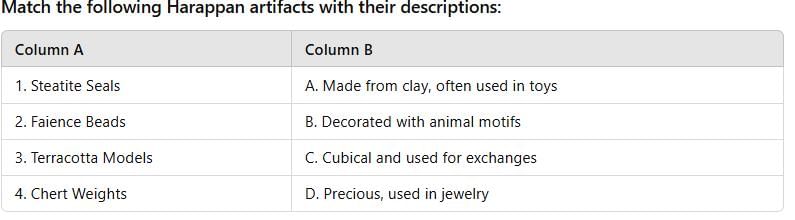
Detailed Solution: Question 17
Arrange the following events related to the Harappan civilization in chronological order:
i. Discovery of Harappan seals
ii. Establishment of settlements in Gujarat
iii. Excavation at Harappa by John Marshall
iv. Decline of the Mature Harappan phase
ii. Establishment of settlements in Gujarat
iii. Excavation at Harappa by John Marshall
iv. Decline of the Mature Harappan phase
Detailed Solution: Question 18
Assertion (A): The Harappan civilization was characterized by advanced urban planning and infrastructure.
Reason (R): The cities were built using standardized bricks and had well-designed drainage systems.
Detailed Solution: Question 19
Statement I: The Harappan civilization predominantly used clay bricks for construction.
Statement II: The Harappan civilization never established any contact with distant lands like Mesopotamia.
Statement II: The Harappan civilization never established any contact with distant lands like Mesopotamia.
Detailed Solution: Question 20
Which rare material, found primarily in large Harappan urban centers like Mohenjodaro and Harappa, was often used to create precious beads that required advanced firing techniques to obtain their distinctive red color?
Detailed Solution: Question 21
Statement I: The presence of terracotta toy models of bullock carts at Harappan sites indicates that riverine routes were the primary means of transporting heavy materials like stone and metal.
Statement II: Archaeological findings suggest that the Harappans relied solely on local materials for their craft production, with no evidence of long-distance trade or external procurement.
Which of the statement(s) is/are true?
Statement II: Archaeological findings suggest that the Harappans relied solely on local materials for their craft production, with no evidence of long-distance trade or external procurement.
Detailed Solution: Question 22
30 videos|321 docs|25 tests |
