NEET Exam  >  NEET Test  >  Physics Class 11  >  Test: Fundamental Forces In Nature (Old NCERT) - NEET MCQ

Fundamental Forces In Nature (Old NCERT) - Free MCQ Practice Test


MCQ Practice Test & Solutions: Test: Fundamental Forces In Nature (Old NCERT) (10 Questions)

You can prepare effectively for NEET Physics Class 11 with this dedicated MCQ Practice Test (available with solutions) on the important topic of "Test: Fundamental Forces In Nature (Old NCERT)". These 10 questions have been designed by the experts with the latest curriculum of NEET 2026, to help you master the concept.

Test Highlights:

  • - Format: Multiple Choice Questions (MCQ)
  • - Duration: 10 minutes
  • - Number of Questions: 10

Sign up on EduRev for free to attempt this test and track your preparation progress.

Test: Fundamental Forces In Nature (Old NCERT) - Question 1

Earth pulls every object towards it with a force called:

Detailed Solution: Question 1
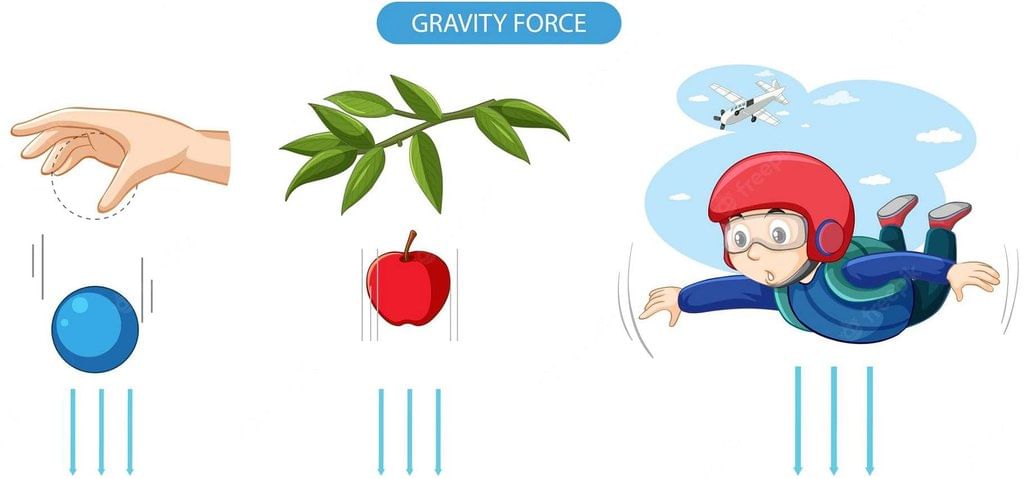
Gravitational force of the earth acts from the centre of the earth and pulls every substance towards itself.

Test: Fundamental Forces In Nature (Old NCERT) - Question 2

What is the study of the modern theory of the strong forces between quarks?

Detailed Solution: Question 2

Quantum chromodynamics is as quantum field theory in which strong interaction is described in terms of an interaction between quarks.

Test: Fundamental Forces In Nature (Old NCERT) - Question 3

Gravity is:

Detailed Solution: Question 3

Gravity acts from the centre of the earth, therefore it is a down ward acting force.

Test: Fundamental Forces In Nature (Old NCERT) - Question 4

The strongest fundamental force in nature is

Detailed Solution: Question 4
Test: Fundamental Forces In Nature (Old NCERT) - Question 5

Gravity is defined  as:

Detailed Solution: Question 5

Gravitational force of the earth acts from the centre of the earth and pulls every substance towards itself.

Test: Fundamental Forces In Nature (Old NCERT) - Question 6

Which force is weakest of all fundamental forces?

Detailed Solution: Question 6

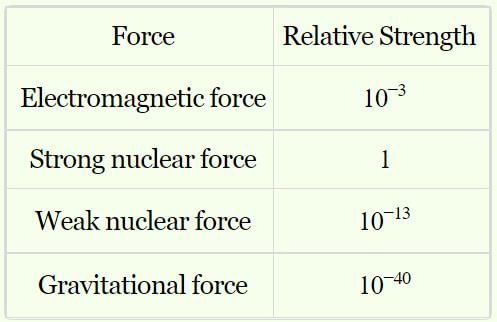
Gravitational force is the attraction between two masses.

Electromagnetic force is the force between two charged particles or two poles of a magnet. It is stronger than Gravitational.

Weak nuclear force is the weak force of attraction between the subatomic particles of the nucleus of an atom. Though the name suggests that it is weak, it is stronger than electromagnetic.

Strong nuclear force is the stronger version of nuclear force.It is the strongest force in nature.

Test: Fundamental Forces In Nature (Old NCERT) - Question 7

Earth has no gravitational force:

Detailed Solution: Question 7

Gravitational force of the earth acts from the centre of the earth and pulls every substance towards itself.

Test: Fundamental Forces In Nature (Old NCERT) - Question 8

Wheel-and-axle and rope move in:

Detailed Solution: Question 8

The wheel-and-axle and rope are two important mechanical devices that work together to transmit force and motion. The wheel-and-axle is a simple machine consisting of a circular wheel attached to a central shaft (the axle), which allows the wheel to rotate freely. The rope, on the other hand, is a flexible cord made of twisted or braided fibers, which can be used to pull or lift objects.

When the wheel-and-axle and rope are used together, they can create a variety of mechanical advantages, depending on the direction and magnitude of the applied force. In general, the relationship between the wheel-and-axle and rope depends on their relative directions of motion. The correct answer to the question is option 'A', which means that the wheel-and-axle and rope move in the same direction. Let us explain this in more detail.

Explanation: When the wheel-and-axle and rope move in the same direction, they form a simple pulley system. In this system, the rope is wrapped around the wheel-and-axle, and when force is applied to one end of the rope, it causes the wheel-and-axle to rotate. The direction of motion of the wheel-and-axle is the same as the direction of the force applied to the rope. The mechanical advantage of this system depends on the size of the wheel-and-axle and the number of times the rope is wrapped around it. The larger the wheel-and-axle, the greater the mechanical advantage, as it allows the force to be applied over a longer distance. Similarly, the more times the rope is wrapped around the wheel-and-axle, the greater the mechanical advantage, as it allows the force to be multiplied by the number of rope segments that support the load.

Examples of the wheel-and-axle and rope moving in the same direction:

1. A flagpole: In this example, the rope is attached to a flag and wrapped around a pulley at the top of the pole. When the rope is pulled down, it causes the pulley (which is a type of wheel-and-axle) to rotate, raising the flag to the top of the pole.

2. A clothesline: In this example, the rope is attached to a clothesline and wrapped around a pulley at one end. When the rope is pulled, it causes the pulley to rotate, pulling the clothesline tight and allowing clothes to be hung on it.

Test: Fundamental Forces In Nature (Old NCERT) - Question 9

Which of these is incorrect about nuclear forces?

Detailed Solution: Question 9

Hadrons are subatomic composite porticle made of two(or) more quarks. They experience strong nuclear force. ​

Test: Fundamental Forces In Nature (Old NCERT) - Question 10

Which of the following class of forces is different from others?

Detailed Solution: Question 10

Spring force is different from magnetic ,electrical and gravitational force as it varies linearly.

97 videos|376 docs|98 tests
Information about Test: Fundamental Forces In Nature (Old NCERT) Page
In this test you can find the Exam questions for Test: Fundamental Forces In Nature (Old NCERT) solved & explained in the simplest way possible. Besides giving Questions and answers for Test: Fundamental Forces In Nature (Old NCERT), EduRev gives you an ample number of Online tests for practice
97 videos|376 docs|98 tests
Download as PDF