CBSE Class 7  >  Class 7 Test  >  Mathematics (Maths) (Old NCERT)  >  Test: Visualising Solid Shapes - Class 7 MCQ

Visualising Solid Shapes - Free MCQ Practice Test with solutions,


MCQ Practice Test & Solutions: Test: Visualising Solid Shapes (20 Questions)

You can prepare effectively for Class 7 Mathematics (Maths) Class 7 (Old NCERT) with this dedicated MCQ Practice Test (available with solutions) on the important topic of "Test: Visualising Solid Shapes". These 20 questions have been designed by the experts with the latest curriculum of Class 7 2026, to help you master the concept.

Test Highlights:

  • - Format: Multiple Choice Questions (MCQ)
  • - Duration: 20 minutes
  • - Number of Questions: 20

Sign up on EduRev for free to attempt this test and track your preparation progress.

Test: Visualising Solid Shapes - Question 1

The number of faces of a sphere is _______.

Detailed Solution: Question 1

The sphere has no flat faces.

  • The number of faces on a sphere is zero.
  • Unlike polyhedra, which have flat surfaces, a sphere is entirely curved.
  • This unique shape results in the absence of any flat faces.

Test: Visualising Solid Shapes - Question 2

The number of vertices of a cube is _______.

Detailed Solution: Question 2

The number of vertices of a cube is

  • The cube has a total of eight vertices.
  • Each vertex is a point where three edges meet.
  • This geometric shape is one of the simplest and most well-known in three-dimensional space.

Test: Visualising Solid Shapes - Question 3

The number of vertices of a cone is _______.

Detailed Solution: Question 3

The number of vertices of a cone is.

  • A cone has one vertex, which is the tip or apex of the cone.
  • The base of the cone is circular and does not count as a vertex.
  • Therefore, the total number of vertices in a cone is 1.

Test: Visualising Solid Shapes - Question 4

The number of faces of a square pyramid is _______.

Detailed Solution: Question 4

The number of faces of a square pyramid is:

  • A square pyramid has a total of 5 faces.
  • This includes one square base and four triangular faces.
  • Each triangular face connects the apex of the pyramid to the edges of the base.

Test: Visualising Solid Shapes - Question 5

The number of faces of a triangular pyramid or tetrahedron is _______.

Detailed Solution: Question 5

The number of faces of a triangular pyramid or tetrahedron is:

  • 4 faces in total.
  • Each face is a triangle.
  • The faces include:
    • 1 base triangle.
    • 3 triangular side faces.

Test: Visualising Solid Shapes - Question 6

The number of triangular faces of a triangular prism is _______.

Detailed Solution: Question 6
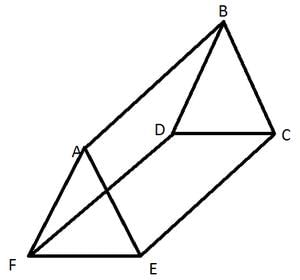
Test: Visualising Solid Shapes - Question 7

The number of rectangular faces of a triangular prism is _______.

Detailed Solution: Question 7

A triangular prism has:

  • 3 rectangular faces
  • Each face connects the corresponding sides of the two triangular bases

Test: Visualising Solid Shapes - Question 8

The number of triangular faces of a rectangular pyramid is _______.

Detailed Solution: Question 8

The number of triangular faces of a rectangular pyramid is:

  • A rectangular pyramid has a rectangular base.
  • It features four triangular faces that connect the apex to each side of the base.
  • Therefore, the total number of triangular faces is 4.

Test: Visualising Solid Shapes - Question 9

Which of the following objects is shaped like a sphere?

Detailed Solution: Question 9

A football is shaped like a sphere because it is round and has a smooth curved surface. 

  • Ice cube (A) – It has flat faces and edges, so it is not a sphere.
  • Football (B) – It is round like a sphere, so this is the correct answer.
  • Dice (C) – A dice is a cube with flat faces and edges, so it is not a sphere.
  • Notebook (D) – A notebook is flat and rectangular, not round like a sphere.

Test: Visualising Solid Shapes - Question 10

The number of edges of a triangular prism is _______.

Detailed Solution: Question 10

A triangular prism has:

  • 2 triangular faces (top and bottom)
  • 3 rectangular lateral faces connecting corresponding vertices of the triangles

Step 1: Count edges of the triangular faces

  • Each triangle has 3 edges.
  • There are 2 triangles → 3 × 2 = 6

Step 2: Count edges connecting the triangles (lateral edges)

  • Each vertex of the bottom triangle is connected to the corresponding vertex of the top triangle → 3 edges

Step 3: Total edges
6 + 3 = 9

So, the number of edges is 9

Test: Visualising Solid Shapes - Question 11

The number of edges of a square pyramid is _______.

Detailed Solution: Question 11

The square base has 4 edges and all the vertices joining one vertex at the top form 4 more edges which totals to 8.

Test: Visualising Solid Shapes - Question 12

The number of edges of a triangular pyramid is _______.

Detailed Solution: Question 12

The number of edges of a triangular pyramid is.

A triangular pyramid, also known as a tetrahedron, has the following characteristics:

  • It consists of 4 triangular faces.
  • There are 4 vertices where the faces meet.
  • Each vertex connects to the others through edges.
  • In total, a triangular pyramid has 6 edges.

Thus, the number of edges in a triangular pyramid is 6.

Test: Visualising Solid Shapes - Question 13

The number of edges of a rectangular pyramid is _______.

Detailed Solution: Question 13

A rectangular pyramid has a rectangular base with 4 edges and 4 triangular faces, each contributing one edge from the apex to a base corner. Since each slant edge is shared by two adjacent faces, there are 4 unique slant edges. Thus, the total number of edges is 4 (base) + 4 (slant) = 8 edges.

Test: Visualising Solid Shapes - Question 14

The number of faces of a triangular prism is _______.

Detailed Solution: Question 14

A triangular prism consists of 2 triangles and 3 rectangles. So it has two triangular faces and three rectangular faces. So it has 5 faces. 

Test: Visualising Solid Shapes - Question 15

The number of faces of a triangular pyramid is _______.

Detailed Solution: Question 15

A triangular pyramid, also known as a tetrahedron, consists of four triangular faces—one base and three sides. Therefore, the correct answer is 4.

Test: Visualising Solid Shapes - Question 16

The number of faces of a rectangular prism is _______.

Detailed Solution: Question 16
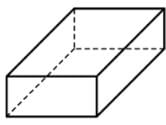
A rectangular prism has six faces, consisting of two each on the top and bottom, front and back, and left and right sides.

Test: Visualising Solid Shapes - Question 17

The corners of a solid shape are called its ________.

Detailed Solution: Question 17

The corners of a solid shape are called its vertices; the line segments of itsskeleton are its edges; and its flat surfaces are its faces.

Test: Visualising Solid Shapes - Question 18

The number of faces of a cylinder is _______.

Detailed Solution: Question 18

 A cylinder has 3 faces: 2 circular faces (top and bottom) and 1 curved surface that wraps around.

Test: Visualising Solid Shapes - Question 19

A _______ is a skeleton-outline of a solid that can be folded to make it

Detailed Solution: Question 19

A _______ is a skeleton-outline of a solid that can be folded to make it

A net is a two-dimensional representation of a three-dimensional shape. It serves as a model for constructing the solid by folding along designated lines.

  • The net outlines the shape and dimensions of the solid.
  • It can be cut out and folded to create the actual solid.
  • Nets are useful in geometry for visualising and understanding solids.

Test: Visualising Solid Shapes - Question 20

Which of the following is a 3D shape?

Detailed Solution: Question 20

A cube is a three-dimensional shape with six square faces of equal size, twelve edges, and eight vertices. It is one of the most commonly recognized 3D shapes in geometry.

77 videos|386 docs|39 tests
Information about Test: Visualising Solid Shapes Page
In this test you can find the Exam questions for Test: Visualising Solid Shapes solved & explained in the simplest way possible. Besides giving Questions and answers for Test: Visualising Solid Shapes, EduRev gives you an ample number of Online tests for practice
Download as PDF