CBSE Class 5  >  Class 5 Test  >  Mathematics  >  Test: Large Numbers- 1 - Class 5 MCQ

Large Numbers- 1 - Class 5 Mathematics Free MCQ Test with solutions


MCQ Practice Test & Solutions: Test: Large Numbers- 1 (10 Questions)

You can prepare effectively for Class 5 Mathematics for Class 5 with this dedicated MCQ Practice Test (available with solutions) on the important topic of "Test: Large Numbers- 1". These 10 questions have been designed by the experts with the latest curriculum of Class 5 2026, to help you master the concept.

Test Highlights:

  • - Format: Multiple Choice Questions (MCQ)
  • - Duration: 15 minutes
  • - Number of Questions: 10

Sign up on EduRev for free to attempt this test and track your preparation progress.

Test: Large Numbers- 1 - Question 1

Which is the largest 7-digit number?

Detailed Solution: Question 1

A 7-digit number has exactly seven digits; the largest 7-digit number has all digits 9.

Largest 7-digit number = 9,999,999 (Indian grouping: 99,99,999).

Check the options by counting digits (ignore commas):

A: 9,99,99,999 → 99999999 (8 digits).

B: 99,99,999 → 9999999 (7 digits).

C: 99,99,000 → 9999000 (7 digits) which is less than 9,999,999.

D: 9,99,999 → 999999 (6 digits).

Hence option B (99,99,999) is the largest 7-digit number.

Test: Large Numbers- 1 - Question 2

Which of the following options is the smallest number among the numbers given below?

Detailed Solution: Question 2

Compare the numbers: 225, 3222, 1000, 111.

Any 4-digit number (3222, 1000) is greater than any 3-digit number, so the smallest must be between 225 and 111.

Compare 225 and 111 by the hundreds digit: 2 > 1, therefore 111 is smaller.

Hence, 111 is the smallest number. (Answer: D)

Test: Large Numbers- 1 - Question 3

If 19,73,19,371 is rounded off to the nearest ten thousand, which of the following numbers will we get?

Detailed Solution: Question 3

Number: 19,73,19,371
Ten-thousand place digit = 1
(19,73,19,371)
Look at the thousands digit = 9
Since 9 ≥ 5, we round up the ten-thousand digit from 1 → 2

So the rounded number becomes:
19,73,20,000

Correct Option: C

Test: Large Numbers- 1 - Question 4

Which of the following options represent consecutive numbers?

Detailed Solution: Question 4

Consecutive integers differ by 1. Check successive differences for each option.

For option B:

1,23,45,346 − 1,23,45,345 = 1.

1,23,45,347 − 1,23,45,346 = 1.

1,23,45,348 − 1,23,45,347 = 1.

Therefore option B represents consecutive numbers.

Other options contain at least one adjacent pair whose difference is not 1, so they are not consecutive sequences.

Test: Large Numbers- 1 - Question 5

Which of the following options is the correct number name for the number 3,25,63,367?

Detailed Solution: Question 5

Write the number in Indian place-value groups: 3,25,63,367 = 3 crore, 25 lakh, 63 thousand, 367.

Convert each group to words: 3 → three crore; 25 → twenty-five lakh; 63 → sixty-three thousand; 367 → three hundred sixty-seven.

Therefore: Three crore twenty-five lakh sixty-three thousand three hundred sixty-seven.

Test: Large Numbers- 1 - Question 6

Which of the following is arranged in ascending order?

Detailed Solution: Question 6

Correct answer (b) In this series, the numbers are arranged in ascending order from the smallest to the largest, using the less than ("<") sign to indicate that each number is smaller than the next. Here's the explanation for the comparisons:
654321 < 876543: This indicates that 654321 is smaller than 876543.
876543 < 888888: This shows that 876543 is smaller than 888888.
888888 < 987654: This means 888888 is smaller than 987654.
987654 < 999999: This indicates that 987654 is smaller than 999999.
So, the entire sequence shows a progression from the smallest number, 654321, to the largest, 999999.

Test: Large Numbers- 1 - Question 7

Which of the following is the place value of 4 in the number 4,67,13,223?

Detailed Solution: Question 7

The number 4,67,13,223 in the Indian place-value system has the leftmost digit 4 in the crore place.

Place value of 4 = 4 × 1,00,00,000 = 4,00,00,000.

Hence option A is correct.

Test: Large Numbers- 1 - Question 8

Which of the following is represented by the expanded form 8,00,00,000 + 10,00,000 + 40,000 + 5000 + 300 + 70 + 1?

Detailed Solution: Question 8

Add the crore and lakh parts: 8,00,00,000 + 10,00,000 = 8,10,00,000.

8,10,00,000 + 40,000 = 8,10,40,000.

8,10,40,000 + 5,000 = 8,10,45,000.

8,10,45,000 + 300 + 70 + 1 = 8,10,45,371.

Therefore the number is 8,10,45,371, option C.

Test: Large Numbers- 1 - Question 9

Which of the following is the smallest 8-digit number?

Detailed Solution: Question 9

An n-digit number ranges from 10n-1 to 10n − 1.

For n = 8, the smallest 8-digit number is 107 = 10,000,000, which in Indian notation is 1,00,00,000.

Option A: 9,00,00,000 = 90,000,000 (8 digits).

Option B: 10,00,000 = 1,000,000 (7 digits).

Option C: 1,00,00,000 = 10,000,000 (8 digits).

Option D: 10,00,00,000 = 100,000,000 (9 digits).

Therefore the correct choice is Option C - 1,00,00,000.

Test: Large Numbers- 1 - Question 10

What is the number name for 67298823 according to the International place value system?

Detailed Solution: Question 10
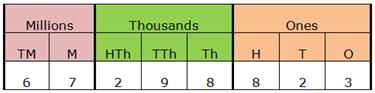
Write the number with commas in the International system: 67,298,823.

Group the places: 67 (millions), 298 (thousands), 823 (units).

Number name: Sixty-seven million two hundred ninety-eight thousand eight hundred twenty-three.

76 videos|469 docs|47 tests
Information about Test: Large Numbers- 1 Page
In this test you can find the Exam questions for Test: Large Numbers- 1 solved & explained in the simplest way possible. Besides giving Questions and answers for Test: Large Numbers- 1, EduRev gives you an ample number of Online tests for practice
76 videos|469 docs|47 tests
Download as PDF