CBSE Class 4  >  Class 4 Test  >  Science  >  Test: Adaptations in Plants- 1 - Class 4 MCQ

Adaptations in Plants- 1 - Class 4 Science Free MCQ Test with solutions


MCQ Practice Test & Solutions: Test: Adaptations in Plants- 1 (10 Questions)

You can prepare effectively for Class 4 Science for Class 4 with this dedicated MCQ Practice Test (available with solutions) on the important topic of "Test: Adaptations in Plants- 1". These 10 questions have been designed by the experts with the latest curriculum of Class 4 2026, to help you master the concept.

Test Highlights:

  • - Format: Multiple Choice Questions (MCQ)
  • - Duration: 15 minutes
  • - Number of Questions: 10

Sign up on EduRev for free to attempt this test and track your preparation progress.

Test: Adaptations in Plants- 1 - Question 1

Shreya plucked a lotus plant from a pond near her house. She observed that it has a long hollow stem. Can you explain the function of the stem?

Detailed Solution: Question 1

The stems in lotus plants are hollow and very light. This helps the leaves to float on water.

Test: Adaptations in Plants- 1 - Question 2

Plants in hilly areas have to bear high speed winds and cold. Which of the following adaptations best helps them face the above conditions?

Detailed Solution: Question 2

The trees that grow in hilly areas have needle like leaves, which are very tough and can survive in the cold, snow and wind.

Test: Adaptations in Plants- 1 - Question 3

Plants give out water through the pores present on the lower side of their leaves. Plants living in deserts need to reduce the loss of water because water is very scarce in deserts. Which of the following is an adaptation developed by the desert plants to manage the above situation?

Detailed Solution: Question 3
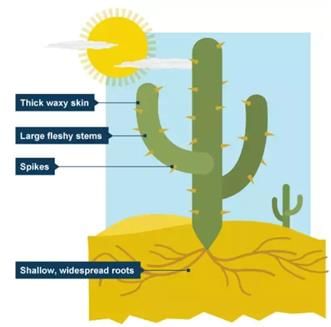
Desert plants have adapted to their environment to minimize water loss. One common adaptation is the modification of leaves into spines. This reduces the surface area through which water can be lost, significantly decreasing transpiration.

Therefore, the correct adaptation developed by desert plants to manage water loss is: Their leaves are modified into spines.

Test: Adaptations in Plants- 1 - Question 4

Which characteristic is typical of evergreen trees?

Detailed Solution: Question 4

Evergreen trees retain their leaves throughout the year, allowing them to photosynthesize continuously. This is in contrast to deciduous trees, which shed their leaves annually to conserve energy during unfavorable seasons.

Test: Adaptations in Plants- 1 - Question 5

In cactus plants, photosynthesis occurs in

Detailed Solution: Question 5

In cactus plants, photosynthesis occurs in its thick and fleshy stems.

Test: Adaptations in Plants- 1 - Question 6

Ramu brought a plant with thick branches and leaves from the plains and planted it in a marshy area. What must the new plant do to survive in its new environment?

Detailed Solution: Question 6

  • In marshy areas, soil does not contain air.
  • To adjust to marshy conditions, the plant should develop breathing roots.

Test: Adaptations in Plants- 1 - Question 7

Mangroves develop aerial roots. This is an adaptation to the

Detailed Solution: Question 7
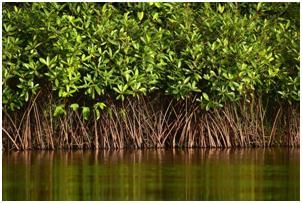
  • Mangroves grow in marshy areas. Marshy soil have clay soil with plenty of water and has no air.
  • The water cannot drain away and remains in the soil.
  • Hence the plants in the soil develop breathing roots that help the roots to breathe.

Check out the image of Mangroves below: 

Test: Adaptations in Plants- 1 - Question 8

Which of the following statements is FALSE regarding hilly trees like the Pine?

Detailed Solution: Question 8
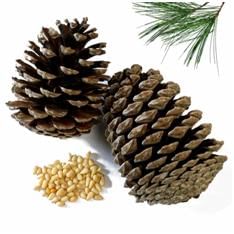
  • Trees in hilly areas are usually tall and cone shape and not dome shaped.
  • Trees in hilly areas do not have flowers.
  • They are conifers and their leaves are needle-shaped.

Test: Adaptations in Plants- 1 - Question 9

Which of the following plants does not need soil to grow?

Detailed Solution: Question 9
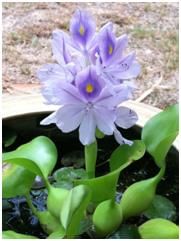
  • Water hyacinth is an aquatic plant that floats on water.
  • Water hyacinth does not need soil to grow.

Test: Adaptations in Plants- 1 - Question 10

The plants that are most useful to man are

Detailed Solution: Question 10

Plants of the grass family provide us with cereals, hence they are most useful to us.

48 videos|193 docs|34 tests
Information about Test: Adaptations in Plants- 1 Page
In this test you can find the Exam questions for Test: Adaptations in Plants- 1 solved & explained in the simplest way possible. Besides giving Questions and answers for Test: Adaptations in Plants- 1, EduRev gives you an ample number of Online tests for practice
48 videos|193 docs|34 tests
Download as PDF