CBSE Class 8  >  Class 8 Test  >  Mathematics (Maths)   >  Test: Understanding Quadrilaterals- 1 - Class 8 MCQ

Understanding Quadrilaterals- 1 - Class 8 Maths Free MCQ Test with solutions


MCQ Practice Test & Solutions: Test: Understanding Quadrilaterals- 1 (10 Questions)

You can prepare effectively for Class 8 Mathematics (Maths) Class 8 with this dedicated MCQ Practice Test (available with solutions) on the important topic of "Test: Understanding Quadrilaterals- 1". These 10 questions have been designed by the experts with the latest curriculum of Class 8 2026, to help you master the concept.

Test Highlights:

  • - Format: Multiple Choice Questions (MCQ)
  • - Duration: 10 minutes
  • - Number of Questions: 10

Sign up on EduRev for free to attempt this test and track your preparation progress.

Test: Understanding Quadrilaterals- 1 - Question 1

Which of the following quadrilaterals has two pairs of adjacent sides equal and diagonals intersecting at right angles?

Detailed Solution: Question 1

Correct Answer :- b

Explanation:- A rhombus is a  parallelogram and a quadrilateral whose opposite sides are parallel and opposite angles are equal.

Area of Rhombus, A = (d1 x d2)/2

The perimeter of Rhombus, P = 4a units

The opposite angles of a rhombus are equal to each other.

In a rhombus, diagonals bisecting each other at right angles.

Diagonals bisect the angles of a rhombus

Test: Understanding Quadrilaterals- 1 - Question 2

If the sides of a quadrilateral are produced in order, what is the sum of the exterior angles so formed?

  • 360°
  • 540°
  • 720°
  • 900°

Detailed Solution: Question 2

When the sides of a quadrilateral are extended, each exterior angle is the supplementary angle to its interior angle. The sum of the exterior angles of any convex polygon is always 360° because each exterior angle represents a turn around the shape, and all turns together make one full circle. Hence, the sum of the exterior angles of a quadrilateral is 360°.

Test: Understanding Quadrilaterals- 1 - Question 3

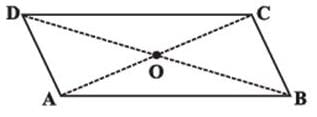
In the given parallelogram ABCD.
AD = ....

Detailed Solution: Question 3

Solution:

In a parallelogram, opposite sides are equal in length.

Given parallelogram ABCD, the sides opposite to AD is BC.

Therefore, AD = BC.

Hence, the correct answer is option C. BC.

Test: Understanding Quadrilaterals- 1 - Question 4

The sum of the measures of the three angles of a triangle is ______.

Detailed Solution: Question 4

In any triangle, the sum of the measures of the three interior angles is always 180 degrees. This fundamental property, known as the angle sum property of triangles, holds true for all types of triangles:

  • Acute triangles
  • Obtuse triangles
  • Right-angled triangles

This property is derived from Euclidean geometry. When you draw a triangle, if you extend one of its sides and construct a line parallel to the other side, the angles will form supplementary pairs. This results in the total sum of 180 degrees.

Test: Understanding Quadrilaterals- 1 - Question 5

The ________ of a rhombus are perpendicular bisectors of one another.

Detailed Solution: Question 5

In a rhombus, the diagonals are perpendicular bisectors of one another. This means that:

  • The diagonals intersect at right angles (90 degrees).
  • Each diagonal divides the other into two equal parts.

Thus, the correct answer is Option C: diagonals.

Test: Understanding Quadrilaterals- 1 - Question 6

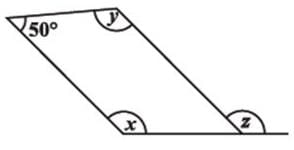
Find the value of the unknown x in this parallelogram.
Detailed Solution: Question 6
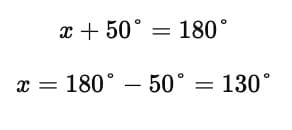
We are given a parallelogram with one angle marked as 50°, and we are to find the value of x (an interior angle).

Opposite angles are equal.

The angle labeled 50° and angle x are adjacent angles of the parallelogram.

Adjacent angles are supplementary (i.e., they add up to 180°).

Correct option is A.

Test: Understanding Quadrilaterals- 1 - Question 7

The opposite sides of a parallelogram are of ________ length.

Detailed Solution: Question 7

- In a parallelogram, opposite sides are always equal in length.
- This means if one side is 5 units long, the side directly opposite it will also be 5 units long.
- This property ensures that the shape maintains its balance and symmetry.
- Additionally, opposite sides are parallel, which is another key characteristic of parallelograms.
- Thus, the answer is that opposite sides of a parallelogram are equal.

Test: Understanding Quadrilaterals- 1 - Question 8

Which of the parallelograms has all sides equal and diagonals bisect each other at right angle?

Detailed Solution: Question 8

If two adjacent sides of a parallelogram are equal, then it is a rhombus.. A quadrilateral whose diagonals bisect each other at right angles is a rhombus.

In square all sides are equal and every angle is right angle.

Test: Understanding Quadrilaterals- 1 - Question 9

Which of the following quadrilaterals has two pairs of adjacent sides equal and diagonals intersecting at right angles?

Detailed Solution: Question 9

Kite, is a quadrilaterals has two pairs of adjacent sides equal and diagonals intersecting at right angles. 

Test: Understanding Quadrilaterals- 1 - Question 10

State the name of a regular polygon of 5 sides.

Detailed Solution: Question 10

A regular polygon with five sides is known as a pentagon.

Key points about pentagons:

  • A pentagon has exactly five sides.
  • Each internal angle in a regular pentagon measures 108 degrees.
  • The sum of all interior angles in a pentagon is 540 degrees.

112 videos|670 docs|49 tests
Information about Test: Understanding Quadrilaterals- 1 Page
In this test you can find the Exam questions for Test: Understanding Quadrilaterals- 1 solved & explained in the simplest way possible. Besides giving Questions and answers for Test: Understanding Quadrilaterals- 1, EduRev gives you an ample number of Online tests for practice
112 videos|670 docs|49 tests
Download as PDF